

Wallace Shawn
The Pershing Square Signature Center is among the busiest and most prolific theatre centers anywhere, offering a combination of new and revived material, primarily by contemporary American playwrights. The complex is home to the Signature Theatre company itself, which caters to general audiences of eclectic tastes; and the more renegade New Group, which tends to tread a darker path. Here’s what’s on offer there currently.


Jill Eikenberry, Wallace Shawn
I often find the New Group’s—really artistic director Scott Elliott’s—dark vision to have little humanist compensation (obviously discounting lighter fare like Sweet Charity). But this one hits the sweet spot. Bleakly funny and given an environmental staging by Elliot, who has a knack for realism, Evening at the Talk House is unusual and, perhaps not altogether intentionally, a very worthy piece of dystopian speculative fiction, on par with such as Robert Sheckley’s The 10th Victim, Walter Miller’s A Canticle for Leibowitz and Stephen King’s (as “Richard Bachman) The Running Man. It may even be chillingly relevant.

Isabelle Fuhrman, Abigail Breslin. Photos by Monique Carboni.
I wish I could say I felt similarly enthusiastic writer-director Erica Schmidt’s All the Fine Boys, an, I think intentionally, claustrophobic play about two teenage girls, horror movie buddies (portent, portent) on the cusp of the sexual experience they crave. Emily (Isabelle Fuhrman) will pursue a dalliance with high school crush Adam (Alex Wolff)—they’re the naïve couple, theoretically the sweet ones—while Jenny (Abigail Breslin) will get entangled with Joseph (Joe Tippett) an older man (early 30s) she knows from church—they’re the hopelessly self-deluding couple, to put it mildly, who act only on impulse with zero sense of consequence until way too late. The play is bumpily acted, probably because it’s bumpily directed—everyone has their moments, though only Ms. Fuhrman seemed to me on solid ground throughout—but that goes along with its being bumpily written; in some ways, the sweet couple are as unsettling as the one headed toward…inevitability. I don’t necessarily need to know the exact reason why I’m taking the ride a playwright wants to take me on, but I want to at least have a sense that the playwright does. I can grudgingly admit it may work for some as a point-of-identification experience—my companion of the evening, a theatre professional from London, said she was “able to relate” to her teenage experience…but I didn’t see the here’s-why-you-care window for anyone lacking the connection.

Isabelle Fuhrman, Alex Wolff. Photo by Monique Carboni.


Entertainment
Live From The Hotel Edison Times Square Chronicles Presents Actor Performer and New Composer Oliver Richman


Welcome to Live From the Hotel Edison, where we celebrate the extraordinary talent that makes New York City one of the most exciting cultural capitals in the world.
On Live From The Hotel Edison Times Square Chronicles Presents, we sat down with actor, singer, songwriter, director and emerging composer who has caught the attention of two of contemporary musical theatre’s most celebrated songwriters, Benj Pasek and Justin Paul. On Monday, November 30, Oliver Richman will take his place on the stage of the Vivian Beaumont Theater as one of the emerging composers personally selected by the Oscar, Grammy, Emmy and Tony Award-winning songwriting team to participate in Lincoln Center Theater’s inaugural The Composer Series.
Oliver Richman comes from an extraordinary artistic lineage. His grandfather, legendary Motown songwriter Ron Miller, gave us such timeless classics as “For Once in My Life,” “Touch Me in the Morning” and “Someday at Christmas.” His paternal grandfather was the accomplished actor Peter Mark Richman, and his mother is singer, songwriter and producer Lisa Dawn Miller.
At just ten years old, Oliver was personally invited by Stevie Wonder to share the stage, earning a standing ovation before an audience of more than 7,500. He went on to graduate with honors from NYU’s Tisch School of the Arts.
In January 2024, Oliver embarked on an extraordinary creative experiment: writing a song every single day. That journey has taken him to a thousand songs, an international social media following and performances at Joe’s Pub, with compositions including “The Ballad of Phil and Phyllis” and “Bunnies.”
He recently starred as Jonah in the Off-Broadway premiere of Nick Blaemire’s musical Soon, and his recording projects include Yesteryear and January.
While Oliver has inherited an extraordinary musical legacy, what excites me most is the distinctive artistic voice he is developing entirely his own. He represents a new generation of composers who are redefining how music is created, discovered and shared.
I am so grateful to Oliver Richman, for sharing his incredible talent.
 We are so proud because the show and our guests are featured on the TV screens in the lobby and the hotel rooms.
Thank-you Magda Katz for videoing and creating the content to go live, Rommel Gopez and The Hotel Edison for their kindness and hospitality, Broadway HD and Dr K and at 200 West 54th Street for giving me back my health and my smile.
We have been named by Variety Entertainment News as one of Summer’s Best Picks in the category of Best Television, Radio, Podcasts. The company we are in, has made us so humbled, grateful and motivated to continue.
“The Daily Geek Report” named host Suzanna Bowling on the list of Most Engaging Hosts.
You can catch us on the following platforms:
Live from The Hotel Edison Times Square Chronicles Presents
Live From The Hotel Edison Times Square Chronicles Presents Going Bachrach’s Meecah

Welcome to Live From the Hotel Edison, where we celebrate the extraordinary talent that makes New York City one of the most exciting cultural capitals in the world.
On Live From The Hotel Edison Times Square Chronicles Presents, we sat down with the powerhouse vocalist, actress, songwriter and recording artist who refuses to be defined by a single genre Meecah. Meecah is nominated for Best Performance In A Musical (Off-Broadway) at the 2026 BroadwayWorld Off-Broadway Awards for her role in Going Bacharach. She is also competing in a fan-voted music contest for iHeartRadio’s “Next Big Music Star.
Meecah grew up singing in church, developing a sound that embraces gospel, soul, R&B, pop and the theatrical. A graduate of Pace University’s musical theatre program, Meecah took on the remarkable challenge of covering all three Schuyler sisters in the national tour of Hamilton. She went on to star as Elsa in the world premiere of The Harder They Come at The Public Theater and has appeared on television in Power Book III: Raising Kanan.
As a recording artist, her EP Eclipse, her single Answers and her sold-out appearance at Joe’s Pub reveal an artist with a distinctive musical identity and something personal to say.
Now, she brings that extraordinary voice to the sophisticated musical world of Burt Bacharach in the Off-Broadway production of Going Bacharach.
I am so grateful to Meecah, for sharing her incredable talent.
Going Bachrach continues its limited engagement at Marjorie S. Deane Little Theater (10 W. 64th Street, New York, NY 10023) until November 29th.
 We are so proud because the show and our guests are featured on the TV screens in the lobby and the hotel rooms.
Thank-you Magda Katz for videoing and creating the content to go live, Rommel Gopez and The Hotel Edison for their kindness and hospitality, Broadway HD and Dr K and at 200 West 54th Street for giving me back my health and my smile.
We have been named by Variety Entertainment News as one of Summer’s Best Picks in the category of Best Television, Radio, Podcasts. The company we are in, has made us so humbled, grateful and motivated to continue.
“The Daily Geek Report” named host Suzanna Bowling on the list of Most Engaging Hosts.
You can catch us on the following platforms:

STRIKE! The word is still ringing in my head. In his directorial debut, Steven Pasquale resurrects Clifford Odets’ incendiary 1935 drama Waiting for Lefty, transforming the theatre into a Depression-era union meeting where New York City taxi drivers are debating whether to strike. From the moment we enter, Pasquale effectively dissolves the boundary between spectator and participant. The question is whether we have come to experience a piece of theatre or to be recruited into a movement.
At the center of the meeting is union boss Harry Fatt, played with terrific authority by Greg Hildreth, who attempts to discourage the increasingly desperate cabbies from striking while they await the arrival of their chairman, Lefty Costello. As tensions escalate, Odets takes us beyond the union hall and into the private lives of those whose economic circumstances have pushed them toward collective action.

Yeller Tooth Sahar Milani and Cameron Scoggins
Originally running approximately 40 minutes, Odets’ tightly constructed drama has been expanded by Pasquale into a 70-minute theatrical event incorporating movement by Susan Misner, original music by Yeller Tooth (Sahar Milani and Cameron Scoggins) and an assortment of historical protest songs performed by the ten-person ensemble. I wish I could say the additional thirty minutes were warranted. They are not.
Musically, the production travels across centuries, from the suffrage-associated “Bread and Roses” and the seventeenth-century “Digger’s Song” to the Italian anti-fascist anthem “Bella Ciao” and the period-appropriate 1932 classic “Brother, Can You Spare a Dime?” Individually, these songs are stirringly performed. Collectively, they interrupt the dramatic momentum rather than deepen it. Music should provide another dimension to the storytelling, revealing what the dialogue alone cannot. Here, it too frequently reiterates what Odets has already articulated with considerable precision.
Where the production is most effective is in the intimate moments when economic deprivation becomes painfully personal. Adam Kantor’s Joe confronts the possibility of losing his wife, Edna (a compelling Tala Ashe), who threatens to leave him if he refuses to fight for himself and his family. Sahar Milani and Cameron Scoggins, as engaged couple Florrie and Sid, poignantly illustrate how poverty can rob two people not only of their present happiness but of their ability to imagine a future together.
Other vignettes move beyond the taxi drivers to examine exploitation in different professions, including an ambitious laboratory assistant confronted with an ethical dilemma and a Jewish doctor subjected to institutional antisemitism. These scenes illuminate the broader reach of economic injustice and discrimination, although the production’s additional musical interludes make an already episodic structure feel increasingly fragmented.
Misner’s choreography finally finds its dramatic justification in a late movement sequence that reveals the significance of Zach McNally’s otherwise unnamed dancer. It is one of the few instances in which an added theatrical element genuinely expands the narrative rather than simply embellishing it.
Written nearly two decades before Samuel Beckett’s Waiting for Godot, Odets’ play similarly revolves around the anticipation of someone whose arrival remains uncertain. The fundamental difference is that Odets’ characters ultimately recognize that their fate cannot depend upon the appearance of a single individual. They must decide for themselves. There is considerable dramatic power in that realization, particularly when it emerges from the distinct experiences of the people assembled in the room.
Odets’ greatest accomplishment is his refusal to reduce the working class to an anonymous collective. His characters have marriages, ambitions, moral convictions, fears and individual aspirations. Their economic circumstances may unite them, but their humanity distinguishes them. Nearly a century later, the struggle for a living wage, the widening disparity between wealth and poverty and the vulnerability of workers remain disturbingly relevant.
Pasquale’s production, however, is so determined to emphasize that relevance that it occasionally sacrifices the very humanity that makes Odets’ argument persuasive. The evening becomes less an exploration of what drives individuals toward collective action and more an attempt to generate collective action within the audience itself. There is a difference between allowing theatre to provoke thought and directing an audience toward a predetermined response.
Ironically, this is a rare instance in which the whole is not greater than the sum of its parts. The performances are committed, the music is beautifully executed, the movement has moments of genuine theatrical invention and Odets’ writing retains its potency. Yet these elements never fully coalesce into a unified theatrical experience. For a play whose central argument concerns the power of unity, that is a particularly unfortunate contradiction.
Pasquale has demonstrated considerable promise as a director, especially in his ability to establish atmosphere and elicit compelling performances. What he needs to develop is the confidence to trust the material. Odets’ words have survived for more than ninety years. They hardly require thirty additional minutes of reinforcement.
I left the theatre with the word STRIKE reverberating in my head. Pasquale certainly succeeded in making his rallying cry heard. I would have preferred to leave contemplating the individual lives that made that cry necessary.
Waiting for Lefty: Classic Stage Company, 136 East 13th Street, until Dec. 6th.

Imagine Something Rotten! colliding with Monty Python, add a generous helping of theatrical irreverence, a deliciously wicked Disney villain, and a score that deserves considerably more attention than the lunacy surrounding it. The result is The King’s Critique, the new original musical comedy by Eric Holmes (book and lyrics) and Nat Zegree (music and lyrics), now playing Off-Broadway at the Pershing Square Signature Center. It is gloriously silly, frequently convoluted, occasionally ridiculous, and performed by a cast whose collective talent makes even the most outrageous moments irresistible.
At the center of this medieval theatrical rebellion is Josephine (Taylor Iman Jones), an ambitious actor, director, and playwright living under the rule of King Benjamin (Justin Collette), who has forbidden women from appearing onstage. Josephine possesses the talent, intelligence, and determination to challenge the decree, along with the rather dangerous conviction that if the king could only witness her brilliance, he would surely change his mind. It is a belief that underestimates the fragility of male authority and the lengths to which those in power will go to preserve it.
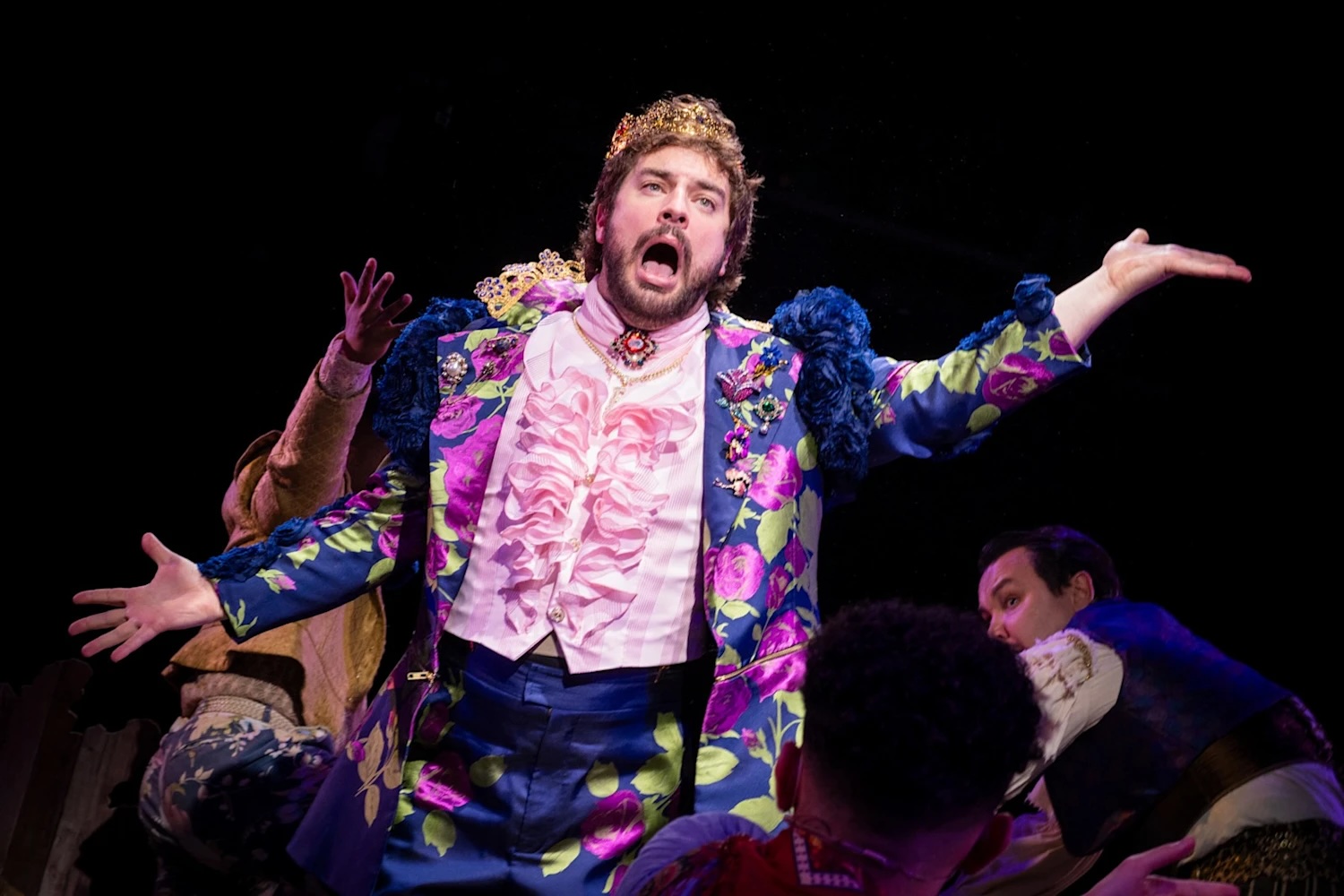
Justin Collette photo by Russ Rowland
Her determination lands not only Josephine but her entire troupe of players aboard a ship destined for a place from which few, if any, return. Apparently, the punishment for believing in one’s own talent can be considerably more severe than a bad review.
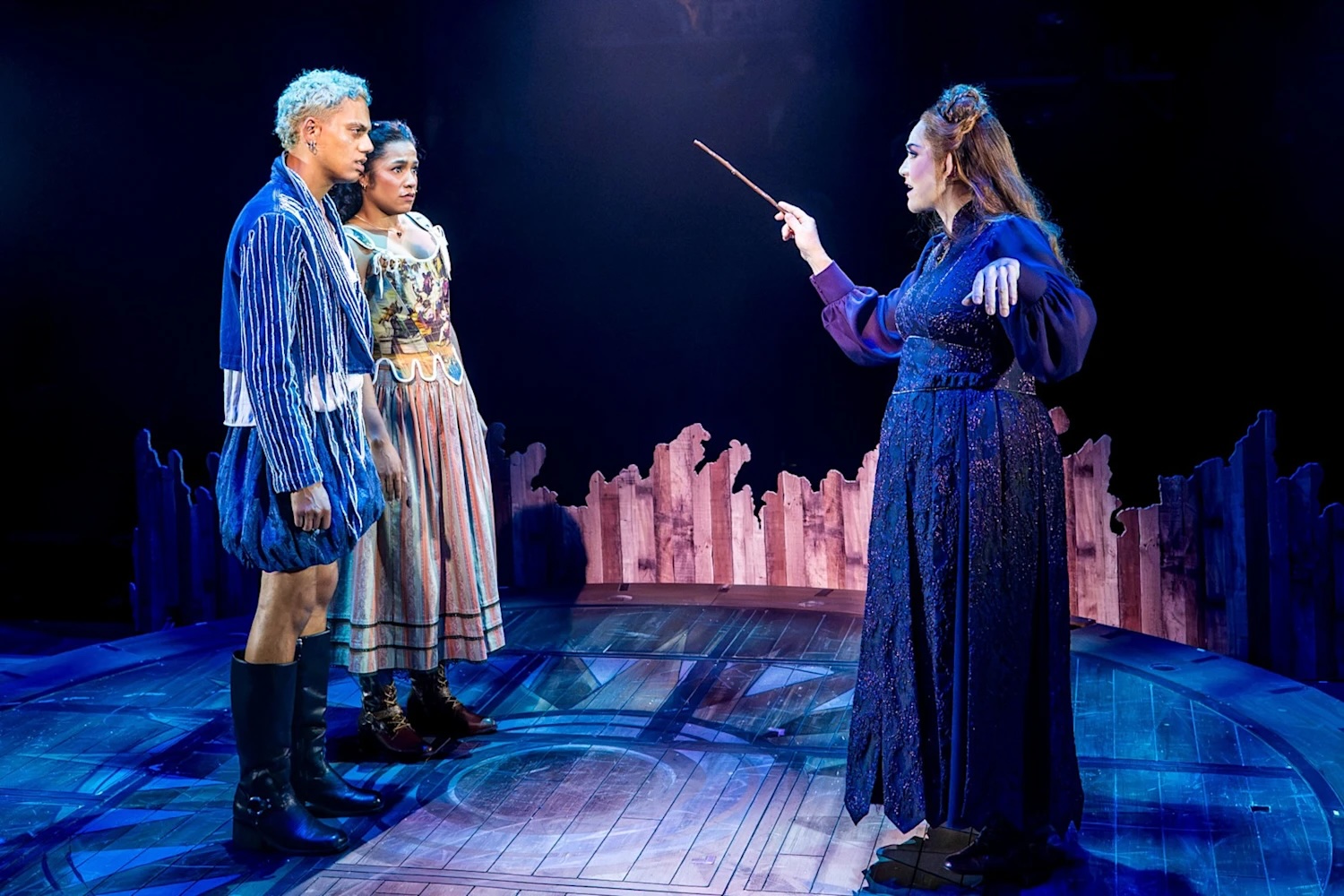
Sky Lakota-Lynch, Taylor Iman Jones, and Donna Lynne Champlin photo by Russ Rowland
Also headed for exile is Sebastian (Sky Lakota-Lynch), a gifted performer whose considerable vocal abilities are rivaled only by his inability to keep his trousers fastened. Expelled from his own theatrical company for his philandering, Sebastian is the sort of man who mistakes sexual conquest for personal accomplishment. His first encounter with Josephine establishes their rivalry immediately. During “I Am,” he interrupts her attempt at self-definition to demonstrate his own vocal prowess. Lakota-Lynch is immensely talented, but Sebastian has met his match. Josephine is not about to surrender the spotlight, and Jones makes certain we understand why.
Then there is Cora, the king’s advisor and resident witch, played with wickedly delicious theatricality by the marvelous Donna Lynne Champlin. Channeling the grand tradition of Disney villainesses, Champlin turns “Such a Shame” into a master class in musical mischief. Cora has plans of her own, intending to use Josephine and Sebastian to overthrow the king and redistribute power to women and others who have been denied a voice. Whether her methods are entirely altruistic is another matter, but Champlin makes every manipulation a pleasure to watch.
Meanwhile, the king’s former mistress Isabella, played at my performance by understudy Kyrie Courter, has transformed herself into a kind of medieval celebrity. Think Britney Spears before reality television, social media, and publicists existed, but with all the familiar absurdities of fame. Courter embraces the comedy, adding another layer to a production that happily tosses historical accuracy overboard whenever a contemporary joke presents itself.
Holmes’s book is the evening’s weakness. The plotting becomes increasingly tangled, and the production sometimes seems more interested in delivering its next joke, musical reference, or theatrical Easter egg than in making the story cohere. Yet the audience, much like the enthusiastic devotees of & Juliet, appears perfectly willing to overlook narrative complications in exchange for exuberant entertainment. There are laughs aplenty, and the references to other musicals provide an additional game for theater lovers who enjoy recognizing the inspirations behind the madness.
What elevates The King’s Critique beyond an entertaining theatrical romp is Zegree’s score. It is far more accomplished than the surrounding silliness might suggest, filled with strong melodies, theatrical intelligence, and opportunities for the performers to demonstrate their exceptional vocal abilities. The orchestrations by Zegree and Ian Chan are particularly beautiful, giving the music a richness that occasionally makes one wish the book would settle down long enough to let the songs breathe.
The evening’s revelation is Taylor Iman Jones. Already a Broadway veteran, Jones possesses the kind of commanding stage presence and extraordinary voice that ought to make her a major star. She combines comic precision with emotional authority, grounding Josephine’s ambition in something far more substantial than the production’s relentless jokes. Her second-act solo, “The Gem of Arcanum Vitae,” is a genuine showstopper. Think “Meadowlark,” with its soaring dramatic intensity and a performer capable of turning an individual declaration into a full-scale theatrical event. Jones delivers a tour de force that makes the case for both her character and her own formidable artistry.
Director Catie Davis keeps the proceedings moving at an exhilarating pace, embracing the show’s unapologetic absurdity while allowing its underlying commentary about gender, power, and artistic freedom to emerge. Beneath the frat-boy humor and deliberately outrageous behavior lies a recognizable truth: those who control the stage also control whose stories are permitted to be told. Josephine’s struggle is not simply about performing. It is about refusing to accept that talent should be restricted by the prejudices of those who hold authority.
Nancy Renee Braun’s choreography is lively, playful, and energetic, complementing the production’s anarchic spirit. Emily Rebholz’s colorful costumes delight in the collision of period fantasy and contemporary theatrical excess, while Paul Tate dePoo III’s scenic design makes inventive use of the Signature Theatre space, accommodating a world that shifts between royal intrigue, theatrical ambition, and outright farce.
The King’s Critique is not a model of disciplined storytelling, nor does it pretend to be. Its book could use tightening, its jokes occasionally threaten to overwhelm its ideas, and its determination to be outrageous can become exhausting. Yet there is something wonderfully refreshing about a musical so willing to be ridiculous, particularly when its performers are this gifted and its score this strong.
Come for the comedy, enjoy the theatrical Easter eggs, and surrender to the sheer silliness. Stay for the music, Donna Lynne Champlin’s delicious villainy, and above all, Taylor Iman Jones, who delivers the sort of performance that reminds us why a great musical theater voice can make even the most improbable material soar.
The kingdom may be in chaos, but the talent is unquestionably first-rate.
The King’s Critique: Pershing Square Signature Center, until Dec. 20th.
Live from The Hotel Edison Times Square Chronicles Presents
Live From The Hotel Edison Times Square Chronicles Presents True Confessions of a Go-Go Girl With Jill Morley

What happens when a struggling actress trades the audition room for the go-go bars of New Jersey? For Jill Morley, it became the inspiration for True Confessions of a Go-Go Girl, a provocative, wickedly funny, and surprisingly revealing look at sexuality, power, identity, and the women behind the fantasy. What began as firsthand observations scribbled in dressing rooms became an acclaimed theatrical work, later adapted into a Lifetime movie. Now, three decades after its beginnings, True Confessions of a Go-Go Girl has returned to the New York stage at the Triad Theatre, with Jacqueline Frances stepping into the role Morley originated.
On Live From The Hotel Edison Times Square Chronicles Presents, we sat down with Jill Morley. Jill is hardly a woman who can be defined by one extraordinary chapter. An award-winning screenwriter, documentary filmmaker, playwright, and National Golden Gloves boxing champion, she has built a career exploring the complicated lives of women who refuse to fit society’s expectations. Her work is fearless, frequently funny, and deeply human. Today on Live From the Hotel Edison, we’re talking about the stories behind the sequins, the unexpected lessons of the go-go world, and what happens when a woman decides to tell her own story rather than let someone else tell it for her. Please welcome Jill Morley.
 I am so grateful to Jill Morley, for sharing her honesty and opening up the conversation.
 True Confessions of a Go-Go Girl continues its limited engagement at The Triad Theatre, 158 West 72nd Street, through December 11, 2026.
We are so proud because the show and our guests are featured on the TV screens in the lobby and the hotel rooms.
Thank-you Magda Katz for videoing and creating the content to go live, Rommel Gopez and The Hotel Edison for their kindness and hospitality, Broadway HD and Dr K and at 200 West 54th Street for giving me back my health and my smile.
We have been named by Variety Entertainment News as one of Summer’s Best Picks in the category of Best Television, Radio, Podcasts. The company we are in, has made us so humbled, grateful and motivated to continue.
“The Daily Geek Report” named host Suzanna Bowling on the list of Most Engaging Hosts.
You can catch us on the following platforms:
-
 Events3 days ago
Thanksgiving Day Playlist
-
 Events3 days ago
Happy Thanksgiving From T2C
-
 Events4 days ago
Count Down To Thanksgiving: Bourbon Pecan Pie With Or Without Chocolate
-
 Broadway4 days ago
The Fantasticks: Broadway Discovers a Whole New Kind of Magic
-

 Business4 days ago
AI Shopping Agents Are Now Buying From Business Websites, and Bot Rules Could Cost You Holiday Sales
-

 Broadway3 days ago
Macy’s Historic 100th Thanksgiving Day Parade Postponed: Exclusive Rehearsal Photos and Can Broadway Still Deliver?
-
 Entertainment3 days ago
Prince Mario-Max zu Schaumburg-Lippe & His Royal Family Wish America A Happy Thanksgiving!
-

 Entertainment2 days ago
Live From The Hotel Edison Times Square Chronicles Presents Actor Performer and New Composer Oliver Richman