
Book Reviews
Authors Night Part Two: When the Hamptons Came to Read


If Part One of our look at the East Hampton Library’s 22nd Annual Authors Night captured the sheer excitement of the evening, Part Two reveals why this particular summer tradition has become something far more interesting than a glamorous book signing.
 Under one enormous tent on August 8, worlds that ordinarily have very little reason to collide suddenly did. Historians sat near novelists. Political insiders shared space with chefs. Architects, journalists, comedians, artists, grief writers and mystery authors met readers face-to-face, while conversations moved effortlessly from the White House to Montauk, from James Baldwin to Sid Caesar, from the Titanic to Tarot.
 That eclecticism is the secret of Authors Night. You may arrive looking for one writer and leave carrying the work of someone you had never heard of two hours earlier.
At the center of any gathering devoted to American nonfiction stands Robert A. Caro, whose monumental The Power Broker changed the way generations understood not merely Robert Moses, but the machinery of political power itself. More than half a century after its publication, Caro’s study remains startlingly relevant because its real subject was never simply one man. It was what happens when ambition, government and unchecked authority converge.
Nicholas Boggs brought Baldwin, his major biography of James Baldwin, returning readers to one of America’s most essential literary and intellectual voices. Baldwin’s questions about race, sexuality, belonging and America’s ability—or refusal—to examine itself have hardly grown less urgent.
That examination of America continued with Gloria Browne-Marshall’s A Protest History of the United States, while Eddie S. Glaude Jr. brought America, U.S.A.: How Race Shadows the Nation’s Anniversaries, considering how America’s celebrations of itself inevitably collide with the parts of its history it would sometimes rather leave outside the ceremony.
Jonathan Mahler turned his attention toward another kind of American power in The Gods of New York, exploring the personalities and forces that shaped a city forever negotiating between money, ambition, politics and myth. Nearby,

Julian Zelizer
Julian Zelizer offered The Presidency of Joseph R. Biden: A First Historical Assessment, bringing together the kind of immediate historical examination that begins almost before an administration has disappeared from view.
Former White House press secretary Karine Jean-Pierre arrived with Independent: A Look Inside a Broken White House, Outside the Party Lines, while Don Lemon brought two books examining subjects that have defined much of his public career: race, religion, faith and America’s continuing argument with itself.
Then there was Bradford E. Billet, whose Chaos Reveals It contains enough history for several lives. Billet’s experiences encompass TWA Flight 800, September 11 and his tenure as New York City’s Commissioner for International Affairs, dealing directly with the United Nations and State Department. It is precisely the kind of book Authors Night is made for: you pick it up because of the title and suddenly find yourself standing across from someone who witnessed history from inside the room.
Hassan Nemazee’s Persia, Politics and Prison offered another journey through power and consequence, while Aziz Abu Sarah’s The Future Is Peace turned toward one of humanity’s oldest and most elusive ambitions: finding a way through conflict rather than perpetuating it.
The evening was equally rich in cultural history. David Margolick’s When Caesar Was King: How Sid Caesar Reinvented American Comedy revisits the astonishing influence of the comic genius whose television work helped shape modern American comedy. Carol Leifer, herself part of comedy history and famously associated with the inspiration for Elaine on Seinfeld, took a considerably less solemn approach with How to Write a Funny Speech . . . for a Wedding, Bar Mitzvah, Graduation & Every Other Event You Didn’t Want to Go to in the First Place. Even the title knows exactly what room it has walked into.
Tom Junod brought In the Days of My Youth I Was Told What It Means to Be a Man, while Jay McInerney, forever associated with the literary electricity of New York, offered See You on the Other Side. Amy DuBois Barnett’s If I Ruled the World joined Gayle Feldman’s Nothing Random, Jenna Blum’s wonderfully titled Murder Your Darling,

Amy Chozick
Amy Chozick’s With Friends Like You, Amy Ephron’s Unseasonably Cold

Adam Ross
Adam Ross’s Playworld, and Joanna Margaret’sThe Daughters among the fiction and literary works inviting readers into entirely different worlds.
Then there was one of the titles impossible to walk past without stopping: J. Brooke’s I Can Tell You the Version That Will Make You Take My Side. In an age when almost everyone seems to arrive with a version of events designed to secure allegiance before the facts have even entered the room, the title alone feels wickedly contemporary.
Mystery and suspense were everywhere. David Baerwald brought The Fire Agent, Rachel Ekstrom Courage Death on the Lanai

Tom Clavin
Tom Clavin Vengeance

Alex DeMille
Alex DeMille The Tin Man,

Steve Israel
Steve Israel The Einstein Conspiracy, Chris Pavone The Doorman, Bob Reiss The Impossible Detective

John Searles
John Searles Single Girls, Alyssa Sheinmel Such Sheltered Lives, and Charles Lachman They Shall Not See the Dawn. Aphrodite Jones, long known for examining notorious criminal cases, arrived with Michael Jackson Conspiracy, Jeffrey Sussman’s Mafia Hits, Misses, Wars, and Prosecutionspromised exactly the wonderfully combustible history its title suggests.
The East End itself naturally had its chroniclers. Christy Scott Cashman brought What Happened in Beulah, while David Cataletto’s Kings of the Coast: Montauk kept the geography decidedly local. Jennifer Ash Rudick’s Inside the Hamptons turned the lens on the homes and aesthetic identity of the East End

Michael Gross
Michael Gross’s Treasured Island examined another enclave synonymous with extraordinary wealth.
Architecture and design were particularly well represented. Pulitzer Prize-winning critic Paul Goldberger’s Why Architecture Matters asks us to look beyond buildings as objects and understand how the spaces surrounding us influence the way we live. David Netto’s Rosario Candela & The New York Apartment: 1927–1937 celebrates the architect whose elegant apartment houses helped define Manhattan luxury. Jeffrey Banks brought Storyteller, while

Steven Kasher
Steven Kasher’s Memoir of a Collection: Finding Meaning Through Art explored the deeply personal relationship between collector and object.

Kendell Cronstrom and Alejandro Saralegui
Kendell Cronstrom and Alejandro Saralegui each celebrated Madoo, preserving the extraordinary Sagaponack garden and creative world associated with artist Robert Dash, while Alice Harris and Christian John Wikane’s A Night at the Disco turned the cultural clock toward another dazzling New York institution: the dance floor.
Food, naturally, had its own irresistible corner. New York Times food authority Florence Fabricant brought Salty Not Sweet, while chef Michael Symon offered Symon’s Dinners Cooking Out.

Jenn Lueke, Sabrina Rudin, Ali Rosen
Jenn Lueke’s Don’t Think About Dinner, Ali Rosen’s The Slow Burn, and Sabrina Rudin’s Healthy With a Side of Happy approached the pleasures—and daily realities—of feeding ourselves from very different directions.
There were books about the body and the complicated business of taking care of it. Breast surgeon Dr. Elisa Port offered The Breast Advice

Michael J. Norton
Michael J. Norton’s deliciously irreverent The S** I Heard at Yoga* suggested that wellness culture deserves a raised eyebrow along with the downward dog.
Some of the evening’s most affecting books dealt with what happens when life refuses to follow the plan. Danielle Crittenden’s Dispatches from Grief and Kate Doerge’s Reimagining Grief confronted loss from different perspectives

Susan Klein and Cynthia Schaffner
while Susan Klein and Cynthia Schaffner brought Heart Art. David Biro’s The Unstoppables looked toward endurance, and April Reynolds’ The Shape of Dreams toward the landscapes we construct within ourselves.
Elsewhere beneath the tent were Lenny Ackerman with Moments Out of Time; Nelson Aspen with Kindred Spirits: A Titanic Talk; Andrew Blauner with On the Couch; Karen and Bill Brodsky with Beyond Honor; Judy Batalion with The Last Women of Warsaw; Harriet Newman Cohen with Passion and Power

Ken Davidoff

Ken Davidoff with 101 Lessons From the Dugout; Tom Freston with Unplugged; Luke Goebel with Kill Dick; Bianna Golodryga with Don’t Feed the Lion

Xochitl Gonzalez
Xochitl Gonzalez with Last Night in Brooklyn; Harrison Hill with The Oracle’s Daughter; Madeleine Henry with The Last Celebrity

Andrew Lownie
Andrew Lownie with Entitled: The Rise and Fall of the House of York

Conner Martin
Conner Martin with The Silver Fish

Lisa Raicek
Lisa Raicek with The Plunge; Deborah Goodrich Royce with Best Boy

Sydney Sadick

Sydney Sadick
Sydney Sadick with Aim High; Allison Winn Scotch with The Insomniacs; John Seabrook with The Spinach King; Heather Ann Thompson with Fear and Fury; and Jessica Walker with The Secret Astronomers.

Monte Farber and Amy Zerner

Monte Farber and Amy Zerner

Monte Farber
Then there were Monte Farber and Amy Zerner whose books on Tarot are legendary. The longtime creative and spiritual partners arrived carrying a book they wrote 35 years ago, when Tarot existed considerably farther outside the mainstream than it does today. As they pointed out, they were writing about Tarot long before Tarot became a cultural trend. There is something rather wonderful about that. Authors Night is necessarily obsessed with what is new—the new novel, the new biography, the new investigation, the book everyone will be discussing tomorrow. But books have their own clocks. Some explode immediately. Others wait patiently for the culture to catch up with them. Thirty-five years later, Tarot is everywhere. What once occupied the esoteric edges now fills bookstores, social media feeds and conversations about spirituality and consciousness. Monte Farber and Amy Zerner were there before the fashion arrived.
That may be the perfect way to understand Authors Night itself. For all the famous names, beautiful homes, summer clothes and Hamptons glamour, the evening ultimately celebrates something considerably less fashionable and far more enduring. Ideas survive.
They move from writer to reader, sometimes immediately and sometimes decades later. They are argued with, rediscovered, rejected, reconsidered and occasionally understood by an entirely different generation than the one for which they were originally written.
On Saturday night in East Hampton, nearly 100 writers arrived carrying those ideas between two covers and thousands of conversations began.


Book Reviews
The Girl’s Guide to Guts: Chloe Melas and Judy Batalion Are Breaking the Silence on Women’s Health


There are certain things women have been taught never to discuss in polite company. Digestive problems, bathroom emergencies, bloating, bleeding, and the indignities of a body that refuses to cooperate are among them. Yet millions of women live with these realities every day, often disguising their discomfort behind perfectly composed appearances. NBC News correspondent Chloe Melas and bestselling author Judy Batalion have decided that the silence has gone on long enough.
Their new book, The Girl’s Guide to Guts: Everything Your Doc Didn’t Tell You (But Your Bestie Would), published by The Dial Press on November 10, is more than another addition to the crowded wellness bookshelf. It is an unapologetically candid examination of what happens when chronic digestive illness collides with careers, relationships, motherhood, sexuality, and the expectation that women should somehow manage everything without making anyone uncomfortable.
Both authors live with ulcerative colitis, a chronic inflammatory bowel disease that can turn the simplest activities into logistical challenges. Their shared experience became the foundation of a collaboration that combines Batalion’s literary intelligence with Melas’s journalistic instincts and the kind of intimate honesty generally reserved for conversations between close friends.
Melas has spent years reporting on the lives of celebrities, navigating red carpets, international assignments, and the demanding schedule of television news. Behind that polished professional exterior, however, she has been managing a disease that does not care about deadlines, cameras, or designer clothes. She has spoken openly about the humiliation of not reaching a bathroom in time and the extraordinary calculations required to maintain a public career while living with unpredictable symptoms.
Batalion, whose acclaimed books include The Light of Days, brings a different but complementary perspective. A historian and writer with a gift for uncovering overlooked experiences, she has spent much of her career examining women’s lives beyond the narratives traditionally assigned to them. Her own experience with ulcerative colitis gives this latest collaboration an intensely personal dimension.
What makes The Girl’s Guide to Guts especially compelling is that its authors are not simply recounting their medical histories. They are asking why so much of women’s everyday experience with digestive illness remains absent from the conversation about healthcare.
A physician can explain inflammation, prescribe medication, and recommend procedures. But who explains how to survive a first date when your stomach is rebelling? How do you negotiate intimacy when you are in pain? What happens when you are raising children, traveling for work, or trying to build a career while your body insists on rewriting the schedule?
These are not superficial concerns. They are the details that determine how someone actually lives.
The book addresses everything from colonoscopies and chronic pain to fertility, pregnancy, food anxiety, relationships, and medical self-advocacy. Drawing on expert interviews as well as their own experiences, Melas and Batalion explore the territory between clinical information and lived reality, where patients often find themselves improvising without a roadmap.
Their timing is particularly significant. Gut health has become one of the most fashionable subjects in wellness, generating an enormous market for supplements, dietary programs, probiotics, and promises of digestive transformation. Yet the cultural enthusiasm for the microbiome has not necessarily translated into a better public understanding of serious gastrointestinal disease.
Crohn’s disease and ulcerative colitis are forms of inflammatory bowel disease, or IBD, involving chronic inflammation of the digestive tract. They are not interchangeable with irritable bowel syndrome, or IBS, which is a different condition. Confusing these diagnoses can minimize the severity of illnesses that sometimes require hospitalization, surgery, and lifelong medical management.
The distinction matters, as does the need to recognize that digestive symptoms should not automatically be dismissed as stress, dietary indiscretion, or something women simply have to tolerate.
On November 9, Melas brought that conversation to a national audience through appearances on NBC’s TODAY, where she discussed her experience with ulcerative colitis and the motivation behind the book. NBC medical contributor Dr. Natalie Azar also addressed common misconceptions about inflammatory bowel disease. The exposure marked an important step in moving the subject out of private conversations and into mainstream discussion.
The response surrounding the publication has been substantial. The book has attracted endorsements from prominent figures including Hoda Kotb, Kris Jenner, Christie Brinkley, Sara Sidner, Rebecca Minkoff, and physician Mark Hyman, reflecting an unusual convergence of entertainment, journalism, medicine, and women’s advocacy.
Its launch is also bringing together an influential circle of supporters. On November 10, Melas and Batalion are scheduled to appear in conversation with Chelsea Clinton at New York’s Asia Society, in an event co-hosted by the Women’s Forum. Additional appearances are planned in Los Angeles, extending the discussion beyond the book’s publication.
The connection to the Crohn’s & Colitis Foundation is particularly meaningful. At the organization’s 59th Annual Broadway’s Got Guts! Gala on November 9, every guest received a copy of The Girl’s Guide to Guts, placing the authors’ message directly into the hands of a community devoted to research, treatment, and patient advocacy.
What distinguishes this project from conventional celebrity health publishing is the willingness to confront embarrassment without disguising it as inspiration. Melas and Batalion are not presenting chronic illness as an obstacle that can be overcome through positive thinking. They are describing the practical, sometimes painful, frequently absurd business of living with it.
There is also a larger question running beneath the humor. Why are women expected to speak openly about certain aspects of their bodies while remaining discreet about others? We have made considerable progress discussing breast cancer, fertility, menopause, and reproductive health. Yet bowel disease continues to occupy an uncomfortable cultural territory, as though the digestive system were somehow less deserving of dignity than the rest of the human body.
The authors understand that knowledge is only part of the equation. Language matters. Shame matters. The ability to describe what is happening without embarrassment can influence whether someone seeks care, asks a difficult question, or finally admits that a symptom is interfering with daily life.
The Girl’s Guide to Guts is ultimately about reclaiming that conversation. It recognizes that women deserve more than medical terminology and instructions delivered across an examination table. They deserve information that acknowledges the full complexity of their lives, including the parts that have traditionally been considered too embarrassing to mention.
Chloe Melas and Judy Batalion have taken a subject that millions experience privately and given it a public voice. Their accomplishment is not simply that they have written a book about digestive disease. It is that they are challenging the notion that women must suffer discreetly to remain socially acceptable.
The title may make you smile. The conversation it begins is long overdue.
Book Reviews
Live From The Hotel Edison Times Square Chronicles Presents Tony-Nominated Lyricist and Book writer Bill Russell Still, Bill

Live From The Hotel Edison Times Square Chronicles Presents, is filmed from the Hotel Edison and is a podcast extension of T2C. We are back after a small hiatus.
Today owner Suzanna Bowling talks with Tony-nominated lyricist and book writer Bill Russell on his new book Still, Bill, Elegies for Angels, Punks and Raging Queens and Side Show, which was nominated for the Tony Award as Best Musical. Russell’s first produced musical was Fortune, which ran Off-Broadway at the Actors’ Plahouse. The musical director and arranger was Janet Hood; the two went on to write several musicals together. Russell then wrote the book and lyrics for the song cycle Elegies for Angels, Punks and Raging Queens, with music by Janet Hood, which originally ran Off-Off-Broadway in 1990 and in the West End in 1993 and a benefit concert in 2001.
He wrote the book and lyrics for the musical Pageant with Frank Kelly; the music was by Albert Evans, and the conception was by Robert Longbottom. The musical, which featured an all-male cast playing beauty queens premiered Off-Broadway at the Blue Angel in 1991 and ran Off-Broadway at New World Stages in 2013, as well as having engagements in London (2000) and Australia.
He wrote the concert adaptation of the musical Call Me Madam for the New York City Center Encores! Then he wrote the book and lyrics for the musical Side Show music by Henry Krieger and received a 1998 Tony nomination for Best Book and shared a nomination with composer Henry Krieger for Best Score. The show was nominated as Best Musical. In 2014 it was revived.
Up in The Air, Lucky Duck, The Last Smoker in America and Unexpected Joy followed.
Everything’s Ducky received the Will Glickman Award for Best New Play (in the San Francisco Bay Area) in 2001 and Garland Awards (presented by “Backstage West”) for Best Score, Set and Costumes. He has also received two Commendation Awards from the Gilman & Gonzalez-Falla Theatre Foundation (one in 2000). He received an honorary degree of doctor of humane letters from Morningside College in 2003, and from the Boston Conservatoryin May 2007.
 On October 27th Russell will release his memoir, Still, Bill: Gay Adventures From Cowboyland to Broadway, via Safe Haven Press.Russell will celebrate the book’s release with a book signing and interview event at the Drama Book Shop October 29, to be hosted by Seth Rudetsky.
I am so grateful to Bill Russell for his conversation and his joy of life.
 We are so proud because the show and our guests are featured on the TV screens in the lobby and the hotel rooms.
Thank-you Magda Katz for videoing and creating the content to go live, Rommel Gopez and The Hotel Edison for their kindness and hospitality, Broadway HD and Dr K and at 200 West 54th Street for giving me back my health and my smile.
We have been named by Variety Entertainment News as one of Summer’s Best Picks in the category of Best Television, Radio, Podcasts. The company we are in, has made us so humbled, grateful and motivated to continue.
“The Daily Geek Report” named host Suzanna Bowling on the list of Most Engaging Hosts.
You can catch us on the following platforms:
Spotify:
Apple Podcasts:
Book Reviews
Princes Mario-Max Schaumburg-Lippe: My Royal Mother Princess Antonia Schaumburg-Lippe & APPLE Revive Goethe!


Princess Antonia Schaumburg-Lippe brings Life of Johan Wolfgang Von Goethe to contemporary listeners through Apple Books and Ad Astra Grand Classics Audiobooks, giving a landmark literary life a polished new voice for the digital age.
In the evolving world of literary culture, where centuries-old texts now travel through earbuds, phones, tablets, and streaming libraries, the arrival of Life of Johan Wolfgang Von Goethe on Apple Books Preview marks a meaningful moment for readers and listeners who value heritage, intellect, and the spoken word. The title, presented under the authorship of James Sime and narrated by Princess Antonia Schaumburg-Lippe, brings one of Europe’s defining literary figures into a contemporary listening environment shaped by accessibility, refinement, and global reach.
The image of the audiobook’s presentation is itself a statement of cultural continuity. On Apple Books, the cover appears beside the title Life of Johan Wolfgang Von Goethe, with James Sime named prominently, and Princess Antonia Schaumburg-Lippe featured as narrator on the artwork. It places a classic biographical work within a clean digital interface, where a historic subject meets one of the most familiar platforms in modern media.
For contemporary audiences, this kind of presentation matters. Goethe’s name carries the weight of literature, philosophy, drama, poetry, science, and European intellectual life. Yet for many people today, the first point of contact with such a figure may not be a university library or a printed volume, but a carefully produced audiobook discovered on a mobile device. In that setting, narration becomes a bridge. It offers tone, rhythm, and clarity. It creates a companionable path into material that might otherwise feel distant.
Princess Antonia Schaumburg-Lippe’s role as narrator gives the project a particular elegance. A biography of Goethe requires more than technical reading. It asks for poise, control, and an understanding of cultural atmosphere. The narrator becomes the listener’s guide through a life associated with disciplined thought, creative ambition, and the enduring presence of German letters. Her involvement helps position the audiobook within a tradition of cultivated storytelling, while allowing the work to feel current and approachable.
The presence of Ad Astra Grand Classics Audiobooks further shapes the project’s identity. The name suggests a commitment to grand literary inheritance, to works that deserve renewed circulation, and to productions that treat classic subjects with respect. In a crowded audio market often driven by speed, novelty, and algorithmic discovery, a project like Life of Johan Wolfgang Von Goethe signals another value, the preservation and presentation of enduring cultural achievement.
The cover artwork reflects that intention. It shows Princess Antonia Schaumburg-Lippe seated in a refined interior, with books, historic visual motifs, an open volume, and a cityscape that evokes European cultural memory. The design frames the audiobook as a formal encounter with literary history. It does not try to strip the subject of dignity for modern consumption. It invites the listener into a world of study, imagination, and thoughtful attention.
A Classic Life Reintroduced
Life of Johan Wolfgang Von Goethe, credited to James Sime, belongs to the long tradition of biographical writing that seeks to place a major figure within the moral, artistic, and intellectual concerns of his age. Goethe has always resisted simple description. He was a writer of rare range, a public figure, a thinker, and a creative force whose influence extended across borders and generations. A biography devoted to him is never only the story of one man. It is also a way of entering the cultural life of Europe at a moment when literature and ideas carried deep civic significance.
The spelling shown in the Apple Books Preview presents the title as Life of Johan Wolfgang Von Goethe, while the accompanying user description refers to Johannn Wolfgang Von Goethe. Both point clearly toward Johann Wolfgang von Goethe, the towering German writer whose legacy remains central to world literature. In a digital environment, where metadata, cover art, search terms, and spoken presentation all play roles in discovery, even the way a name appears becomes part of the contemporary life of a classic.
Goethe’s work has remained vital because it speaks to human development, ambition, love, knowledge, discipline, and the shaping of the self. His name is associated with a European ideal of breadth, the idea that a serious life can include art, science, public service, reflection, and personal evolution. To bring such a figure into audiobook form is to recognize that modern listeners still seek depth, but often through new habits of attention.
Audiobooks have changed the way people encounter classic literature. They allow major works to accompany travel, private routines, study, and moments of quiet concentration. They restore something ancient to the literary experience, the sense of being addressed by a voice. In the case of Life of Johan Wolfgang Von Goethe, the voice of Princess Antonia Schaumburg-Lippe gives the biography a human presence, turning printed prose into a sustained listening experience.
That transformation is central to the renewed appeal of grand classics. A biography that may once have belonged to a shelf of serious works can now circulate through Apple’s ecosystem, reaching listeners who may be discovering Goethe for the first time. The audiobook format does not diminish the text. It extends its reach. It gives the work another life in a medium suited to the pace and mobility of contemporary culture.
There is also a symbolic richness in the project’s placement on Apple Books. Apple has become one of the defining names in the distribution of digital reading and listening. Its platform is associated with sleek design, global availability, and the seamless movement between media. To see a Goethe biography there is to witness the old and new operating together. A life rooted in the eighteenth and nineteenth centuries appears in a twenty-first-century marketplace of attention.
The Role of Voice in Literary Heritage
Narration is one of the most intimate forms of cultural interpretation. A narrator does not rewrite the text, yet every pause, cadence, and emphasis shapes the listener’s experience. In literary biography, this responsibility becomes especially important. The narrator must carry dates, names, intellectual developments, emotional turns, and historical context without overwhelming the listener. The performance must be steady enough to sustain trust and expressive enough to maintain engagement.
Princess Antonia Schaumburg-Lippe’s contribution therefore stands at the center of this audiobook’s contemporary identity. Her name on the cover is not incidental. It is part of the production’s promise. The project presents her as a narrator who brings presence and distinction to a classic biography. That presence invites listeners to hear Goethe’s life through a lens of refinement and cultural seriousness.
The choice also reflects a broader movement within premium audiobook production. Listeners increasingly recognize that narration matters as much as selection. A classic work can be transformed by the right voice. A biography can become more vivid when its sentences are delivered with composure. A historic figure can feel more immediate when the listener senses care in the pacing and tone.
Ad Astra Grand Classics Audiobooks appears to understand this. The project’s visual and textual presentation emphasizes grandeur, continuity, and literary prestige. It does not frame Goethe as an academic obligation. It presents his life as an experience worthy of time and attention. That is an important distinction in modern cultural publishing, where the success of a classic often depends on how invitingly it is introduced.
The audiobook also participates in the democratization of cultural heritage. For generations, access to canonical biography required proximity to printed books, formal education, or specialist interest. Today, a listener can find a title like Life of Johan Wolfgang Von Goethe through a digital storefront and begin engaging with Goethe’s world almost immediately. The technology is simple. The cultural implication is significant.
This does not mean the encounter becomes casual. On the contrary, the best digital editions encourage serious listening by making the path smoother. The listener still enters a demanding world of ideas, history, character, and literary development. What changes is the threshold. Apple Books and Ad Astra Grand Classics Audiobooks make that threshold easier to cross.
A Modern Platform for Grand Classics
The Apple Books Preview setting gives the audiobook a polished contemporary frame. Its clean layout, with the Apple mark, search icon, and shopping bag icon visible above the title display, situates the work inside a familiar consumer experience. Yet the content itself resists disposability. The contrast is productive. It shows how modern platforms can serve as custodians of older cultural forms when the material is treated with care.
For luxury-culture audiences, the project resonates because it values continuity. Luxury in this context is not merely material. It is the luxury of time spent with a serious subject, the luxury of language handled with respect, and the luxury of access to cultural memory without haste. An audiobook devoted to Goethe, narrated by Princess Antonia Schaumburg-Lippe, invites that kind of engagement.
The cover’s visual language supports this impression. The dark tones, gilded borders, library setting, and formal presentation of the narrator create an atmosphere of learned elegance. The open book suggests study. The shelves suggest inheritance. The cityscape and architectural forms connect the listener to Europe’s historic imagination. Everything in the composition points toward the idea of a classic being carefully reintroduced.
James Sime’s name on the Apple Books listing anchors the work in biographical authorship. The biography itself becomes the foundation upon which the audio production builds. The narrator, the publisher, the platform, and the artwork all serve the central purpose of bringing the life of Goethe into renewed circulation. Each element has its role, and together they create a complete cultural object.
That completeness is part of the appeal. In the age of fragmented attention, listeners often respond to works that feel thoughtfully assembled. A title, a cover, a narrator, and a platform can signal whether a production has been made with care. Here, the details point to a clear intention, to present Goethe as a figure of enduring importance and to make his life available in a format suited to modern listening.
Goethe’s life remains especially suited to rediscovery because it speaks across disciplines. He represents a model of intellectual breadth that feels newly relevant in an era of specialization. His world included poetry, drama, prose, science, politics, aesthetics, travel, and personal development. A biography gives listeners a structured way to encounter that breadth, not as a collection of separate achievements, but as the unfolding of a life.
A narrator can help make that unfolding feel coherent. Through voice, the listener follows transitions, absorbs context, and stays close to the human subject. Princess Antonia Schaumburg-Lippe’s narration becomes the thread through which the listener moves from one stage of Goethe’s life to the next. In this sense, the audiobook form is especially well matched to biography. It restores the feeling of a life being told.
The Contemporary Listener and the Classic Mind
The return of classic biography through audiobook platforms reflects a larger cultural appetite for depth. Contemporary audiences live amid constant information, yet many continue to seek works that provide orientation rather than noise. Biographies of major figures can offer exactly that. They show how a person’s character, education, choices, relationships, and ambitions take shape across time.
Life of Johan Wolfgang Von Goethe enters that appetite with a subject of unusual richness. Goethe’s name evokes artistic achievement and intellectual seriousness. His life encourages reflection on how creativity matures, how influence is earned, and how a writer becomes part of a wider civilization. For listeners, the biography can become a sustained act of cultural immersion.
The role of Apple in this process is practical and symbolic. Practically, Apple Books gives the audiobook visibility and ease of access. Symbolically, it places Goethe inside a contemporary ecosystem of reading and listening where classics must stand beside new releases, popular nonfiction, entertainment titles, and global media. The presence of this biography in that setting affirms that serious literature still belongs in the mainstream of cultural consumption.
Ad Astra Grand Classics Audiobooks, by presenting the title with such formal visual identity, reinforces that affirmation. The production does not treat the classic as remote. It treats it as available, dignified, and ready for a new audience. That is the essential work of any successful classic imprint, to preserve stature while renewing contact.
Princess Antonia Schaumburg-Lippe’s presence gives the production its defining human character. A listener encountering the title may first notice the name Goethe, then the name James Sime, then the narrator whose image appears on the cover. This sequence matters. It moves from subject to author to voice. It tells the listener that this is both a literary biography and a performed cultural experience.
The project also reflects the evolving role of narration as cultural stewardship. To narrate a classic is to participate in its preservation. The narrator becomes part of the work’s modern history, helping determine how it is heard by audiences who may never encounter the printed edition. In this way, Princess Antonia Schaumburg-Lippe contributes to Goethe’s continuing presence beyond the page.
Audiobooks of this kind can also serve educational life. They can introduce younger listeners to major figures, accompany independent study, and support lifelong learning. They can make complex material more approachable without reducing its seriousness. A well-narrated biography allows listeners to stay with a subject through duration, which remains one of the deepest forms of respect a culture can offer its classics.
The Apple Books Preview image captures only a single digital moment, yet it points to a wider story. It shows a historic literary life adapted for contemporary discovery. It shows a named narrator lending presence to a canonical subject. It shows a publisher or imprint, Ad Astra Grand Classics Audiobooks, investing in the continued circulation of important works. It shows how technology can make room for cultural depth when guided by thoughtful production.
A Refined Revival for a Digital Age
The phrase bringing Goethe to contemporary audiences is especially apt. The project does not suggest that Goethe needs reinvention. It suggests that every generation needs its own route toward him. For some, that route will remain printed books. For others, it will be academic study. For many now, it may begin with a search on Apple Books and a voice that invites them to listen.
That shift is one of the defining cultural developments of the present era. Literary heritage no longer depends on a single format. A classic can live in print, digital text, audio, classroom discussion, personal study, and curated platforms. Each format opens a different door. The audiobook door is particularly powerful because it returns literature to sound, attention, and time.
In Life of Johan Wolfgang Von Goethe, the combination of James Sime’s biographical work, Princess Antonia Schaumburg-Lippe’s narration, Apple Books’ digital reach, and Ad Astra Grand Classics Audiobooks’ presentation creates an encounter that feels both established and renewed. The subject is historic. The delivery is current. The tone is dignified. The purpose is clear.
There is a quiet confidence in presenting Goethe this way. The production assumes that contemporary listeners can engage with a serious literary life. It trusts the audience’s intelligence. It offers access without condescension. That balance is essential for any cultural project that seeks to honor the past while speaking to the present.
The significance of Princess Antonia Schaumburg-Lippe’s narration lies in the way it personalizes that balance. Her name and image on the cover give the audiobook a recognizable presence, while the title remains centered on Goethe. The result is a presentation that respects the hierarchy of the work, subject first, biography second, narration as the living medium through which both reach the listener.
The involvement of Apple adds another layer of relevance. In the modern cultural landscape, platforms shape discovery. A title available through Apple Books can move beyond specialist circles and enter the daily lives of people who listen while commuting, studying, traveling, or setting aside private time for literature. This is how classics continue to travel.
Ad Astra Grand Classics Audiobooks contributes the curatorial frame. The phrase Grand Classics carries a promise that the works selected have scale and enduring value. In pairing that identity with Goethe, the imprint aligns itself with one of the great names of European letters. In pairing it with Princess Antonia Schaumburg-Lippe’s narration, it gives the project a distinctive voice and image.
For audiences who care about culture, literature, and refined audio production, the result is a welcome addition to the expanding world of premium classic audiobooks. It reminds listeners that the past remains active when it is thoughtfully presented. It confirms that biography still has the power to introduce greatness through the shape of a life. It shows that digital platforms can support serious cultural listening when the work is made with intention.
The project’s lasting value may be found in its simplicity. A classic biography is given a contemporary audio form. A distinguished narrator brings it forward. A major platform makes it visible. A grand classics imprint frames it with care. Through those elements, Life of Johan Wolfgang Von Goethe becomes more than a listing on Apple Books Preview. It becomes a renewed invitation to spend time with one of literature’s essential lives.
In a media environment filled with rapid change, such invitations carry meaning. They create continuity between generations of readers and listeners. They remind audiences that cultural inheritance depends on presentation, access, and voice. They show that Goethe’s life, as written by James Sime and narrated by Princess Antonia Schaumburg-Lippe, can still enter the present with clarity, dignity, and purpose.
The arrival of this audiobook through Apple and Ad Astra Grand Classics Audiobooks stands as a polished example of how classic literature can be carried into contemporary life. It honors Johann Wolfgang von Goethe’s enduring place in world culture while giving modern audiences a graceful way to listen, learn, and remain connected to the grand tradition of literary biography.
Goethe, Johann Wolfgang von Goethe, Johan Wolfgang Von Goethe, Johannn Wolfgang Von Goethe, Princess Antonia Schaumburg-Lippe, James Sime, Life of Johan Wolfgang Von Goethe, Apple Books, Apple Books Preview, Ad Astra Grand Classics Audiobooks, audiobooks, classic audiobooks, literary biography, German literature, European culture, world literature, luxury culture, spoken word, narration, cultural heritage, digital publishing, literary classics, biography audiobook, refined listening, literary history, classic literature, audiobook release, cultural storytelling, premium audio, grand classics, book culture
Book Reviews
Live From The Hotel Edison Times Square Chronicles Presents: Zoom Style With Jim Brochu

Live From The Hotel Edison Times Square Chronicles Presents, is normally filmed from the Hotel Edison, but today we went Zoom Style. Live From The Edison Times Square Chronicles is a podcast extension of T2C.
Today owner Suzanna Bowling talked with Jim Brochu. Brochu wrote and starred Off-Broadway in Zero Hour, a one-person play about the life and career of actor and comedian Zero Mostel, from 2009–2010. For this performance, he won the Drama Desk award for Outstanding Solo Performance.
Brochu’s stage debut was in a production of William Shakespeare’s Taming of the Shrew. In 2005, he was nominated by the Los Angeles Ovation Awards as Best Actor in a Musical for The Big Voice, an honor he won from both the Palm Springs Desert Star Awards and the Valley Theatre League ADA Awards. In 2007 and 2008, he and Steve Schalchlin co-wrote the musical The Big Voice: God or Merman, which Brochu starred in Off-Broadway. The Big Voice: God or Merman? was also given the Ovation Award as Best Musical, presented to Brochu and Schalchlin by Jerry Herman.
Brochu was a friend of Lucille Ball and is the author of her unauthorized biography, titled Lucy in the Afternoon, and in this capacity, appeared on an episode of MythBusters.
 Jim Brochu has written his first murder mystery, set in turn of the 20th century vaudeville. Like Agatha Christie’s “Murder on the Orient Express,” everybody has a reason and an opportunity to murder Frank. The characters are all at the early part of their careers, which is why Jack Benny turns out to be the guy who figures out the real killer. The group are a mixture of fictional characters and real characters, perhaps with their original names, which will be changed as they become famous. Also there is a big Surprise at the end of the book but you have to be a real movie buff to recognize it.
I am so grateful to Jim Brochu for being with us and sharing his life and career with us.
We are so proud because the show and our guests are featured on the TV screens in the lobby and the hotel rooms.
Thank-you Magda Katz for videoing and creating the content to go live, and Rommel Gopez and The Hotel Edison for their kindness and hospitality.
We were named by Variety Entertainment News as one of Summer’s Best Picks in the category of Best Television, Radio, Podcasts. The company we are in, has made us so humbled, grateful and motivated to continue.
“The Daily Geek Report” also named host Suzanna Bowling on the list of Most Engaging Hosts.
You can catch us on the following platforms:
Pandora:
https://www.pandora.com/podcast/live-from-the-edison-hotel-times-square-chronicles-presents/PC:1001084740
Stitcher:
https://www.stitcher.com/show/1084740
Spotify:
Amazon:
Apple Podcasts:
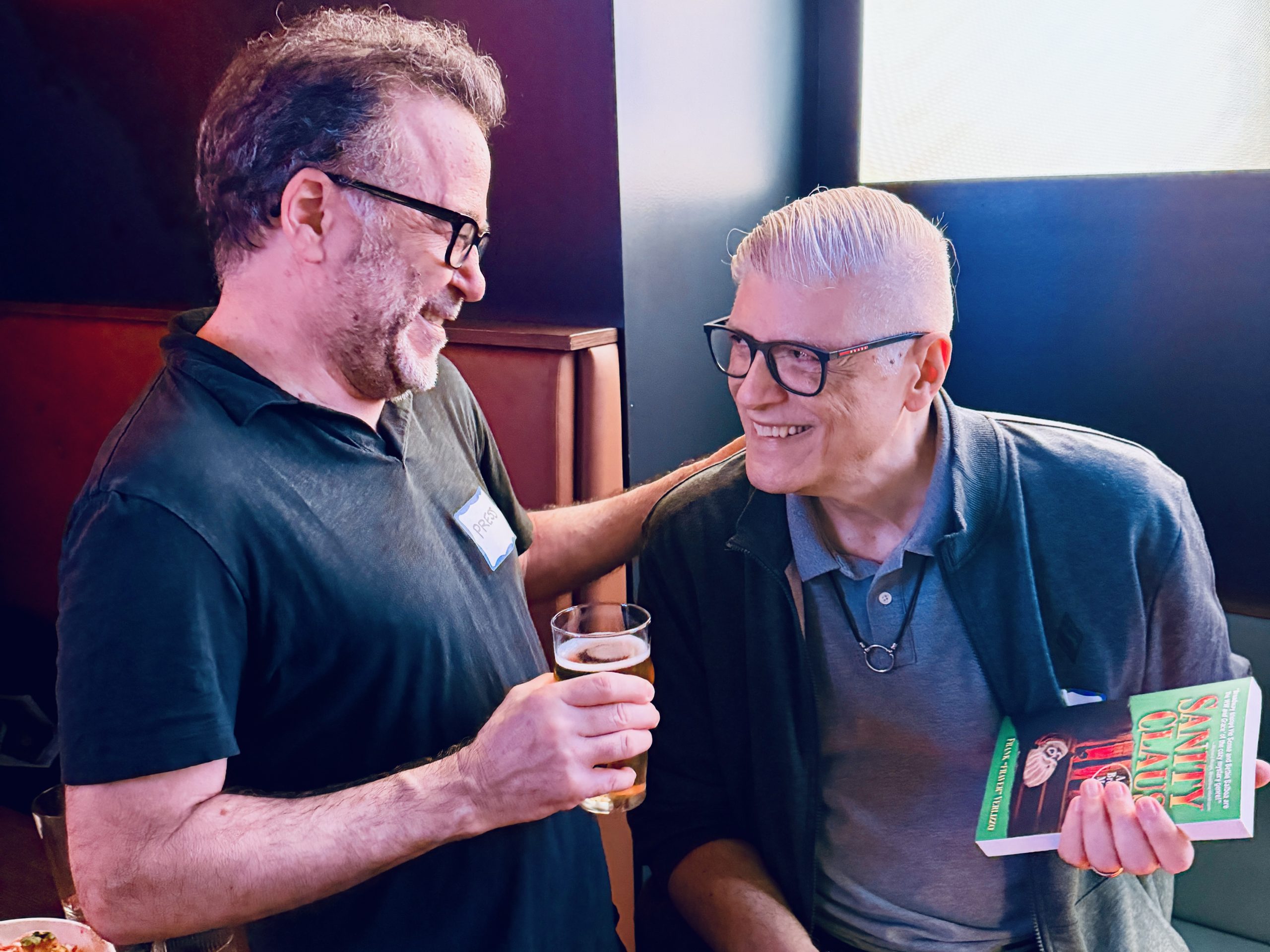
Ron Fassier and Frank “Fraver” Verlizzo Photo by Richard Hillman
Times Square has never been particularly interested in behaving itself, which made it exactly the right neighborhood for The Men Event’s latest Times Squeer Social, where networking, cocktails, Broadway and a little literary murder mystery shared the same room.
Held Tuesday, August 18, at Planet Hollywood, the free three-hour mixer brought New York’s LGBTQ+ community together for an evening designed less around name tags and forced networking than the considerably more civilized pleasures of drinking, flirting, talking, connecting and seeing where the evening might lead.
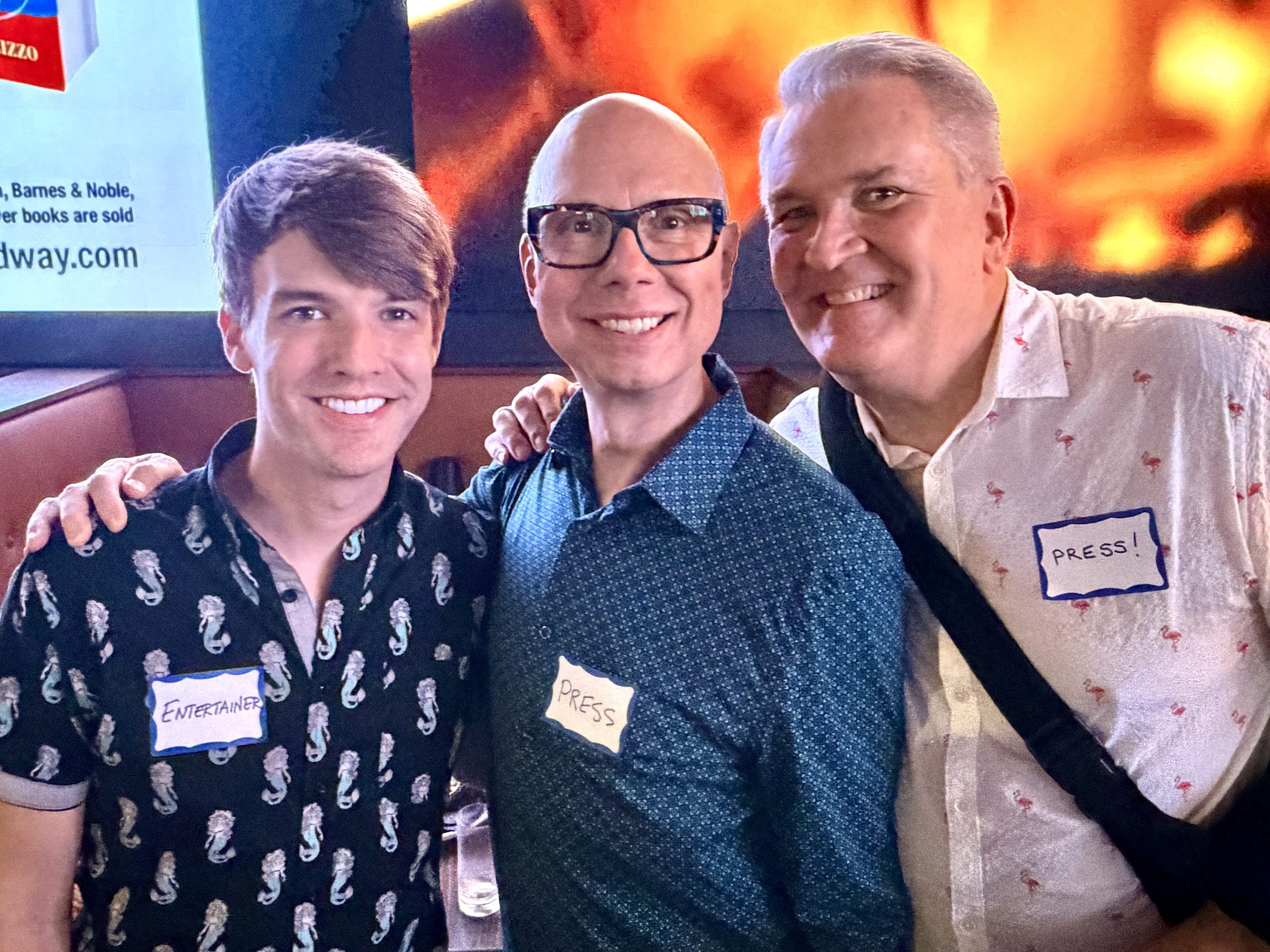
Mark William, Richard Ridge and Richard Hillman
The Men Event’s signature monthly gathering included drink specials, raffle prizes and no cover—always three rather persuasive words in Manhattan.

Photo by Richard Hillman
This edition came with a particularly Broadway twist: the celebration of Frank “Fraver” Verlizzo’s new mystery novel, Sanity Claus.
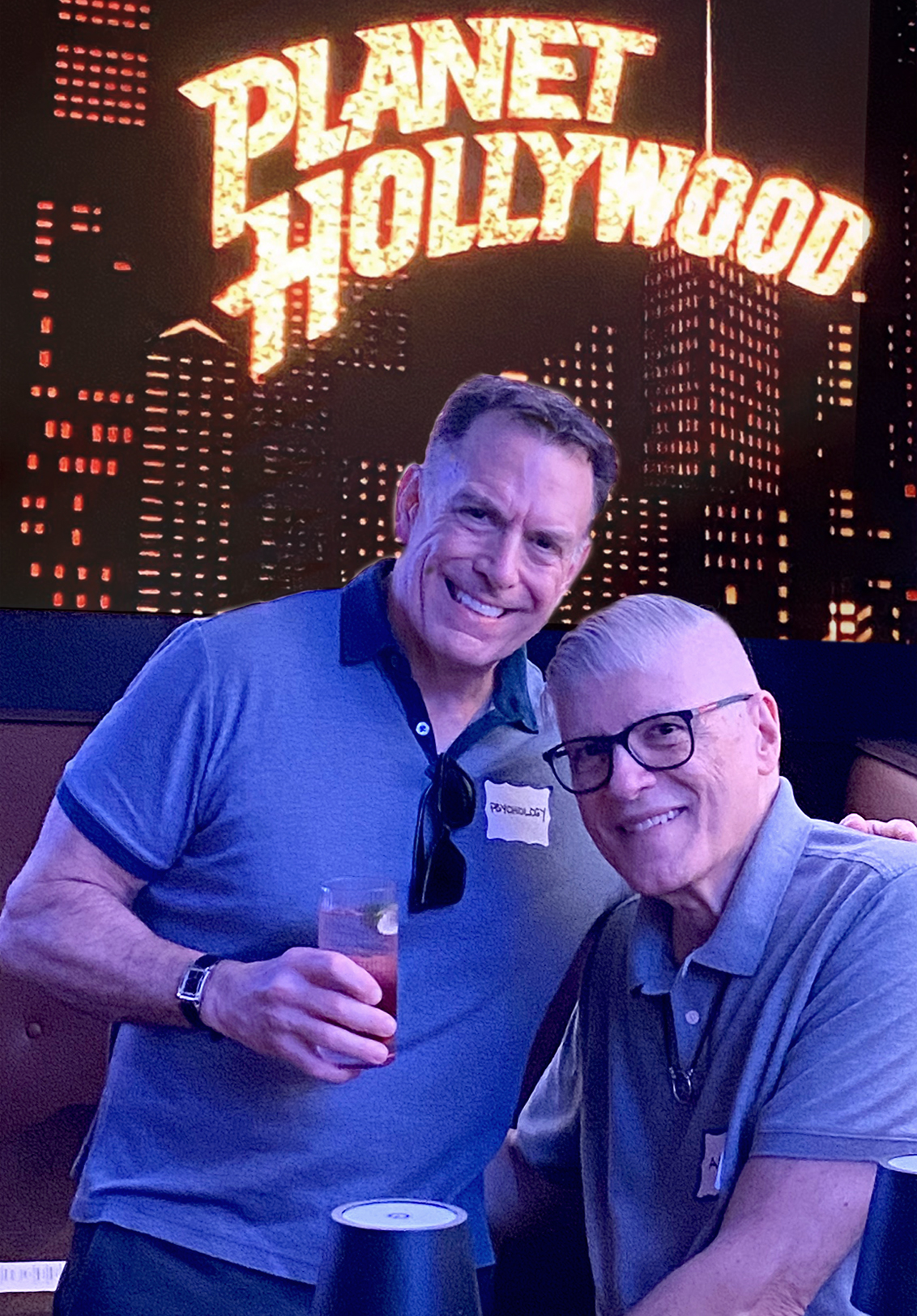
Michael and Frank “Fraver” Verlizzo
For Broadway people, Fraver hardly needs an introduction. Long before becoming a mystery novelist, Verlizzo created some of the theatre’s most recognizable visual identities, designing posters and advertising art that helped define how Broadway sold itself to the world. That made the collision of Broadway history, mystery fiction and Times Square nightlife feel rather perfectly placed.
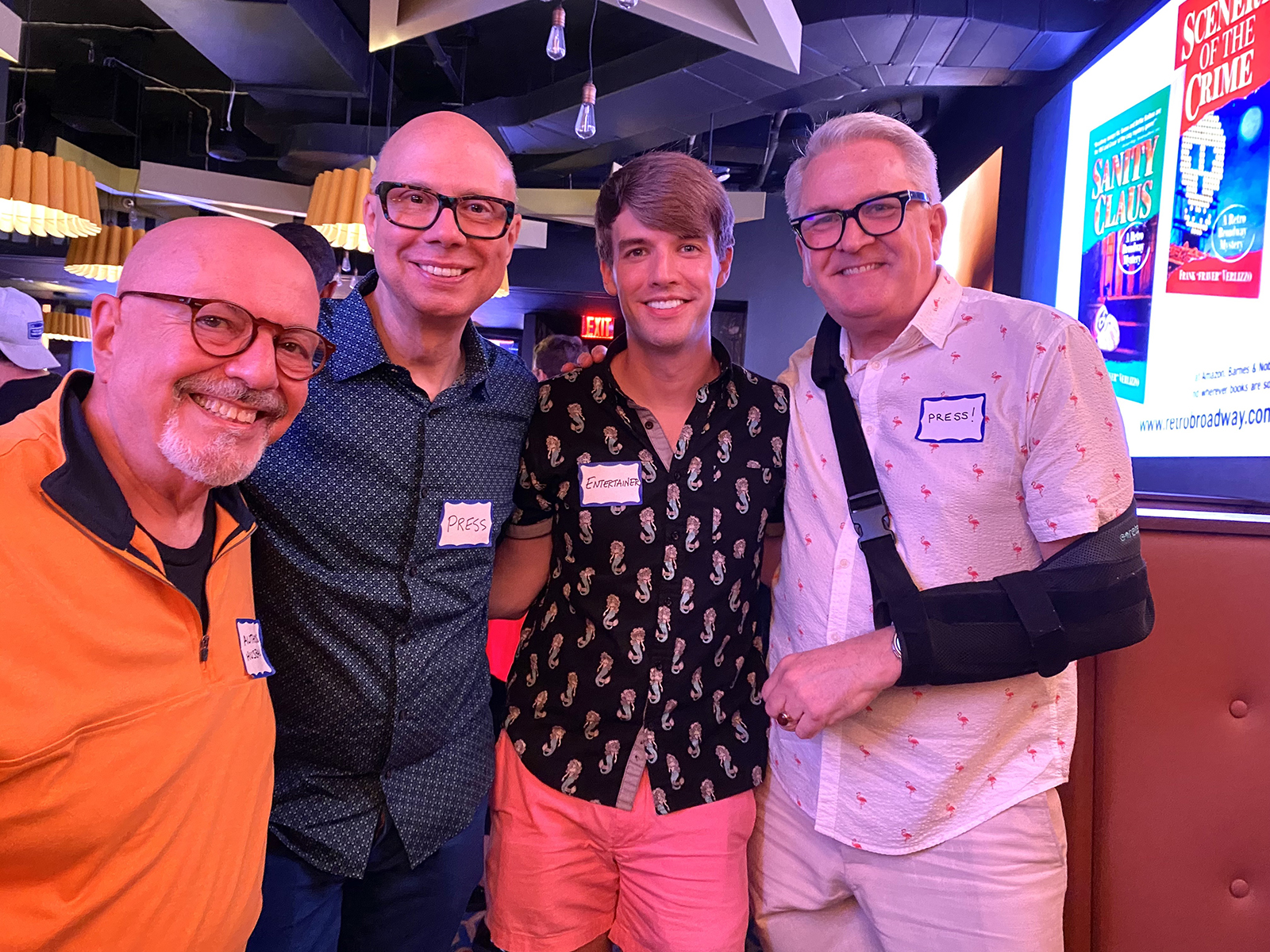
The Boys
Sanity Claus gave the evening its literary centerpiece, but Times Squeer Social remains fundamentally about something increasingly precious in New York: actually meeting people in person.
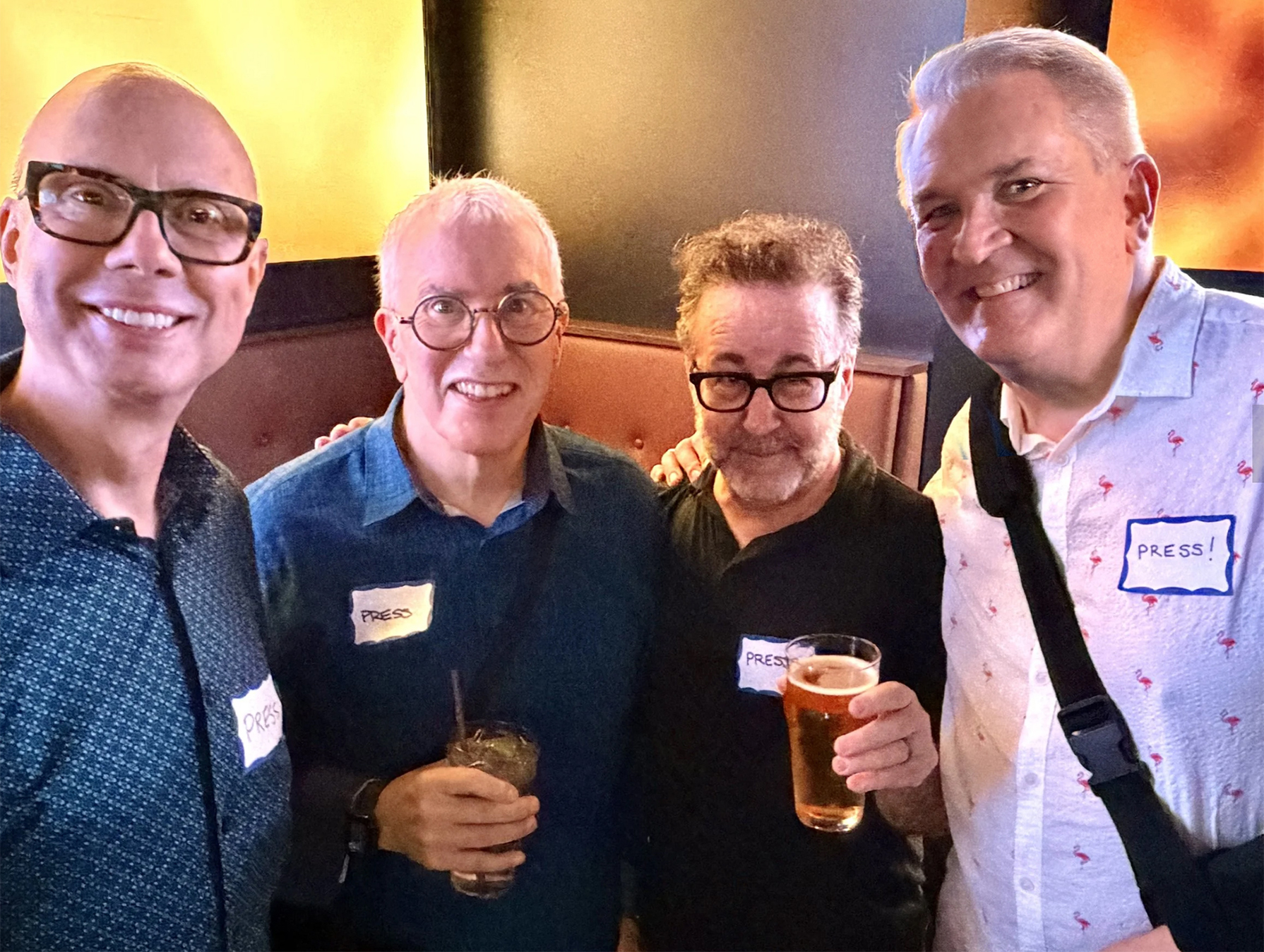
The Press
Since launching in 2004, The Men Event has built its identity around creating social connections within the LGBTQ+ community, producing everything from networking parties and speed dating to theatre nights, gallery walks and comedy events. The organization says it has created more than 2,000 events over the past two decades.
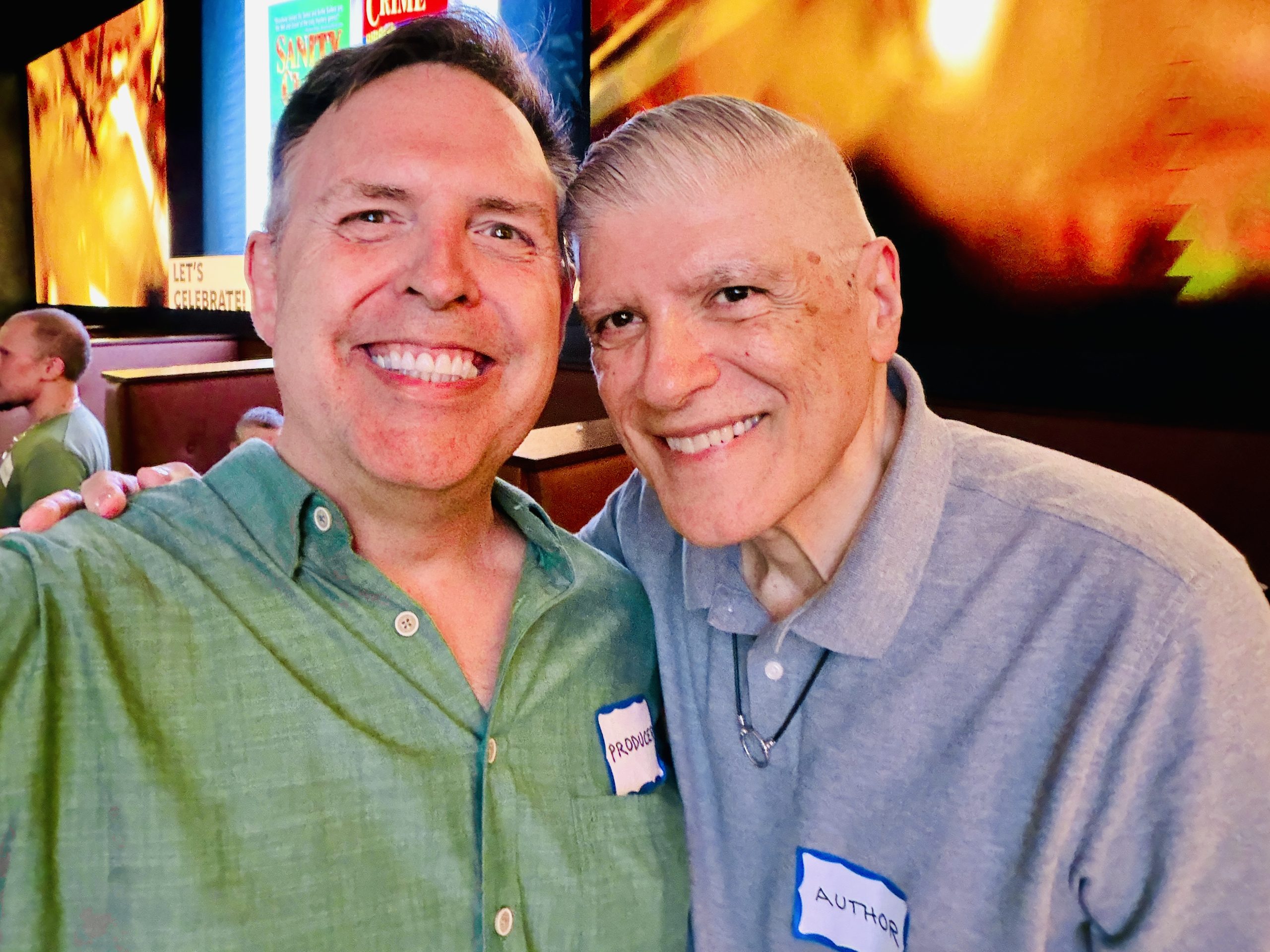
Hugh Hysell and Frank “Fraver” Verlizzo
That matters in an era when “social” increasingly means staring at somebody’s photograph on a screen and deciding their entire worth with the movement of a thumb. Times Squeer Social offers the wonderfully old-fashioned alternative: walk into a room and say hello. You might meet a future collaborator. You might make a new friend. You might find somebody worth flirting with. You might win something. And on this particular Tuesday night, you could also leave having discovered a Broadway mystery by one of the men responsible for making Broadway itself look so enticing. Not bad for a free night in Times Square.
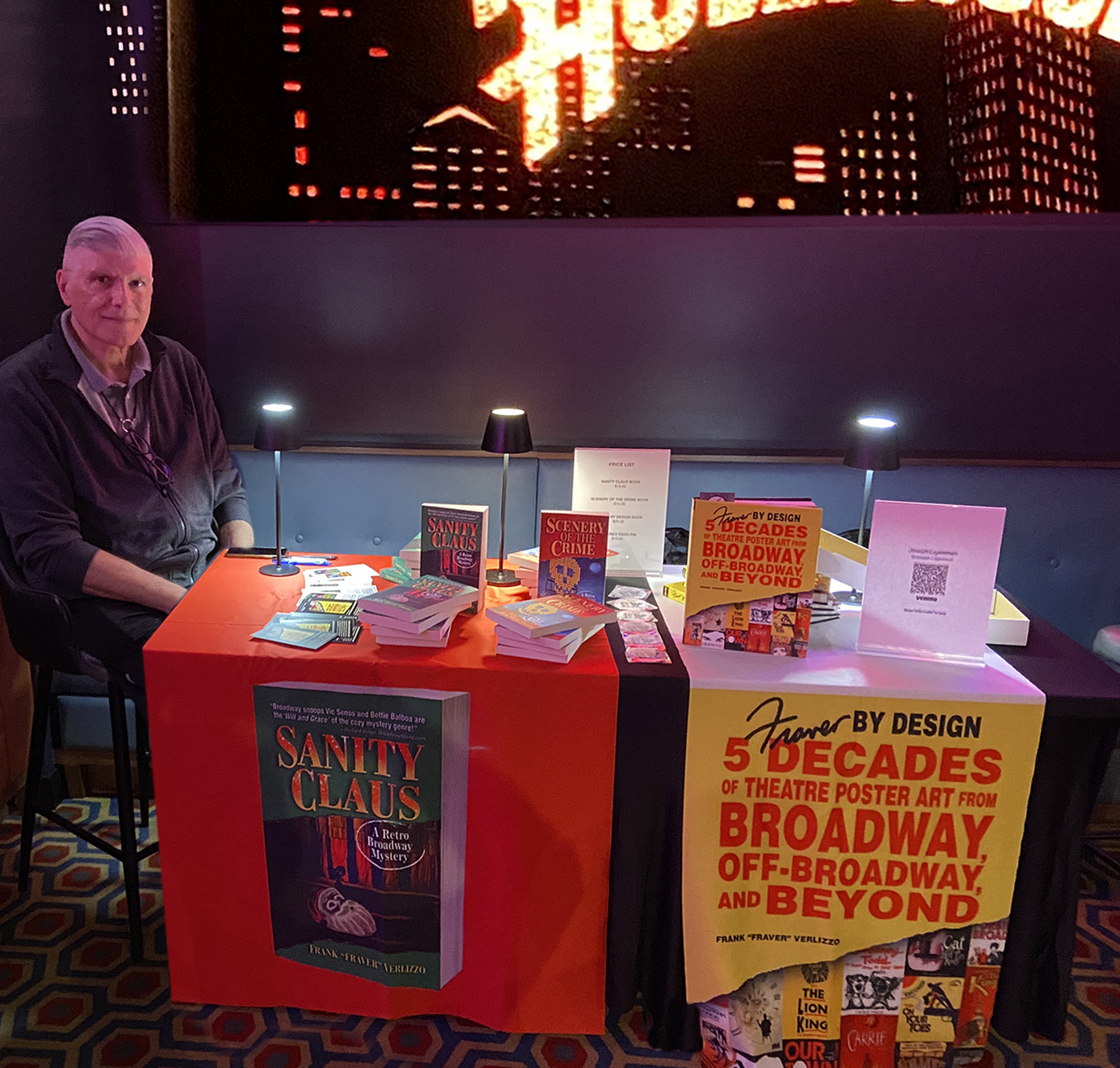
Fraver Table
If you missed this one, Times Squeer Social isn’t disappearing. The Men Event has already scheduled its next edition at Planet Hollywood for September 22. In a neighborhood built on spectacle, sometimes the most interesting thing happening isn’t what’s flashing across the giant screens outside. It’s who you meet upstairs.


Rope: Murder, Privilege, and the Art of Getting Away With It

The Glorious Corner

The York Theatre Celebrates Kelli O’Hara and Charles Wright: A Night Honoring Broadway’s Past, Present, and Future

Prince Mario-Max Schaumburg-Lippe: Ten Secrets I Learned From Yogmata Keiko Aikawa!

Disney’s Parks and Streaming Are Growing. It Still Wants $3 Billion in Cuts.

Macy’s Thanksgiving Day Parade Celebrates 100 Years With a Star-Studded Holiday Spectacular and Performers Galore

Theatre News: Bryan Cranston Returns to Broadway, Julia Roberts Finds Silence, Alec Baldwin Heads To The Tank, Hadestown Heads Home and John Kander at 100

Prince Mario-Max Schaumburg-Lippe: MariBelle And The Chocolate Factory!
Rope: Murder, Privilege, and the Art of Getting Away With It
The Glorious Corner
The York Theatre Celebrates Kelli O’Hara and Charles Wright: A Night Honoring Broadway’s Past, Present, and Future
Prince Mario-Max Schaumburg-Lippe: Ten Secrets I Learned From Yogmata Keiko Aikawa!
Disney’s Parks and Streaming Are Growing. It Still Wants $3 Billion in Cuts.
Macy’s Thanksgiving Day Parade Celebrates 100 Years With a Star-Studded Holiday Spectacular and Performers Galore
Theatre News: Bryan Cranston Returns to Broadway, Julia Roberts Finds Silence, Alec Baldwin Heads To The Tank, Hadestown Heads Home and John Kander at 100
Prince Mario-Max Schaumburg-Lippe: MariBelle And The Chocolate Factory!
-

 Business4 days ago
Google Releases Gemini 4 Hydrogen, and It Changes the Math on Business AI Costs
-

 Business5 days ago
Prince Mario-Max Schaumburg-Lippe: How To Resolve The Microsoft Outage and Outlook Outage. Ending The Problems, We Got The Troubleshooting For You!
-

 Cabaret4 days ago
My View: Photos… “Here’s To Life”….Ann Hampton Callaway at 54 Below
-

 Broadway4 days ago
Theatre News: Broadway’s Next Big Stars, a New Home for Creativity, and Some Very Familiar Faces
-

 Business2 days ago
OpenAI Opens ChatGPT to Business Profiles and Customer-Facing AI Agents
-

 Business3 days ago
Open Source Edge0 Model Brings 145 Billion Parameter AI to a Single Laptop, and Businesses Should Pay Attention
-

 Entertainment4 days ago
A Century of Wonder: Macy’s 100th Thanksgiving Day Parade Takes New York to Extraordinary Heights
-

 Entertainment4 days ago
Prince Mario Max Schaumburg Lippe: Bal Impérial: A Magnificent Celebration of French Heritage!