
Theatre
Blackfriars Repertory Theatre and the Storm Theatre Bring Sister Calling My Name To The Sheen Center


Susie Duecker and John Marshall Photo by Michael Abrams
Blackfriars Repertory Theatre and the Storm Theatre presents a new production of Buzz McLaughlin’s Sister Calling My Name directed by Peter Dobbins (Ah, Wilderness!;The Rainmaker). Performances began on January 24 for a run through February 16 in the Black Box Theater at The Sheen Center for Thought & Culture (18 Bleecker Street at the corner of Elizabeth Street, NYC). Opening night is set for January 30 and this marks the play’s New York premiere. Sister Calling My Name is about a brother’s reluctant reunion with his developmentally disabled sister who has become an extraordinary artist. When he discovers his sister’s guardian, a nun, is a woman he knew from his past, the three are all thrown into an emotionally charged encounter that leaves them forever changed. The play deals with issues of love, loss, faith, doubt, family, and redemption.
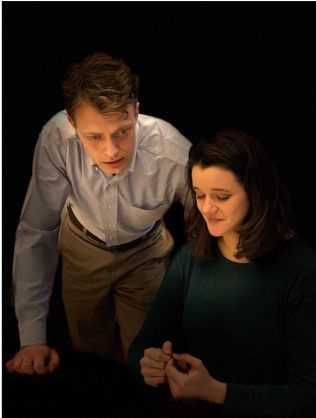
The cast of Sister Calling My Names features Susie Duecker (As You Like It; The 12 Dates of Christmas), John Marshall (The Imbible; Apple Seed) and Gillian Todd (The F; Orestes 2.0). Sister Calling My Name features scenic design by Daniel Prosky, costume design by Jake Poser, lighting design and production coordination by Michael Abrams, and sound design by Ian Werhle. Kellie Taylor is the stage manager and assistant director and Fleur Alys Dobbins is the associate artistic director of the Storm Theatre. “Buzz McLaughlin’s Sister Calling My Name takes us on the difficult journey home”, said director Peter Dobbins. “It’s a trip often avoided as there can be regrets and recriminations at every turn, but this gripping memory play takes us through the struggles of reconciliation to the most sublime of rebirths.”
Sister Calling My Name plays at The Sheen Center in The Black Box Theater (18 Bleecker Street at the corner of Elizabeth Street, NYC). Performances are Thursday – Friday at 7:30pm and Saturdays at 2pm & 7:30pm. There is a special Sunday matinee added on February 17 at 2pm. Opening night is January 30. Tickets are $35. Tickets/reservations for all events at The Sheen Center for Thought & Culture are available online at SheenCenter.org, by phone at 212-925-2812, and in-person at The Sheen Center box office (Monday through Friday 11:00am to 5:00pm and one hour before shows).


“There is something profoundly disturbing about a photograph of people laughing when you know what is happening just beyond the frame.”
In Here There Are Blueberries, Moisés Kaufman and Amanda Gronich confront one of history’s most uncomfortable truths: the people responsible for unimaginable atrocities were not necessarily recognizable monsters. They were ordinary human beings who went to work, enjoyed vacations, celebrated birthdays, fell in love, and posed for photographs while participating in the systematic murder of millions.
Now playing at Broadway’s Ethel Barrymore Theatre, this extraordinary documentary drama from Tectonic Theater Project is not another retelling of the Holocaust through the experiences of its victims. Instead, it examines the private lives of those who perpetrated and facilitated its horrors, asking how human beings could maintain the appearance of normality while surrounded by industrialized death. The question is not confined to Nazi Germany. Its implications reach uncomfortably into our own time.
Co-written by Kaufman and Gronich, conceived and directed by Kaufman, and co-created by Scott Barrow and Grant Vargas, the production begins with a deceptively simple observation: “That’s the thing about history. Not all of it is knowable.”

Michelle Beck, Delia Cunningham, Kathleen Chalfant Photo by Matthew Murphy
The story begins at the United States Holocaust Memorial Museum in Washington, D.C., where researcher Rebecca Erbelding (Delia Cunningham) receives an unexpected communication from a man who has possessed a mysterious photograph album for approximately 60 years. Discovered in an abandoned apartment, the album is believed to contain photographs taken at Auschwitz. Initially, Erbelding is reluctant to accept it. These are not the familiar images of emaciated prisoners, they are photographs of their perpetrators enjoying themselves.
Through David Bengali’s remarkable projections and David Lander’s evocative lighting, the audience becomes part of the investigation as the photographs are examined, enlarged, and gradually identified. The discovery of SS commandant Richard Baer, followed by the identification of Josef Mengele, transforms what initially appears to be an ordinary collection of personal photographs into an extraordinary historical document.
The album belonged to Karl Höcker, an SS officer who served as adjutant to the Auschwitz commandant. Its images offer a rare glimpse into the social lives of the men and women who helped operate the camp. We see them relaxing, laughing, singing, and enjoying the pleasures of ordinary existence. They appear comfortable, even happy. There is no visible suggestion of the unimaginable suffering occurring nearby.
And that is precisely what makes these photographs so horrifying.

Delia Cunningham, Montego Glover Photo by Matthew Murphy
One of the production’s most compelling observations concerns the camera itself. The German Leica helped make photography increasingly portable and accessible, allowing people to document their daily lives with an immediacy that feels remarkably contemporary. In many respects, these photographs function as the social media of their era. They preserve the moments their subjects wanted remembered: friendships, celebrations, leisure, and camaraderie.
What they omit is infinitely more revealing.
Today’s Instagram feeds and TikTok videos offer similarly curated versions of existence. We photograph what pleases us, what flatters us, and what supports the identities we wish to project. The difference, in this instance, is almost unbearable. These people were not simply excluding the unpleasant details of their lives. They were documenting their happiness while participating in, administering, or supporting one of humanity’s greatest crimes.
Kaufman’s direction is meticulous, allowing the evidence to accumulate without resorting to theatrical sensationalism. The photographs themselves become witnesses, and the audience is invited to examine them with the same growing unease experienced by the researchers.

Brandon Flynn, Kathleen Chalfant Photo by Matthew Murphy
Kathleen Chalfant is terrific as Judy Cohen, the museum’s director of photographic research. Her measured intelligence and quiet authority give the investigation its necessary gravity. Cunningham’s Erbelding provides the curiosity and determination that propel the discoveries forward. Scott Barrow, Michelle Beck, Michael Cerveris, Montego Glover, and Conrad Ricamora move between museum personnel and historical figures, creating a theatrical landscape in which past and present continually intersect.

Delia Cunningham, Kathleen Chalfant, Michael CerverisPhoto by Matthew Murphy
Brandon Flynn is especially convincing as Rainer Höss, the grandson of Auschwitz commandant Rudolf Höss, whose confrontation with his family’s history introduces another troubling dimension. What does it mean to inherit the name of someone responsible for mass murder? How does a descendant reconcile familial identity with historical truth? The production refuses to pretend that such questions have easy answers.

Scott Barrow Photo by Matthew Murphy
Yet its most chilling revelation concerns six photographs of young German women, members of the Helferinnen, the female auxiliaries who worked within the Auschwitz administrative system. These women were rewarded for their service with recreational outings to Solahütte, an SS retreat near Auschwitz. There, surrounded by the beauty of the countryside, they enjoyed leisure time with the men who administered the camp. In one particularly unsettling series of photographs, the women are seen eating blueberries, laughing and enjoying themselves with the carefree exuberance of young people on holiday. Hence the title, Here There Are Blueberries.
The innocence of the activity stands in grotesque contrast to the reality of their employment. These were not women living in some distant village, unaware of what was happening. They worked within the camp’s administrative structure. Their photographs document a culture in which participation in atrocity had become sufficiently normalized that leisure and mass murder could coexist without apparent contradiction.
Claims of ignorance become increasingly difficult to reconcile with the circumstances in which they lived and worked. The play does not establish that every individual knew every detail of the extermination process, but it makes the broader moral evasion impossible to ignore.
One statement by a woman is particularly devastating: “I believed one must harden oneself against the sight of human suffering. People who want to build empires cannot afford to be squeamish.”
Consider the implications of that philosophy. Human suffering is not denied. It is acknowledged and then deliberately dismissed as an inconvenience to ambition. Compassion becomes an obstacle, and cruelty becomes an administrative necessity.
Therein lies the real horror of Here There Are Blueberries. The machinery of genocide did not require every participant to behave like a raging fanatic. It required people willing to perform their assigned duties, accept the rewards of their positions, and disregard the consequences of their actions.
We are accustomed to imagining evil as something visibly different from ourselves. We expect cruelty to announce itself through appearance, behavior, or some unmistakable indication of moral corruption. Yet the photographs reveal attractive young women, smiling men, ordinary friendships, and familiar expressions of happiness. There is no particular face of evil. It can look like anyone.
That realization gives the play its contemporary urgency. We live in a world where human suffering can become background noise, where images of devastation compete with entertainment, and where people learn to compartmentalize what they know in order to continue living comfortably. The circumstances of contemporary society are not interchangeable with the Holocaust, whose systematic, state-sponsored extermination was historically specific. But the human capacity to normalize cruelty, surrender moral responsibility, and look away from suffering remains an urgent subject for examination.
The production also raises questions about the limits of historical understanding. Photographs reveal what happened within a frame, but they cannot fully disclose what their subjects believed, understood, or chose not to acknowledge. History demands evidence, yet even evidence cannot always provide the complete truth of an individual’s conscience.
My guest, who is Jewish, had one reservation about the production. She felt that the actors appeared more Aryan than Jewish, creating a visual imbalance that made it difficult for her to connect with the story. It is an interesting response, particularly because the production deliberately centers the perpetrators rather than the victims. Her reaction also underscores how personal and complicated the experience of watching Holocaust-related theatre can be.
For me, however, the production’s decision to focus on the perpetrators is precisely what makes it so unsettling. We know the atrocities. We have seen the photographs of the camps and heard the testimony of survivors. What we have seldom been invited to examine so closely is the astonishing ordinariness of the people who helped make those atrocities possible. The photographs do not show individuals tormented by guilt. They show people enjoying their lives. That distinction is devastating.
Here There Are Blueberries began as a work-in-progress at Miami’s Colony Theatre in 2018, premiered at La Jolla Playhouse in 2022, continued to Washington’s Shakespeare Theatre Company, and made its Off-Broadway debut at New York Theatre Workshop in 2024. Following a national tour and a United Kingdom premiere, it has arrived on Broadway with its questions more urgent than ever.
What Kaufman and his collaborators have created is not simply a historical investigation but a theatrical confrontation with the stories human beings tell themselves to justify their behavior. The production is intelligent, restrained, impeccably assembled, and profoundly disturbing. Its power lies in its refusal to offer the audience the comfort of believing that evil always announces itself.
I left the theatre thinking about those young women eating blueberries, laughing in the sunshine while unimaginable suffering continued nearby. Their pleasure was real. So was the horror. Both existed at the same time, in the same place, within the same human experience.
Can we live as a society knowing what we are capable of? More importantly, can we recognize the moment when our own comfort depends upon refusing to see someone else’s suffering?
Here There Are Blueberries does not allow us to look away. Nor should it.
Here There Are Blueberries opened November 9, 2026, at Broadway’s Ethel Barrymore Theatre, 243 West 47th Street, where its limited engagement continues through January 10, 2027.

Our own “Ask Sam” columnist, Samantha Bessudo Drucker, is bringing Kevin & Sam Talk Shop to The Times Square Chronicles!
 An unscripted diva crossing into the scripted world, Samantha joins her friend and mentor, actor, author, producer and sought-after acting coach Kevin Scott Allen, for candid conversations about acting.
Each week, they bring you 20 minutes of news you can use: practical techniques to strengthen your work and insights into the actor’s mindset to help navigate auditions, performances and a creative career.
Kevin brings five decades of acting experience and more than 100 IMDb credits. Sam brings her hosting skills, curiosity, humor and firsthand experience applying his lessons as she pursues her own acting ambitions.
They want you in the conversation! Send your acting questions to samantha@socialimage.net, and they may tackle your topic in an upcoming episode.
Join each week for Kevin & Sam Talk Shop. Let’s get to work!
 WATCH & CONNECT
 Season 1 Playlist: https://www.youtube.com/
 Kevin’s Instagram: https://www.instagram.com/
 Samantha’s Instagram: https://www.instagram.com/
Off Broadway
The Curious Case of Benjamin Button: A Heartbreaking Reminder That Love Should See Beyond Appearances

All my life, I have thought God got something terribly wrong. Why are we born young, only to grow old? Wouldn’t it make infinitely more sense to arrive in this world with the wisdom of age and gradually grow younger, shedding the burdens of time rather than accumulating them? It always seemed a rather wonderful arrangement. Then I saw The Curious Case of Benjamin Button at The Public Theater, and I realized something I had never considered. What happens when only one person lives that way, while the rest of the world regards him as a monster?

The cast photo by Joan Marcus
Based on F. Scott Fitzgerald’s 1922 short story, with book and lyrics by Jethro Compton and music and lyrics by Darren Clark, this extraordinary musical relocates the story to a small Cornish fishing village at the end of World War I. Compton, who also directs and designs the scenery, has created a theatrical world so complete, so inventive, and so emotionally devastating that its impossible premise becomes utterly believable. What begins as a curious fantasy becomes a profound examination of humanity’s inability to accept what it does not understand.

Andrew Durand and cast photo by Joan Marcus
Benjamin Button (Andrew Durand) enters the world as a fully formed 70-year-old man, dressed and already bearing the physical indignities of age. His mother (Sachiko Mae) is so horrified by what she has given birth to that she regards her own child with disgust, ultimately taking her life. His father (Brandon J. Ellis), consumed by shame, hides Benjamin away in the attic. Before Benjamin has had the opportunity to experience anything resembling childhood, he has already been condemned for the simple crime of being different.
This is where the story first broke my heart. What kind of world looks at a child and sees a monster? Benjamin has done nothing wrong. He has not chosen his appearance, his circumstances, or the extraordinary direction in which his life will unfold. He simply wants what every human being deserves: to be loved, to belong, and to experience life. Yet the very people entrusted with protecting him cannot see beyond what he looks like.
Eventually, Benjamin escapes the confines of his father’s home and discovers the local pub, where he meets Ebron (Claire-Frances Sullivan), a spirited young barmaid who becomes the great love of his life. Their connection is immediate, tender, and beautifully complicated. Their families oppose the relationship, and the lovers eventually separate, each setting out on a different journey while remaining bound to the other.
Benjamin goes to sea, where he befriends Jack (Morgan Morse), discovering friendship and adventure in a world that has offered him precious little of either. When Benjamin and Jack prepare to leave for war, fate brings Benjamin and Ebron together again. One night of love changes their lives, and eventually they become parents to Locryn (Kris Saint-Louis) and Elowen (Kelsee Kimmel).
For a time, Benjamin experiences the ordinary happiness that has always seemed beyond his reach. But time, which moves forward for everyone around him, continues to move backward for Benjamin. His body grows younger while his family grows older. Following an accident involving his daughter, Benjamin becomes desperate to find a cure for his condition. Unable to reveal the truth to Ebron, he leaves the woman he loves and his son, believing that somehow he can correct what nature has made of him.
It is a devastating decision, born not from a lack of love but from the conviction that he must change himself to deserve it. His search leads him back to Jack, whose reaction to Benjamin’s transformation is another cruel reminder of how quickly affection can disappear when confronted with something it cannot comprehend. Benjamin eventually returns, but this is not a fairy tale in which love conveniently conquers every obstacle. The consequences of time, separation, and fear cannot simply be undone.

Kelsee Kimmel and Andrew Durand photo by Joan Marcus
Durand is magnificent. His physical performance alone is remarkable, beginning with the stiffness, aches, and limitations of a septuagenarian and gradually transforming into the restless energy and awkward innocence of youth. Yet his achievement extends far beyond an impressive technical exercise. He gives Benjamin an emotional transparency that makes his loneliness almost unbearable. There is something especially moving about watching a man whose body becomes increasingly young while his experiences grow increasingly old. Durand captures the sweetness of first love, the exhilaration of discovery, and the terrible realization that the world may never allow him to live an ordinary life.
Kelsee Kimmel is equally compelling as Elowen, providing the emotional center around which Benjamin’s extraordinary existence revolves. Their relationship possesses a lyrical beauty that transcends the unusual circumstances of his birth. She is the sea, and he is the moon, two forces forever connected, drawn toward one another even when separated by distances neither can control. Benjamin dreams of walking on the moon, and during his lifetime he witnesses humanity accomplish that seemingly impossible feat. The symbolism is exquisite. Mankind can conquer the heavens, yet still struggle to accept the person standing directly in front of us.
Darren Clark’s score is glorious, drawing upon the musical traditions of Cornwall with Celtic influences, folk rhythms, and melodies that seem to emerge from the sea itself. At times, the harmonies possess the haunting beauty of sirens calling across the water. At others, the music bursts with the irrepressible energy of a village celebration. The entire ensemble doubles as the orchestra, playing violins, guitars, accordion, cornet, cello, and drums while singing and inhabiting multiple characters. Their musicianship is astonishing, and the music never feels like accompaniment. It is the lifeblood of the production.
Chi-San Howard’s choreography is equally inspired. The performers move with such instinctive rhythmic precision that their bodies seem to become additional instruments. Every gesture, turn, and movement contributes to the storytelling. Under Mark Aspinall’s musical direction, the company functions as a beautifully calibrated ensemble, creating an atmosphere in which music, movement, and narrative become inseparable.
Compton’s scenic design is deceptively simple and extraordinarily effective. A large wooden dock and layered staircases establish the village’s maritime world, while fishing nets and buoys suspended above the stage create the impression of a place shaped by generations of sailors, fishermen, and storytellers. Throughout the evening, one feels transported to an old Cornish pub, listening to the extraordinary tales of people who have spent their lives at the mercy of the sea. The difference is that these stories unfold directly before us, as though memory itself has taken physical form.
Anna Kelsey’s costumes are beautifully conceived, allowing the performers to move effortlessly between narration and characterization through remarkably efficient changes. Zoe Spurr’s lighting is especially inventive, transforming the stage from the warmth of a village gathering to the dangerous mystery of the open water. Her work becomes particularly mesmerizing during the sequences in which Benjamin appears to drown, moments when light, movement, and theatrical illusion combine to breathtaking effect. Luke Swaffield’s sound design preserves the intimacy of the storytelling while allowing the music to surround us. Like most shows today sometimes they lyrics are lost.
The supporting company deserves enormous recognition. Sachiko Mae and Brandon J. Ellis establish the emotional cruelty of Benjamin’s beginnings, while Morgan Morse gives Jack a humanity that makes his eventual rejection all the more painful. Kris Saint-Louis and Claire-Frances Sullivan bring tenderness to the family Benjamin struggles to preserve. Matt Wolpe, Katie Horner, Trevor Lindley Craft, and Britney Coleman contribute to an ensemble whose versatility is nothing short of extraordinary. These are not simply performers who happen to play instruments. They are consummate theatrical storytellers whose collective talent creates an entire community before our eyes.
Beneath the humor, exuberance, and extraordinary musical invention lies a story about time and tides, both of which move according to laws that human beings cannot control. There is mythology here, certainly, but also an uncomfortable truth about the human condition. We claim to celebrate individuality, yet so often punish anyone whose existence challenges our expectations. We admire difference when it entertains us, but recoil when it asks us to reconsider our understanding of what is normal.
Benjamin’s tragedy is not that he ages backward. It is that the people around him cannot accept him as he is. His life is filled with extraordinary experiences, yet so much of his happiness is stolen by shame, rejection, and the desperate belief that he must somehow become like everyone else. He spends precious years searching for a cure to a condition that is only monstrous because others have decided to see it that way.
What makes The Curious Case of Benjamin Button so affecting is that it never loses its humanity amid the fantasy. It is funny, exuberant, inventive, and filled with remarkable music, but its emotional power comes from a deceptively simple question: Why is it so difficult for us to love someone without demanding that they conform to our expectations?
I entered the theatre believing that Benjamin Button’s backward journey through life might be a wonderful gift. I left understanding that no gift, however extraordinary, can protect someone from a world determined to misunderstand him.
We have learned to send human beings into space, to cross oceans, and to accomplish things once considered impossible. Benjamin lives long enough to witness a man walk on the moon, the very dream that once seemed beyond his reach. Yet the greatest journey humanity has still to make may be the one that takes us beyond appearances, prejudice, and fear.
The Curious Case of Benjamin Button, playing at The Public Theater through December 6, is a breathtaking theatrical achievement and a profoundly moving reminder that love should never depend upon looking like everyone else.
One small step for mankind would be learning to see beyond what someone looks like and recognize the human being within.
Broadway
Theatre News: Broadway’s Next Big Stars, a New Home for Creativity, and Some Very Familiar Faces

Broadway is preparing for a star-studded 2027, with Steve Carell and John C. Reilly stepping into one of American comedy’s most beloved partnerships, Jessica Chastain returning in an imaginative new play, and Jordan Fisher preparing to channel Prince. Meanwhile, Schmigadoon! welcomes a new leading lady, and Lin-Manuel Miranda and Thomas Kail celebrate a meaningful addition to the Theatre District.
Steve Carell and John C. Reilly Are Broadway’s New Odd Couple
Neil Simon’s The Odd Couple is returning to Broadway with a pairing that already sounds like comic perfection. Steve Carell will play the obsessively tidy Felix Ungar opposite John C. Reilly’s gloriously disorganized Oscar Madison when the revival begins performances at the Stephen Sondheim Theatre on March 3, 2027. Opening night is set for March 23, with a limited 15-week engagement.
The supporting company is equally impressive. Tony winner Laura Benanti plays Gwendolyn Pigeon, with Heléne Yorke as her sister Cecily. James Monroe Iglehart takes on Murray, Kevin Del Aguila plays Roy, Rob McClure is Vinnie, and David Zayas rounds out the poker table as Speed.
Simon understood that the funniest relationships often emerge from two people who are utterly incapable of living together yet somehow cannot live without each other. Carell’s gift for controlled comic desperation and Reilly’s wonderfully unpredictable humanity could make this a particularly delicious revival. With a company this accomplished, the prospect of those legendary poker games is almost irresistible.
 Michelle Visage Brings Her Own Brand of Mischief to Schmigadoon!
The wonderfully eccentric world of Schmigadoon! is about to welcome another formidable personality. Michelle Visage, best known as a judge on RuPaul’s Drag Race, will make her Broadway debut December 4 at the Nederlander Theatre, taking over the role of the formidable Mildred Layton from Tony nominee Jennifer Simard. Her limited engagement continues through January 31, 2027.
Visage is hardly a stranger to musical theatre. Her West End credits include Everybody’s Talking About Jamie, The Addams Family, and Sea Witch. Before becoming a television personality and recording artist with the group Seduction, she studied musical theatre at AMDA.
Mildred is a character who requires a delicious combination of righteousness, authority, and comic absurdity. Simard has made the role a particular pleasure, and Visage’s larger-than-life personality should bring an entirely different flavor to the proceedings. The question is not whether Visage can command attention. It is what she will do with a character who believes she should command everyone else’s.
 Jordan Fisher Steps Into Prince’s World With Purple Rain
Jordan Fisher has spent much of his career being compared to Prince. Now the resemblance is becoming a theatrical assignment.
The 32-year-old performer will star as The Kid in the Broadway adaptation of Purple Rain, the landmark 1984 film that helped transform Prince into a cultural phenomenon. The production is expected this spring.
Fisher arrives with substantial Broadway credentials, having appeared in Hamilton, Dear Evan Hansen, Sweeney Todd, Hadestown, and Moulin Rouge! The Musical. His combination of vocal ability, physicality, and stage presence makes him an intriguing choice for a role inseparable from one of popular music’s most singular artists.
The challenge, of course, is considerable. Prince was not simply a performer with a distinctive sound and appearance. He was an extraordinary musician whose magnetism came from an artistic identity that could never be duplicated. The success of Purple Rain will depend less on imitation than on Fisher’s ability to capture the emotional intensity, vulnerability, and defiance beneath the legend.

Lin-Manuel Miranda and Thomas Kail Photo by Tricia Baron
Lin-Manuel Miranda and Thomas Kail Open The Gilbert Parker Studio at The Drama Book Shop
One of the Theatre District’s most treasured institutions has reclaimed an important part of its history. On November 12, Lin-Manuel Miranda and Thomas Kail celebrated the opening of The Gilbert Parker Studio at The Drama Book Shop, 266 West 39th Street, restoring a dedicated performance and development space to the beloved theatrical bookstore.
For Miranda and Kail, the occasion was particularly personal. At the shop’s former West 40th Street location, the 60-seat Arthur Seelen Theatre provided a creative home for emerging artists. Among the works nurtured there were In the Heightsand Freestyle Love Supreme, both of which helped shape their extraordinary careers.
The new studio honors Gilbert Parker, the influential theatrical literary agent whose clients included Terrence McNally, Beth Henley, A.R. Gurney, Ken Ludwig, and George Furth. Parker was a mentor to Kail and a close friend of Miranda, and his connection to both artists extended to Wesleyan University, where all three studied. In 2012, Miranda and Kail established a scholarship in his name.
The flexible 50-seat studio includes sound and lighting capabilities and a dressing room, offering established and emerging artists a place to develop new theatrical work.
At a time when New York’s creative spaces are increasingly threatened by rising costs and commercial pressures, the opening carries significance beyond its square footage. Theatre needs places where artists can experiment without the immediate burden of commercial expectations. In the Heights did not begin as a Broadway phenomenon. It began as an idea that needed a room, collaborators, and the freedom to grow.
The Gilbert Parker Studio offers the next generation precisely that possibility.
 Jessica Chastain Returns to Broadway in Lost Lear
Jessica Chastain will return to Broadway next spring in Lost Lear, a new play written and directed by Dan Colley, making his Broadway debut. Joining her are Corey Stoll and Michael Urie, creating an unusually compelling trio for a work that explores memory, family, and the strange intersections between theatre and reality.
Performances begin March 29, 2027, at the Booth Theatre, with opening night scheduled for April 23. The production will play a limited 16-week engagement.
Chastain portrays Joy, a former actress living in a care home whose fading connection to the present has convinced her that she is once again rehearsing Shakespeare’s King Lear. Her nurse, played by Urie, accommodates her shifting reality by assuming whatever theatrical role she requires. When her estranged son Conor, played by Stoll, arrives hoping to confront the unresolved history between them, he discovers that reaching his mother may require entering the imaginary production she now inhabits.
The premise is fascinating, particularly because Shakespeare’s tragedy already concerns the devastating consequences of misunderstanding love, loyalty, and family. By placing King Lear inside the fractured memory of a former actress, Colley creates the possibility of examining those themes through a deeply personal lens.
Chastain’s last Broadway appearance, in the 2023 revival of A Doll’s House, demonstrated her ability to sustain extraordinary dramatic tension through restraint. Stoll brings an equally formidable intelligence to his stage work, while Urie’s versatility should prove invaluable in a role that requires navigating between caregiving and performance.
Of all the new productions announced, Lost Lear may offer one of the season’s most intriguing theatrical questions: when memory begins to disappear, can imagination become another way of telling the truth?


As a stalwart of the Philadelphia theater scene, Theatre Exile opened its 30th Season with Gruesome Playground Injuries, a dark, tragicomedy by Rajiv Joseph. A two-hander told in eight non-linear scenes, it spans 30 years wherein two childhood friends, Doug and Kayleen, cross paths in the school nurse’s office, hospital rooms and clinics.The play asks the question as to why in order to relieve pain, we manage to inflict more pain on ourselves. Doug and Kayleen are simultaneously drawn to each other and repelled at the same time. Wanting to help each other, somehow they never can reach each other at the right time. This play had its Off-Broadway debut in January 2011 at the Second Stage Theatre in New York with its Off-Broadway revival in 2025 at the Lucille Lortel Theatre in Manhattan.

Jenna Kuerz, Daniel Burgess Photo by Paola Nogueras
Jenna Kuerzi is highly convincing as the emotionally damaged Kayleen. In going from ages eight to thirty-eight not only does her hair and her demeanor change, but she manages to change her vocal range as well. Prone to stomachaches and depression, we commiserate with her when we learn of her unhappy homelife. On the other hand, we have little pity for Doug, played by live wire Daniel Burgess, as he seems to bring on his own calamities. In every scene we see him with a new wound, scar or broken limb. Coming from a normal family, we can only surmise that he is a dare-devil who tries to defy the odds at every turn.
Directed by Deborah Block, the play moves along at lightning speed with the actors moving the set pieces and changing costumes onstage. The wonderful set by Colin McIlvaine, which utilizes a real monkey bars and swing, has an ethereal quality under the blue lighting by Drew Billau. It is a calm, blue zone where the two actors meet and share all the chaos going on in their lives. Sadly, because Doug always enters with some new trauma, he never does get to swing from those monkey bars. A baseball scoreboard is cleverly used to denote the ages of the actors in each new scene. However, since there are only eight scenes and in a baseball game there are nine innings, we are left hoping that there would be one more scene. But that is not a bad thing, as it means that we were fully invested in the characters and wanted to see more.
For tickets go to boxoffice@theatreexile.org Or Call 215-218-4022
Gruesome Playground Injuries
by Rajiv Joseph
Directed by Deborah Block
Running now through November 15
Theatre Exile
1340 South 13th Street, Philadelphia, PA


Here There Are Blueberries: The Banality of Evil, Captured in a Photograph

It’s beginning to look a lot like…

Kevin & Sam Talk Shop: Bite-Sized Wisdom for Actors

Travelers Get SCREWED – FAA Grounding Is Not A Covered Reason For Travel Insurance To Pay A Refund at CHASE Saphire Card!

Open Source Edge0 Model Brings 145 Billion Parameter AI to a Single Laptop, and Businesses Should Pay Attention

My View: Photos… “Here’s To Life”….Ann Hampton Callaway at 54 Below

The Curious Case of Benjamin Button: A Heartbreaking Reminder That Love Should See Beyond Appearances

A Century of Wonder: Macy’s 100th Thanksgiving Day Parade Takes New York to Extraordinary Heights
Here There Are Blueberries: The Banality of Evil, Captured in a Photograph
It’s beginning to look a lot like…
Kevin & Sam Talk Shop: Bite-Sized Wisdom for Actors
Travelers Get SCREWED – FAA Grounding Is Not A Covered Reason For Travel Insurance To Pay A Refund at CHASE Saphire Card!
Open Source Edge0 Model Brings 145 Billion Parameter AI to a Single Laptop, and Businesses Should Pay Attention
My View: Photos… “Here’s To Life”….Ann Hampton Callaway at 54 Below
The Curious Case of Benjamin Button: A Heartbreaking Reminder That Love Should See Beyond Appearances
A Century of Wonder: Macy’s 100th Thanksgiving Day Parade Takes New York to Extraordinary Heights
-

 Cabaret5 days ago
My View: If The Photos On The Walls Of Birdland Could Talk…”There Has Never Been A Night Like Last Night” Tedd Firth’s 50th Birthday
-

 Broadway4 days ago
A Second Look at Schmigadoon!: New Faces, Sharper Comedy, and a Company Finding Its Rhythm
-

 Entertainment3 days ago
Prince Mario-Max Schaumburg-Lippe New York City – Best Museums For Free – And They Are Americas Best!
-

 Cabaret3 days ago
My View: A Family United By Love, Laughter, and MUSIC at Cafe Carlyle…John, Jessica, & Maddie
-

 Entertainment4 days ago
Prince Mario-Max Schaumburg-Lippe: NYC’s Best Luxury Spas, Pools, Saunas and Cold Plunges!
-

 Cabaret3 days ago
My Vew: It Was All About Being A New Yorker at The Dutch Treat Club
-

 Family4 days ago
Live From The Hotel Edison Times Square Chronicles Presents Dr. K The Couture Dentist
-

 Entertainment2 days ago
Prince Mario-Max Schaumburg Lippe Celebrates Legendary Photographer Patrick McMullan at One Art Space Tribeca Manhattan!