

Choreographer Janet Watson, wife to The Fantasticks lyricist-librettist Tom Jones died February 8th after a long illness. The past few years were difficult for Janet, Tom and their sons as her illness took over.
On Broadway Janet choreographed the Tony Award-winning original production of Big River. From the mid 1980s to the mid 2000s she worked extensively Off-Broadway including Mirette, Philemon, In the Bone Room, Portfolio Revue, The Show Goes On, the 1984 revival of Pacific Overtures, the 1996 revival of I Do! I Do!, Noel and Gertie and the 2006 revival of The Fantasticks, which is still running.
Born in Tulsa, Oklahoma, she came to New York in the early 1960s after her older sister, Susan Watson, had her first big success as the original Kim MacAfee in Bye By Birdie. Susan originated the role of “The Girl” in the summer 1959 one-act version of The Fantasticks and later starred in the TV production.
Janet studied at the University of Colorado and danced with the Merce Cunningham Dance Company. She became head of the dance department at Texas Tech for a time, and also worked extensively at the Actors Theatre of Louisville in the late 1960s and early 1970s.
She returned to New York in the mid 1970s to pursue a career as a choreographer.
Jones said his wife was “an incredible athlete” who was a competitive diver, a skater, and a regular competitor in the New York Marathon.
But in her professional life, Jones said, her special magic was the ability “to an actor who was maybe insecure and shy about movement, and make them truly believe they could move. That was her biggest gift.”
She is survived by her sister, her husband and their sons, Sam and Mike.
Several of the Jones\Schmidt shows and revues have found a home at The York Theater through the years. Janet’s husband Tom Jones is planning a memorial service at The York Theater on Tuesday, March 1st at 4:00 pm to celebrate her life for family and friends.
The York Theater is in the process of reconfiguring and revitalizing new seating for the theater. In an effort to raise funds, The York has decided to make individual seats available for “purchase” as a means to honor or give lasting memorial to friends of the theater. The cost was $2000. Each seat will have a plaque which honors the person in who’s memory it was purchased many of Tom Jones friends are buying them saying “Friends at The Fantasticks” to honor Janet for Tom.
Most of this article comes from Playbill.com written by Robert Viagas.


Presley Gerber was beautiful. Almost startlingly so. He had the genetics of two models, the face of his famous mother, Cindy Crawford, and an entrance into a world most people spend their lives trying to reach. He was born into money, fame, access and extraordinary privilege. He became a model himself, working for major fashion houses.

Kaia and Presley Walker Gerber
His sister, Kaia Gerber, became one of the most recognizable models of her generation. From the outside, the Gerber family seemed to possess the kind of life our culture continually tells us is the prize.

Rande Gerber, Cindy, Kaia and Presley Gerber
Presley Gerber died Sunday at 27 years old. According to the Los Angeles County Medical Examiner, he died at a rehabilitation facility. His family has confirmed his death and asked for privacy during what their representative described as a “very difficult and painful time.” As of this writing, no cause of death has been determined.

Rande Gerber, Cindy, Kaia and Presley Gerber
That last fact matters. We do not know what killed Presley Gerber, and his death should not become an invitation for strangers to diagnose him after the fact. What we do know is what he chose to tell us while he was alive. Presley had spoken publicly about depression and his struggles with mental health. He created “Mental Health Mondays,” using his social-media platform to discuss those struggles and try to help other people experiencing their own. Years earlier, he tattooed the word “misunderstood” across his face, later explaining that he chose it because that was how he had felt throughout his life.
 In December 2025, his disclosures became considerably more troubling. He spoke publicly about panic attacks, loss and the medications he was taking. He also expressed fear about medication withdrawal and frustration that, after seeing numerous psychiatrists, he felt he needed more direction in managing what he had been prescribed. He told followers that he was speaking because he hoped someone listening would realize that they were not alone.
There is something heartbreaking about that now.
We live in a culture that is very good at measuring what somebody has and remarkably bad at understanding what somebody carries. Presley Gerber had beauty. He had famous parents. He had money. He had access. He had opportunities most aspiring models could only dream about. None of those things tells us what it felt like to wake up inside his mind every morning.
That may be the hardest thing for people to understand about suffering. Pain does not conduct a financial background check before entering the room.
Money can buy excellent doctors. It can buy treatment, privacy, beautiful surroundings and opportunities unavailable to millions of other people. Those advantages are real and should not be romanticized away. But money cannot guarantee peace. Beauty cannot guarantee self-worth. Fame cannot guarantee that somebody feels seen. Loving parents cannot climb inside an adult child’s mind and repair everything hurting there. Sometimes the people who appear to have been handed the entire world are fighting battles invisible to everyone looking at them.
Presley’s life also reminds us how little a photograph tells us. We look at beautiful people standing on red carpets and unconsciously complete the rest of the story ourselves. Beautiful means happy. Wealthy means safe. Famous means fulfilled. Successful means whole. None of those equations is reliable.
Perhaps that is why the word Presley once chose to put on his face feels so haunting today: misunderstood. We cannot know everything he meant by it, and we shouldn’t pretend that we do. But we know that a young man surrounded by enormous privilege nevertheless felt misunderstood strongly enough to write the word across the face the world considered so beautiful. There is an uncomfortable lesson in that.
We spend enormous amounts of our lives chasing the things we imagine will finally make us safe from unhappiness. More money. A better body. A beautiful face. Recognition. Connections. The right family. The right address. The right career. We look at people who possess those things and think they have somehow crossed an invisible border into a life where ordinary human suffering cannot reach them. There is no such border.
Presley Gerber was someone’s son. He was someone’s brother. He was a young man who struggled, talked publicly about those struggles and tried to turn some of what he had experienced into something that might help another person. Whatever the medical examiner ultimately determines about how he died, that deserves to be remembered alongside the photographs, the famous surname and the headlines.
Twenty-seven is terribly young. And somewhere tonight, behind all the celebrity attached to this story, there is a mother and father who have lost their son and a sister who has lost her brother. Fame does not protect them from that grief either.
You can be gorgeous. You can be famous. You can be born into money, prestige and opportunity. You can seemingly have the world waiting at your feet. And you can still hurt.
Perhaps Presley Gerber’s life asks us to stop assuming we know who has everything.
Sometimes everything we can see has absolutely nothing to do with what is happening inside.
Broadway
Duncan Sheik Dies at 56, With a New Musical and a New Spring Awakening About to Take the Stage


Spring Awakening Ken Fallin
There is something almost unbearably poignant about the timing.
 On September 16, Seaview announced the young actors who will inherit Spring Awakening, the revolutionary musical Duncan Sheik created with Steven Sater. One day later, Sheik died in Manhattan at the age of 56. His family announced his death Friday, saying that he died Thursday night surrounded by love.

Duncan Sheik
So a production that was already about introducing one of the defining musicals of this century to another generation suddenly becomes something more: a continuation of the artistic life of the man who gave it its extraordinary sound.
Sheik had already lived one successful musical life before Broadway claimed him. His 1996 song “Barely Breathing” became one of those records inseparable from its decade, remaining on the Billboard Hot 100 for 55 weeks and earning him a Grammy nomination. But the introspective singer-songwriter never seemed particularly interested in spending the rest of his career repeating the thing that had made him famous.
Broadway gave him somewhere far more interesting to go. With Sater, Sheik took Frank Wedekind’s once-banned 1891 play about adolescents trapped between sexuality, ignorance, repression and authority and gave those young people a contemporary musical language. Spring Awakening didn’t merely put rock music into a period story. Its great theatrical trick was allowing the music to become the interior world its characters could not otherwise express.
When Spring Awakening opened at Broadway’s Eugene O’Neill Theatre in 2006, it introduced Broadway audiences to a remarkable young company that included Jonathan Groff, Lea Michele, John Gallagher Jr. and Skylar Astin. The production won eight Tony Awards, including Best Musical. Sheik received Tonys for Best Original Score, shared with Sater, and Best Orchestrations, and the cast recording later received the Grammy for Best Musical Show Album. More importantly, it changed the sound of Broadway.

The Civilians, Duncan Sheik and Kyle Jarrow
Sheik understood that contemporary music didn’t need to dress itself up as traditional musical theatre before being allowed through the stage door. His music could remain intimate, restless, erotic, angry, melancholy and startlingly modern while serving a story written more than a century earlier. The result was not simply a successful rock musical. It was a score that made an entire generation of young audiences feel that Broadway might actually be speaking their musical language.
Now Spring Awakening is about to speak to another one. Beginning November 27, the musical returns to New York for a limited 12-week Off-Broadway engagement at Studio Seaview, officially opening December 17. Tony Award winner Danya Taymor directs, with choreography by Celia Rowlson-Hall, making her theatrical debut, and music supervision by Or Matias. This isn’t a production built around established stars. It is deliberately handing the material to young performers who may become tomorrow’s. The newly announced principal company features Jack Bateman as Georg, Jada Simone Clark as Thea, Leif Coomer as Ernst, Ryo Kamibayashi as Moritz, Ashlyn Maddox as Wendla, Nando Morland as Otto, Antonio Porciello as Hanschen, Khadija Sankoh as Martha, Grace Slear as Anna, Tyler Jordan Wesley as Melchior and Amalia Yoo as Ilse.

Duncan Sheik
There is something particularly appropriate about Bateman and Porciello reaching the production through its open casting call, where 2,532 performers were seen. Twenty years ago, Spring Awakening helped introduce Broadway to actors whose names would become enormously familiar. This production is once again looking toward the unknown.
The revival intends to return the musical to the rawness of Wedekind’s original play, placing its young people in an intimate space where desire, fear, repression and discovery cannot easily be escaped. That intimacy feels particularly right for Sheik’s music. These songs were never really about spectacle. Their power came from hearing everything these characters were forbidden to say suddenly explode into sound.

MCC theater presents ‘Alice By Heart’ book by Steven Sater with Jessie Nelson, music by Duncan Sheik, lyrics by Steven Sater, choreographed by Rick and Jeff Kuperman, directed by Jessie Nelson starring, in alphabetical order, Mia DiLena, Zachary Downer, Noah Galvin, Molly Gordon (Alice), Ari Groover, Michael Hartung, Zachary Infante, Andrew Kober, Grace McLean, Andrew Mueller, Nkeki Obi-Melekwe, Catherine Ricafort, Colton Ryan, Heath Saunders, Wesley Taylor and Natalie Walker
Sheik’s theatrical life extended far beyond Spring Awakening. He wrote music and lyrics for American Psycho, collaborated again with Sater on Alice by Heart, and composed for The Secret Life of Bees and Whisper House. He remained an unusual Broadway figure: cerebral, musically sophisticated and never particularly interested in sounding like everyone else.
Remarkably, Spring Awakening isn’t the only Duncan Sheik musical moving forward without him.
On Monday, September 21—just four days after his death—the cast and creative team of the new Off-Broadway musical Memoirs of Amorous Gentlemen are scheduled to meet the press in New York and perform one of its songs publicly. Sheik wrote the music, with a book by Leah Nanako Winkler.

Sophie Ann Caruso, Duncan Sheik, Jamie deRoy photo Stephen Sorokiff
The musical stars Sophia Anne Caruso, who made an indelible impression as Lydia in Beetlejuice, as Colette; Cory Jeacoma (Beautiful) as Léon; Nkeki Obi-Melekwe (Tina) as Nana; and Drama Desk Award nominee Jenny Powers (Little Women) as Madame. Tony, Olivier and Emmy Award winner Rob Ashford directs and choreographs, with Or Matias serving as music supervisor.
That gathering was planned as an introduction to a new Duncan Sheik musical. Instead, it will inevitably become something else as well: one of the first occasions on which theatre artists will perform new Sheik music after his death.
The timing is almost impossible to ignore. On September 16, New York learned who would inherit Spring Awakening. On September 17, Sheik died. On September 21, performers are scheduled to sing from a musical he never lived to see fully arrive.
That is not simply legacy. That is work interrupted in motion.
Sheik’s theatrical career extended well beyond Spring Awakening. He wrote music and lyrics for American Psycho, collaborated again with Steven Sater on Alice by Heart, and composed Whisper House and music for The Secret Life of Bees. But Memoirs of Amorous Gentlemen now occupies a different place in that body of work. It isn’t something being rediscovered from his past. It is part of the future he was still creating.
His colleagues and performers began paying tribute almost immediately. Michele, Astin and members of the Spring Awakening family remembered not simply the composer whose work helped establish their careers, but a generous musician and mentor who had been there when many of them were themselves young artists trying to discover who they were. Which makes what happens at Studio Seaview this November especially moving.
Duncan Sheik could easily have remained the handsome singer-songwriter forever introduced as the man who recorded “Barely Breathing.” Instead, he followed that success somewhere much stranger and more consequential. He found Wedekind, found Sater, found the theatre and helped create a musical that altered Broadway’s vocabulary.
Twenty years later, another generation has just been handed those songs. At the same time, another company is preparing to introduce music he had only just finished creating. Sheik will not be there for either.
But on Monday, someone will sing one of his newest songs. In November, another young actor will begin singing one of the songs that made him part of Broadway history.
Duncan Sheik is gone at 56. His music, remarkably, was already on its way to the next stage.
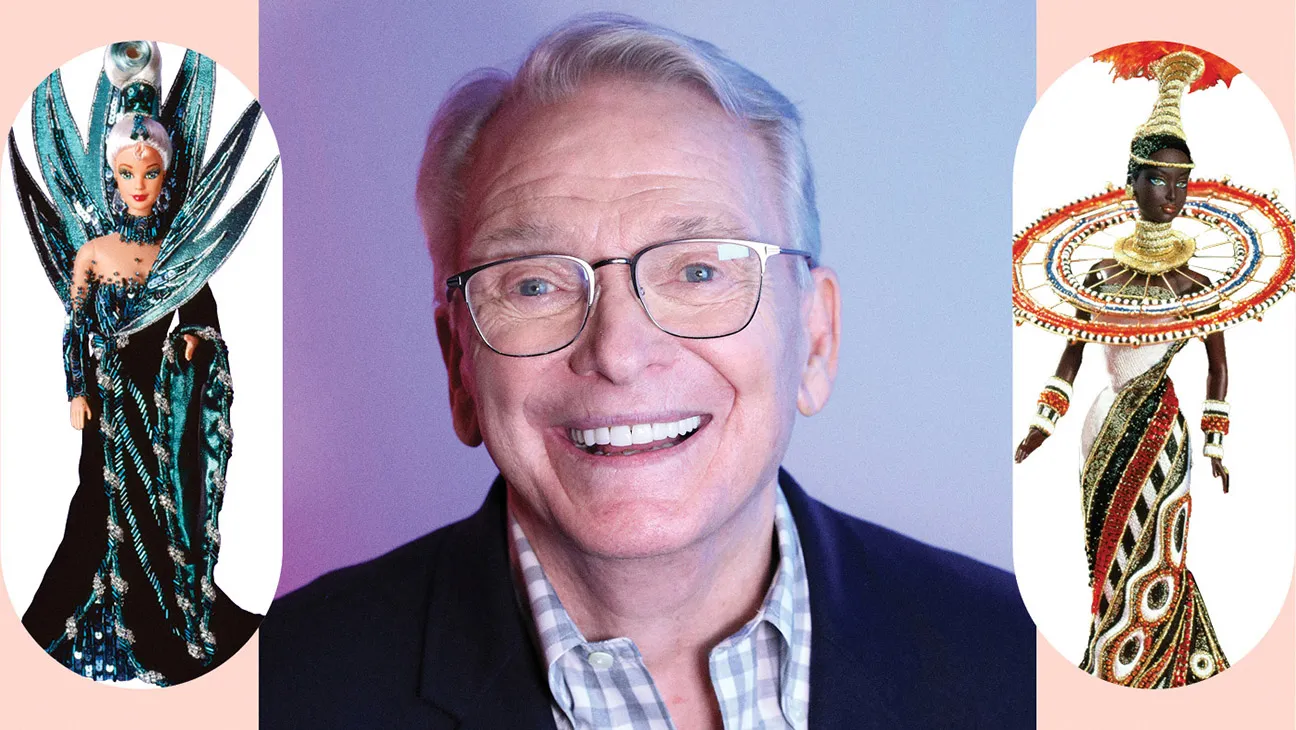
Over the years, T2C had the pleasure of covering Bob Mackie on several occasions, giving us our own glimpses—and photographs—of the man behind all that extraordinary glamour.

Bob Mackie, Marilyn Maye
There are costume designers who dress performers, and then there was Bob Mackie, who understood that sometimes a costume could become as famous as the person wearing it. Mackie, the legendary designer whose feathers, beads, rhinestones, sequins and wicked sense of theatricality helped define American glamour for more than half a century, died September 14 in Palm Springs, California. He was 87. His death from pneumonia was confirmed by his longtime design director, Joe McFate.

Bob Mackie and Marilyn Maye Photo By Genevieve Rafter Keddy
Cher may have been his most enduring canvas, but Mackie’s extraordinary list of women included Carol Burnett, Dolly Parton, Diana Ross, Tina Turner, Barbra Streisand, Bernadette Peters, Liza Minnelli, Mitzi Gaynor, Bette Midler and Ann-Margret. He understood something essential about stars: you weren’t simply dressing a body. You were helping create the image the audience would remember. For Dolly, that included the glorious butterfly gown she wore for the 1979 television special Dolly & Carol in Nashville, another perfect marriage of Mackie’s extravagance and a performer whose personality could actually carry it.

Bob Mackie and Cher
And remember we did.
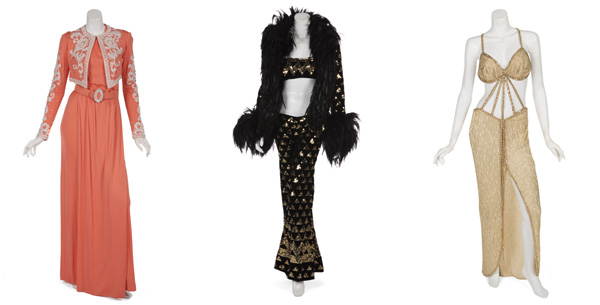 Mackie created Cher’s daring, feathered sheer ensemble for the 1974 Met Gala and the enormous feathered headdress and midriff-baring black ensemble she wore to the 1986 Academy Awards—looks that helped change what a woman could wear on a red carpet. Decades before today’s stars routinely arrived at premieres dressed to become the next morning’s photograph, Mackie and Cher understood fashion as an event.

The Costumes by Bob Mackie
But Mackie could be every bit as brilliant when the point was laughter rather than seduction. His work throughout the 11-year run of The Carol Burnett Show demonstrated an entirely different side of his genius. His most famous comic creation remains the green velvet curtain dress Burnett wore as Starlett O’Hara in the legendary Gone With the Wind parody “Went with the Wind!”—complete with the curtain rod still running through the shoulders. The joke worked because Mackie didn’t design something merely ridiculous. He made it ridiculous and fabulous.
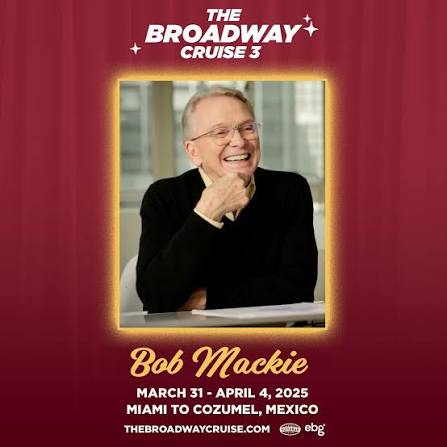 His relationship with Broadway stretched across nearly five decades. Mackie’s Broadway costume credits began with the 1971 revival of On the Town, followed by Lorelei in 1974, where he designed Carol Channing’s costumes, Debbie in 1976, Platinum in 1978, The Best Little Whorehouse Goes Public in 1994 and Moon Over Buffalo in 1995. He designed Carol Burnett’s costumes for the 1999 Broadway production of Stephen Sondheim’s Putting It Together and Liza Minnelli for Minnelli on Minnelli that same season. In 2009, he designed Bernadette Peters’ gowns for her special Broadway concert benefiting Broadway Barks and Broadway Cares.
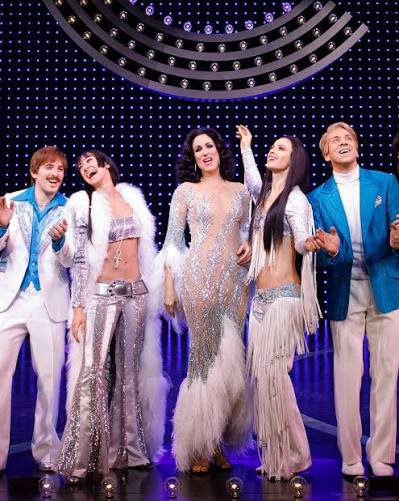
The Cher Show photo by Joan Marcus
Then came The Cher Show. Opening at the Neil Simon Theatre on December 3, 2018, the musical told Cher’s life through three actresses portraying the star at different stages of her career. There was really only one person who could design the costumes. Mackie had not simply dressed Cher during that history. He was part of the history.

Bob Mackie:,Diana Ross. Original Design for a Mattel Doll. Fashion. Motown Superstar. Diva. 1990s, ca.1990s
In one of Broadway’s more delicious pieces of theatrical symmetry, Bob Mackie became a character in The Cher Show while simultaneously designing the clothes surrounding that character. Michael Berresse portrayed him onstage, while the real Mackie recreated some of the extraordinary looks that had helped construct Cher’s public image over the preceding half-century. The production contained hundreds of costumes, including painstaking recreations of some of Cher’s most recognizable Mackie creations.

Bob Mackie during the 2019 Drama Desk Awards at Steinway Hall on June 2, 2019 in New York City.
In 2019, Broadway finally gave him the prize that had somehow eluded him. Bob Mackie won the Tony Award for Best Costume Design of a Musical for The Cher Show. He also won the Drama Desk and Outer Critics Circle Awards for the production. Remarkably, despite a Broadway career dating to 1971, The Cher Show brought him his first Tony nomination—and his first win.

Bob Mackie during The 69th Annual Outer Critics Circle Awards Dinner at Sardi’s on May 23, 2019 in New York City.
There is something particularly satisfying about that award. Mackie had spent his career creating clothes for people who walked onto stages to receive trophies. This time, he was the one walking up to collect one.

Bob Mackie attends The 69th Annual Outer Critics Circle Awards Dinner at Sardi’s on May 23, 2019 in New York City.
Broadway was only one part of an enormous career. Mackie won nine Emmy Awards, received three Academy Award nominations and was inducted into the Television Academy Hall of Fame in 2002. His film work included Oscar-nominated designs for Lady Sings the Blues, Funny Lady and Staying Alive. In 2019, the Council of Fashion Designers of America honored him with its Geoffrey Beene Lifetime Achievement Award.
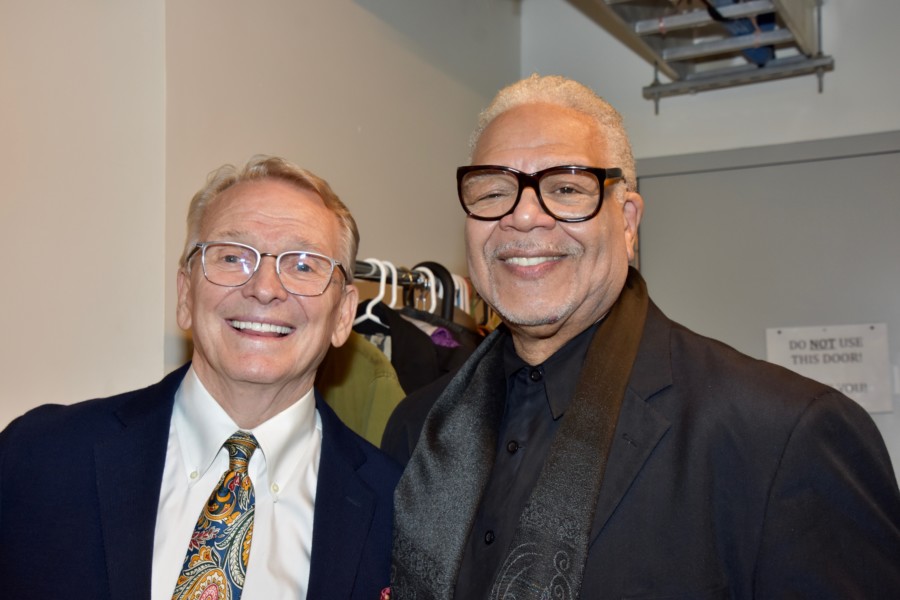
Bob Mackie and Ken Page
His influence never became trapped in the era that made him famous. Generations of younger performers and designers continued rediscovering Mackie’s work, and his designs have been worn or referenced by contemporary stars including Miley Cyrus, Taylor Swift and Zendaya. What once scandalized red carpets eventually became the vocabulary of the red carpet itself.
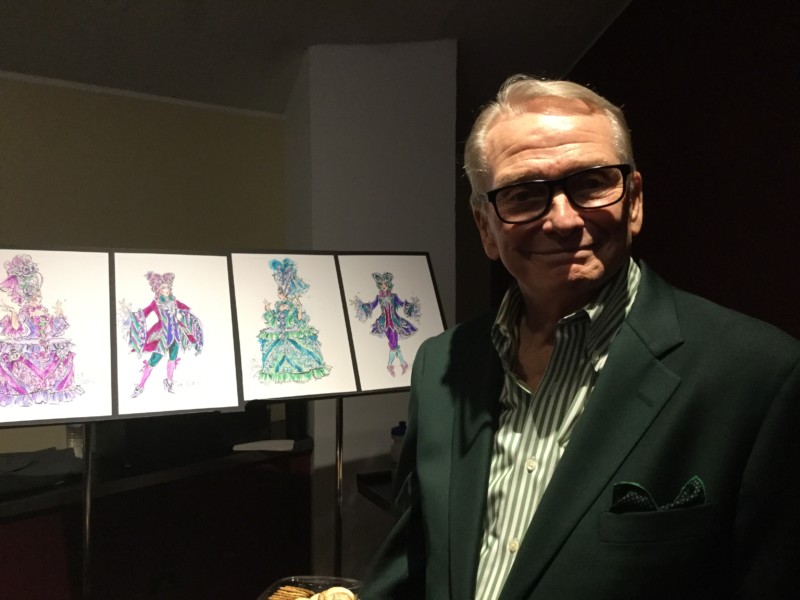
Bob Mackie
That may be Mackie’s greatest legacy. He understood that glamour did not have to apologize for itself.

Bob Mackie
He was not afraid of too many feathers, too many beads, too much sparkle or a woman walking into a room fully aware that every eye was about to turn toward her. Yet beneath all that extravagance was extraordinary technical discipline. Those costumes had to move. They had to survive dancing, quick changes, television schedules and eight-performance Broadway weeks. Fantasy only looks effortless when someone has done an enormous amount of work.
Mackie’s life also contained profound personal loss. His only son, Robin, died in 1993 from an AIDS-related illness, and his longtime partner and fellow costume designer Ray Aghayan died in 2011. Mackie is survived by his former wife, Lulu Porter, his granddaughter Alyssa Townsend and great-granddaughters Kyla and Keira Townsend.
Bob Mackie spent his life making entrances possible.
Cher walking onto a stage seemingly wearing little more than strategically placed beads and absolute confidence. Carol Burnett descending a staircase with a curtain rod across her shoulders. Diana Ross shimmering beneath stage lights. Bernadette Peters wrapped in a gown that seemed designed specifically for the color of her hair. Broadway exploding into a parade of Cher’s life in The Cher Show.
Those images remain because Mackie understood that costume design isn’t decoration. At its best, it tells us who someone is before that person has said a word.
Bob Mackie made clothes that spoke. Most of them said essentially the same thing: Look at her. And we did.

Tim Curry, the deliciously subversive British actor whose Dr. Frank-N-Furter changed popular culture forever, died Tuesday night at his home in Los Angeles. He was 80. For millions, Curry will always be the corseted, fishnet-clad mad scientist of The Rocky Horror Picture Show, or the terrifying Pennywise of Stephen King’s It, the magnificently suspicious Wadsworth of Clue, Rooster Hannigan in Annie, or the demonic Darkness in Legend. But before Hollywood discovered that extraordinary face, voice and capacity for making danger irresistible, Curry belonged to the theatre. And throughout his career, he kept coming back to it.
 Born April 19, 1946, in Warrington, England, Curry studied drama and English at the University of Birmingham before beginning his professional career in the original London production of Hair in 1968, appearing as Woof and as a member of the Tribe. From there came an astonishingly eclectic collection of classical, experimental and musical theatre: Titus Andronicus, Man Is Man, The Maids, Life of Galileo, Loot, Danton’s Death and A Midsummer Night’s Dream, in which he played Puck.
 Then, in 1973, came the role that changed everything.
Curry originated Dr. Frank-N-Furter in Richard O’Brien’s The Rocky Horror Show at London’s tiny Royal Court Theatre Upstairs. The production moved through London, then to the Roxy in Los Angeles, and finally to Broadway’s Belasco Theatre in 1975. Broadway wasn’t ready for it: the show closed after only 45 performances. History, however, had considerably different plans. Curry’s Frank-N-Furter—seductive, outrageous, dangerous, funny and utterly unconcerned with anyone else’s definition of normal—became one of the defining theatrical creations of the era. Curry received a Drama Desk nomination for the Broadway performance, and the 1975 film adaptation transformed what Broadway had rejected into a cultural phenomenon.
 It would have been easy for an actor to spend the rest of his career trapped inside those fishnets. Curry did precisely the opposite.
Later in 1975, he returned to Broadway as the Dadaist poet Tristan Tzara in Tom Stoppard’s Travesties, transferring with the Royal Shakespeare Company production from London to the Ethel Barrymore Theatre. It was an early demonstration of something audiences would discover repeatedly: Curry could be flamboyant without being frivolous and intellectually formidable without losing the wicked glint that made watching him such fun.
In 1980, Curry took on Wolfgang Amadeus Mozart opposite Ian McKellen’s Salieri in Peter Shaffer’s Amadeus on Broadway. His Mozart earned Curry his first Tony Award nomination for Best Actor in a Play as well as a Drama Desk nomination. The role demanded exactly the contradiction Curry did so well: vulgarity and genius occupying the same body, childishness sitting beside something almost touched by God.
London theatre continued to claim him. He played the Pirate King in The Pirates of Penzance at Theatre Royal Drury Lane, earning an Olivier nomination, and later worked extensively at the National Theatre in The Rivals, Love for Love, Dalliance and The Threepenny Opera, playing Macheath—Mack the Knife—in the latter. He was an actor who could move from Gilbert and Sullivan to Brecht without surrendering the unmistakable quality that made him Tim Curry.
He returned to New York theatre as William Hogarth in The Art of Success at Manhattan Theatre Club and then, in 1992, returned to Broadway in the musical My Favorite Year. As the drunken, fading movie star Alan Swann, Curry found both the comedy and sadness beneath the character’s theatrical excess and earned his second Tony nomination, this time for Best Actor in a Musical.
In 2001, he played Ebenezer Scrooge in A Christmas Carol at the Theater at Madison Square Garden. Then came the Broadway role that introduced an entirely new generation to Tim Curry onstage.
Eric Idle asked Curry to play King Arthur in Monty Python’s Spamalot. Curry led the original Broadway company alongside David Hyde Pierce, Hank Azaria and Sara Ramirez when the musical opened in 2005. His wonderfully exasperated, magnificently straight-faced Arthur earned him a third Tony nomination for Best Actor in a Musical. He subsequently took the role to London’s West End, earning another Olivier nomination.
Three Tony nominations across three very different performances—Mozart in Amadeus, Alan Swann in My Favorite Yearand King Arthur in Spamalot—tell their own story about his range.
His later stage appearances included The Player in Rosencrantz and Guildenstern Are Dead at Chichester and Reverend Whoopsie in Eric Idle’s What About Dick? in Los Angeles in 2012. That July, Curry suffered a major stroke that left him using a wheelchair and significantly altered the course of his performing life. He nevertheless continued working, particularly as a voice actor, and remained connected to Rocky Horror, including appearing as the Criminologist in Fox’s 2016 television version.
The screen career, of course, was extraordinary in its own right. The Rocky Horror Picture Show, Annie, Clue, Legend, Home Alone 2, Muppet Treasure Island and his unforgettable Pennywise in It made Curry recognizable to generations who may never have seen him walk onto a Broadway stage. His voice alone became an instrument, leading to decades of animation and voice work and a Daytime Emmy Award.
There was something inherently theatrical about Tim Curry even when no theatre was involved. He understood entrance. He understood timing. He understood that outrageousness works best when the performer underneath it possesses absolute control. And he possessed that rare quality that cannot be taught in acting school: when Tim Curry entered a scene, your eyes went to him.
He could be sinister and hilarious in the same breath. He could make villainy seductive, absurdity sophisticated and camp genuinely dangerous. Most importantly, he never seemed to apologize for taking up the space a performance required.
Yesterday we lost Dolly Parton. Today we have lost Tim Curry. They say these things come in threes. For once, I would be delighted for the old saying to be wrong.

There are stars, there are icons, and then there are those extraordinarily rare people who somehow become part of the American vocabulary. Dolly Parton was one of them.
Dolly Parton, the singer, songwriter, actress, entrepreneur, philanthropist and gloriously self-created woman who traveled from a one-room home in the Smoky Mountains to become one of the most recognizable people in the world, died peacefully Tuesday in Nashville. She was 80.

Dolly Parton-Rockstar
It seems almost impossible to write about Dolly in the past tense because she spent seven decades making herself so vividly present. The hair. The rhinestones. The impossible fingernails. The laugh. The jokes she made about herself before anyone else could make them. But underneath the deliberately exaggerated package was something far more formidable: one of the great American songwriters and one of the shrewdest women ever to navigate show business.
 Born Dolly Rebecca Parton on January 19, 1946, in Sevier County, Tennessee, she was one of 12 children raised in poverty in the Smoky Mountains. She began writing songs as a child and headed to Nashville immediately after graduating from high school. By 1967 she had joined The Porter Wagoner Show, beginning the partnership that brought her national attention but eventually became too small to contain her ambition.
When she left Wagoner in 1974, she didn’t simply say goodbye. She wrote “I Will Always Love You.” Years later, when Elvis Presley wanted to record the song but his manager demanded a share of its publishing rights, Parton refused. It was an extraordinary business decision. Whitney Houston’s 1992 recording would eventually turn the song into a worldwide phenomenon. Dolly kept her publishing. That combination—heart and steel—was Dolly.
She could write “Jolene,” one of the most instantly recognizable songs in popular music, and “Coat of Many Colors,” turning childhood poverty into something tender rather than sentimental. She crossed from country into pop with “Here You Come Again,” then walked into Hollywood opposite Jane Fonda and Lily Tomlin in 9 to 5 and proved almost immediately that she was a natural screen presence. The Best Little Whorehouse in Texas and Steel Magnolias followed.
Then there was Dollywood. What might have looked like celebrity branding became something much larger: an economic engine in the region that created her. Her business interests eventually stretched across entertainment, hospitality and consumer products, but Dolly never seemed embarrassed by money or hypnotized by it. She understood what money could do.
 That became clearest through the Dolly Parton Imagination Library, founded in 1995 to provide books to young children. Her philanthropy extended far beyond literacy, including support following the devastating Tennessee wildfires and a $1 million contribution to COVID-19 research at Vanderbilt University that helped fund work connected to the Moderna vaccine. Her family has asked that, in lieu of flowers following her death, donations be made to the Imagination Library.
Her honors became almost absurd in their abundance: Grammys, CMA Awards, a Kennedy Center Honor, induction into the Country Music Hall of Fame and, after initially protesting that she did not consider herself sufficiently rock-and-roll, induction into the Rock and Roll Hall of Fame. She responded to that last honor in quintessential Dolly fashion: she made a rock album.
Her private life remained remarkably private. She married Carl Dean in 1966, and while Dolly became one of the most photographed women on Earth, Dean largely declined the circus. Their marriage lasted 59 years, until his death in 2025.
Dolly’s final act may now belong to Broadway. This winter, DOLLY: A True Original Musical, the autobiographical musical she helped create, is scheduled to arrive at the St. James Theatre. Previews begin December 7, with an opening night set for January 19, 2027—Dolly Parton’s 81st birthday.
The musical features Parton’s existing songs alongside new music she wrote specifically for the stage, with a book by Parton and Maria S. Schlatter. Tony winner Bartlett Sher directs, with choreography by Mandy Moore. The score draws upon the songs through which Dolly had already been writing her autobiography for decades, including “Jolene,” “Coat of Many Colors,” “9 to 5” and “I Will Always Love You.”
The date now carries a poignancy nobody intended when it was announced. What was supposed to be an 81st birthday celebration will instead become something else: Broadway opening its doors to Dolly Parton without Dolly Parton there to walk through them.
Yet there is something strangely appropriate about her having written herself into the next chapter before leaving us.
Dolly understood image better than almost anyone. She famously constructed herself from exaggeration and then spent a lifetime allowing people to underestimate the intelligence underneath it. She could be outrageous without becoming vulgar, sentimental without becoming foolish, enormously wealthy without pretending she had forgotten poverty, and deeply rooted in where she came from without allowing it to determine how far she could go.
Most importantly, she understood storytelling. She took a frightened woman begging another woman not to steal her man and made “Jolene.” She took a coat sewn from scraps and made childhood poverty beautiful. She took leaving a professional relationship and wrote one of the most enduring farewell songs ever composed. Now that song inevitably belongs to her.
Dolly Parton spent her life telling us exactly who she was, often while making us laugh so hard that we failed to notice how much truth she had slipped into the joke.
The rhinestones were real. So was the woman underneath them. Come January 19th, the lights at the St. James Theatre will rise on Dolly Parton’s story. She simply won’t be sitting there to watch it.
-

 Business4 days ago
Meta Brings AI Agents to Small Businesses — and the AI Assistant Is Becoming an Operator
-

 Celebrity5 days ago
The Glorious Corner
-

 Entertainment5 days ago
Prince Mario Max Schaumburg Lippe: Counting Days Until The Rockettes Christmas Spectacular Is Back At Radio City Music Hall NYC
-

 Cabaret5 days ago
Jeff Harnar Brings Sondheim Back to Birdland in a Loving Tribute to Sondra Lee
-

 Broadway5 days ago
Broadway and Theatre News: Damn Yankees Returns, Stars Head Back to the Stage and the Flea Defies the Storm
-

 Book Reviews4 days ago
Live From The Hotel Edison Times Square Chronicles Presents Tony-Nominated Lyricist and Book writer Bill Russell Still, Bill
-

 Business5 days ago
McDonald’s Is Using AI to Decide What Your Big Mac Should Cost
-

 Broadway2 days ago
School Girls; Or, The African Mean Girls Play: Being Made to Feel Ashamed of Your Skin Color