

Jonathan Raviv and Troy IwataIt seems romanticizing a man boy love association, is the new topic for musical theatre. Take John Kander’s Kid Victory, and now Tim Rosser (music) and Charlie Sohne’s (book and lyrics) The Boy Who Danced on Air. Both have an incredible score, plausible books, sensational casts and yet one has to wonder who their audiences’s are. The Abingdon Theater Company, has taken some strange steps this year and though I can see why they would want to nurture Rosser and Sohne, not sure why this project. Inspired by the 2010 documentary “The Dancing Boys of Afghanistan,” about the practice of bacha bazi “boy play” is a little on the warped side. This ancient tradition of wealthy men buying boys as young as 10 from poor families, dressing them like women, training them to dance, to lure other men, acting like pimps to provide a sexual outlet, so they do not cheat on their wives, is beyond twisted. The practice is outlawed, yet it continues with a wink and a nod.

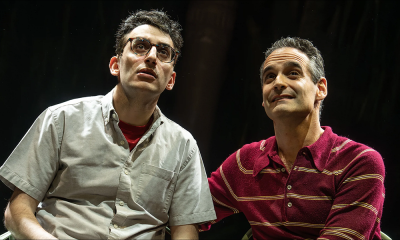
Troy Iwata
In The Boy Who Danced on Air we follow the story of Paiman (Troy Iwata), who is now 16. We first meet him at 10 when he is sold to the older handsome Jahandar (Jonathan Raviv), who is married. Jahandar tells Paiman that his father didn’t want him as much as he does, as if this is a plausible excuse. Jahandar forms an attachment to Paiman, but the rule of thumb is that as Paiman passes puberty and starts to turn into a man, the tryst must be cut off. In kindness Jahandar arranges for his marriage, but Paiman wants to keep dancing. Things get future complicated when he falls for another dancing boy Feda (Nikhil Saboo), who inspires Paiman and makes him feel safe. Feda’s master Zemar (Ohs Ghanimah), Jahandar’s friends covets Paiman. When Jahandar finds out about the boys love for another boy he becomes increasing jealous. The story is narrated by an unknown man (Deven Kolluri).

Osh Ghanimah and Nikhil Saboo
The incredible cast is all wonderful in the roles they have been given. Part of what is bothersome here is Iwata and Saboo (Feda) both seems like they are in there 20’s, which takes away from how really young they are. Good in one way as the older age gap between victim and master is less blatant. Bad because the ages now do not show how truly insidious this is. The entire cast has phenomenal vocals and strong acting abilities. We believe the master, slave relationship and the dependency that turns into a bond. The relationship between the two boys is real and we feel their love and understand completely why this would happen. Saboo nearly steals the show with his song “For A Night.” Raviv also stands out in “I Can See It” and “For A Night.”We feel Iwata’s journey and Ghanimah brings humor and a true sense of depravity to the stage. Even Kolluri brings us on the adventure with his smooth vocals.

Tony Speciale, directs The Boy Who Danced on Air with sensitivity and some very clever tricks to showcase the age gap. The use of silhouettes is highly effective. The lighting design by Wen-Ling Liao allows much to take place, as does the scenic design by Christopher Swader and Justin Swader.
Mr. Rosser and Mr. Sohne, are young and extremely talented. The music is infectious and theatrical with threads of Pop and Arabic ties blending nicely. The lyrics are grown-up, making their points with statements like “Year by year the boy learns his place.” Until the end the show flows smoothly. There are some things that need to be clarified in the ending but strangely enough the message here is to believe in yourself and follow your dreams, despite your circumstances.
As wonderful as this show is and it has some amazing moments, musicals are now justifying things is society that may not have a right to be seen in such a bright light. Conversations about taboo subjects need to be opened up, maybe this is the venue that will allow this to happen.
The Boy Who Danced on Air: The Abingdon Theatre, 312 West 36th St. until June 11th.



Richard Nelson has been inviting audiences to sit around the Apple family dinner table since 2010, allowing politics, personal disappointments, and the changing American landscape to unfold through the conversations of a fictional family in Rhinebeck, New York. His latest, We’ll See, opened on November 3, election night, as the country waited to discover what the midterms would bring. The irony was impossible to ignore. Outside the theater, America was deciding its political future. Inside, a group of accomplished actors was discussing the country’s decline with all the urgency of deciding whether to have another cup of coffee.
I kept waiting for something to happen. It didn’t.
Nelson’s plays have always relied on the seemingly mundane, finding political significance in domestic conversations rather than theatrical fireworks. There is intelligence in that approach, particularly when the personal and political collide. But naturalism is not an excuse for inertia, and We’ll See mistakes conversation for drama. These people talk, reminisce, complain, and worry, yet almost nothing they say or do changes the temperature of the room.
The Apples have returned for the first time since the 2020 virtual production of What Do We Need to Talk About? The actors have inhabited these characters for more than fifteen years, aging alongside them, and that continuity gives the evening an authenticity few theatrical ensembles can claim. Unfortunately, familiarity does not automatically translate into compelling theater.
For this election-night gathering, the family has put its phones on airplane mode and forbidden anyone from mentioning the president’s name, as if to do so might summon him to the dinner table. It’s a conceit that could have been deliciously funny, especially given the political anxiety surrounding the evening. Instead, it becomes a convenient way to avoid the very conflict that might have made the play interesting.

Jay O. Sanders, Laila Robbins, Maryann Plunkett, Sally Murphy Photo by Joan Marcus
Sisters Barbara (Maryann Plunkett) and Marian (Laila Robins) are now living together because Rhinebeck has become prohibitively expensive.

Jay O. Sanders, Maryann Plunkett Photo by Joan Marcus
Their brother Richard (Jay O. Sanders), meanwhile, can still afford to fly business class to Europe. There is an entire play waiting to be written about the economic differences within this one family, but Nelson barely acknowledges the contradiction before moving on to another subject.

Laila Robbins Photo by Joan Marcus
Barbara worries about ICE and the threats facing the English-language learners she volunteers and teaches. She also carries the consequences of an angry outburst at one of her high school students, an incident that resulted in her unplanned retirement. Here, finally, Nelson gives us something worth exploring. A teacher whose professional life was undone by a moment of lost control, a woman trying to reconcile her convictions with her actions, and a political climate that has made even the classroom a battleground. Plunkett is superb, giving Barbara an emotional complexity that the writing rarely allows the other characters.

Sally Murphy Photo by Joan Marcus
Then Jane (Sally Murphy), the youngest Apple sibling, announces that she didn’t vote and is no longer a registered Democrat because she believes the party has abandoned her. Now we’re getting somewhere. Or so I thought.
In a family so consumed by the state of the nation, surely this revelation should provoke something more than another round of civilized discussion. Where is the outrage? The disagreement? The sense that these people might actually have something at stake? Jane’s disillusionment could have exposed the fractures within a family that ostensibly shares political values. Instead, Nelson lets the moment drift away. In today’s political climate, when friendships and families are being torn apart by ideology, the absence of genuine confrontation feels less like restraint than avoidance.
Jane longs for the days when Rhinebeck’s town supervisor was simply the town supervisor, rather than a Democrat or a Republican. It’s a revealing observation about how completely politics has infiltrated American life. But an observation is not a dramatic event, and We’ll See is overflowing with observations.

Jay O. Sanders, Yvonne Woods, Sally Murphy, and Laila Robins Photo by Joan Marcus
Richard’s girlfriend Yvonne (Yvonne Woods), an actress battling cancer, joins the gathering. Woods is a terrific actress, but from the time she appears I wondered what her character was doing there. Cancer, mortality, the fragility of life, and the fear of losing someone should bring a powerful emotional counterweight to the family’s political complaints. Instead, Yvonne seems almost incidental. When an actress of Woods’s caliber is given so little to explore, something is wrong with the writing.
The company is, without question, the evening’s saving grace. Plunkett, Robins, Sanders, Murphy, and Woods are extraordinarily accomplished performers. They listen, react, and inhabit their characters with such ease that nothing feels manufactured. Their relationships are believable, their silences natural, and their shared history palpable. This is acting at its finest, which makes the lack of dramatic substance all the more frustrating.
Jason Ardizzone-West’s scenic design provides the familiar dining-table setting, while Nelson’s direction keeps everything deliberately understated. There is no theatrical excess, no manipulation, and certainly no attempt to manufacture excitement. Unfortunately, there is also very little excitement to be found.

Maryann Plunkett iPhoto by Joan Marcus
At one point Barbara declares, “Every time I hear his slimy voice I want to throw up.” I practically wanted to applaud. Finally, a flash of genuine disgust, an emotion strong enough to cut through the evening’s polite melancholy. But just as quickly, the play returns to its comfortable rhythm.
This is what I found most frustrating. Nelson has placed his characters in the middle of a political moment defined by anger, division, fear, and uncertainty, yet he seems unwilling to let any of those emotions truly disrupt the family gathering. Everyone is concerned about the country. Everyone is disappointed. Everyone has an opinion. But nobody seems particularly interested in challenging anyone else.
If the point is that Americans have become exhausted by politics, I understand it. If the point is that the country has changed and people no longer recognize the world they once inhabited, I understand that too. Neither revelation requires an entire evening of watching people discuss their disappointments over dinner.
Meanwhile, the real election has already unfolding outside the theater. I couldn’t help thinking that the more compelling drama was happening on everyone’s silenced phone.
Nelson has assembled a remarkable company, and there is something admirable about his commitment to documenting American life through the same family over sixteen years. But longevity is not a substitute for relevance, and subtlety should never be confused with the absence of dramatic purpose.
We’ll See is beautifully acted, carefully observed, and relentlessly uneventful. I admired the performers. I appreciated their craft. I understood the political concerns. I was also bored.
The title is We’ll See. By the end of the evening, I couldn’t help wondering what, exactly, we had seen.
We’ll See. The Public Theatre, 425 Layfette Street, through November 22.

Jill Morley’s wickedly funny, painfully honest theatrical memoir returns to The Triad Theatre, challenging everything women have been taught about sexuality, respectability, and empowerment.

Jacqueline Frances Photo by Jill Morley
There is a wonderful film called Dangerous Beauty, based on the life of Veronica Franco, a 16th-century Venetian courtesan who understood that intelligence, wit, sexuality, and independence could give a woman power in a world determined to deny it to her. While respectable women were expected to marry, obey, and produce heirs, Franco found another way to navigate a society in which women’s choices were severely restricted. Her freedom came at a price, but at least she understood the bargain.

Jacqueline Frances Photo by Jill Morley
Centuries later, Jill Morley’s True Confessions of a Go-Go Girl, now enjoying a return engagement at The Triad Theatre, raises many of the same questions. What happens when a woman discovers that her body can be a source of income rather than shame? Who decides what makes a woman respectable? And why is a woman who profits from male desire so often condemned by a society that has spent centuries teaching women to organize their lives around attracting men?

Andrew Adubsa, Jacqueline Frances and Sydney Langford Photo by Jill Morley
Morley’s autobiographical work takes us into the decidedly unglamorous world of New Jersey’s go-go clubs during the 1990s, where the lights were unforgiving, the clientele unpredictable, and the money could be surprisingly good. Based on her own transformation from tomboy to top-ranked bikini dancer, the production is a vivid, frequently hilarious, and unexpectedly moving examination of sexuality, self-discovery, and the complicated economics of being female.

Jacqueline Frances, Andrew Adubsa, and Sydney Langford Photo by Jill Morley
Taking over the role Morley originally created and performed, Jacqueline Frances proves a compelling storyteller, navigating the material’s shifting emotional landscape with humor, vulnerability, and considerable theatrical intelligence. She understands that this is not simply a story about taking one’s clothes off. It is about discovering an identity beneath the expectations other people have placed upon you.

Jacqueline Frances and Sydney Langford Photo by Jill Morley
The transformation is particularly fascinating because Morley’s journey into the go-go world was not initially one of sexual confidence. Her discovery of femininity came through unlikely teachers, including a gay roommate who helped her recognize aspects of herself she had never fully explored and a bouncer who taught her how to move onstage. In a world where women are routinely told how to look, behave, and present themselves, there is something deliciously ironic about a woman learning to inhabit her own sexuality in a seedy club off the Jersey Turnpike.

Jacqueline Frances and Sydney Langford Photo by Jill Morley
Frances moves through a gallery of colorful characters drawn from Morley’s experiences, giving the evening the texture of a theatrical memoir rather than a conventional solo confession. Andrew Adubsa, wonderfully limber and unabashedly sexy, and Sydney Langford contribute movement, energy, and physical allure, helping transform recollection into a living, breathing world. Their presence reinforces the production’s central idea that dance is not merely decoration. It is a language through which confidence, vulnerability, fantasy, and power can be expressed.

Andrew Adubsa and Sydney Langford Photo by Jill Morley
Director Dan Wackerman, an OBIE Award winner, gives the material both structure and heart, allowing its humor to flourish without sacrificing the darker realities beneath it. Jo Weldon’s choreography is entirely at home in this environment, capturing the sensual vocabulary of go-go performance without turning the evening into a gratuitous display. The movement belongs to the storytelling.

Jacqueline Frances and Sydney Langford Photo by Jill Morley
And what stories there are.

Jacqueline Frances Photo by Jill Morley
The women who populate Morley’s world are neither helpless victims nor uncomplicated symbols of liberation. They are individuals negotiating money, ambition, sexuality, survival, and the often uncomfortable realities of working in an industry built around male desire. The financial rewards are real, as are the dangers. So is the exhilaration of discovering that something society has taught you to conceal can become a source of confidence and economic independence.
This is where True Confessions of a Go-Go Girl becomes considerably more interesting than its provocative title suggests.
For generations, women were taught that sex belonged within marriage, that desire was something to suppress until the appropriate man arrived, and that their greatest security would come from being chosen as someone’s wife. Yet those same women were expected to be attractive, desirable, accommodating, and endlessly available to the men they married. Society established the rules, then judged women according to how obediently they followed them.
The contradiction is extraordinary.
Morley’s story turns that arrangement inside out. Here is a woman who discovers that male attention has an economic value, that sexuality need not be synonymous with shame, and that she can make choices about her own body without first obtaining society’s permission.
Of course, earning money from male desire is not automatically the same thing as possessing power. The clubs have their own hierarchies, dangers, and forms of exploitation. Financial independence can coexist with vulnerability, and a woman can exercise agency while still operating within a system designed largely for male gratification. Morley’s honesty about those contradictions is precisely what gives the piece its substance.
What makes the evening empowering is not the suggestion that every woman should become a go-go dancer. It is the insistence that a woman’s choices, her intelligence, her pleasure, and her sense of self belong to her.
That brings us back to Veronica Franco and Dangerous Beauty. The courtesan and the go-go dancer inhabit vastly different centuries and social worlds, but both challenge the notion that female virtue must be measured by obedience. Both expose the uncomfortable relationship between sexuality and economics. Both force us to confront the difference between a woman being desired and a woman having the freedom to decide what she wants.
There is also something liberating about the show’s refusal to treat sexual experience as a permanent moral verdict. Women are permitted to change, to experiment, to make mistakes, to enjoy themselves, to earn money, and to reconsider their decisions. Their identities need not be reduced to the most provocative chapter of their lives.
The Triad Theatre, at 158 West 72nd Street, provides an appropriately intimate setting for this theatrical confession. The cabaret room, considerably cleaned up from its less distinguished days, has become a respectable venue for an evening devoted to questioning precisely what respectability means.
True Confessions of a Go-Go Girl is evocative, fully realized, wickedly funny, and painfully honest. Beneath its sequins, sensuality, and Jersey Turnpike grit lies a surprisingly sophisticated examination of the ways women learn to see themselves—and the freedom that comes when they stop allowing everyone else to do the defining.
The most provocative thing about this production is not the dancing, the sexuality, or even the confessions.
It is the realization that women have spent generations being told what they should want, whom they should love, and how much of themselves they must surrender to be considered worthy.
Jill Morley’s story offers a different proposition: A woman does not have to surrender herself to be desired, and she does not have to be chosen by a man to choose the life she wants.
True Confessions of a Go-Go Girl continues its limited 14-performance engagement at The Triad Theatre, 158 West 72nd Street, through December 11, 2026.

There are musicals that entertain, musicals that move us, and occasionally a musical that takes a subject you would never imagine belonging onstage and makes you wonder why nobody thought of it sooner. Roundabout Theatre Company’s extraordinary new musical The Heart, which opened last night at the Laura Pels Theatre, accomplishes precisely that. Its subject is organ transplantation, a process in which one person’s death becomes another person’s chance at life. It sounds like the premise for a medical documentary or an exceptionally sophisticated public service announcement. Instead, it is a thrilling, emotionally charged, 90-minute musical propelled by one of the most exhilarating electronic scores I’ve heard in quite some time.
I first heard about The Heart when it played La Jolla, California, where I was emphatically told that this was a show I needed to see. Had someone suggested that a musical about organ donation would have me riveted, I would have questioned their judgment. Never say never. With a book and additional lyrics by Kait Kerrigan and music and arrangements by the married creative team of Anne Eisendrath and Ian Eisendrath, The Heart transforms the complex medical, logistical and emotional journey of an organ transplant into a work of remarkable theatrical imagination.
The story unfolds over 24 hours, beginning with a 19-year-old California surfer, played with youthful warmth by Nick T. Daly, whose carefree existence is shattered by a car accident. The sounds of Pacific waves give way to the urgent rhythms of an emergency room, where medical monitors deliver the devastating news that the young man is brain-dead. Because he never registered as an organ donor, the decision to donate his organs falls to his divorced parents, portrayed with extraordinary emotional restraint by Jason Tam and Joaquina Kalukango.
Their grief is neither tidy nor predictable. Tam and Kalukango approach the impossible decision from different emotional directions, allowing us to witness the confusion, resistance and unbearable weight of a choice that must be made while their son’s body is still warm. The musical understands that organ donation, however miraculous its outcome, begins with someone’s unimaginable loss.
From there, Kerrigan’s book moves through an intricate network of lives: nurses, physicians, transplant coordinators, donor-network personnel, technicians, grieving relatives and the strangers whose futures depend upon decisions being made hundreds of miles away. Every minute matters, and the production finds a theatrical equivalent for the extraordinary coordination required to move a human heart from one body into another.

Drew Gehling, Wren-Rivera Photo Joan Marcus
What makes the show so compelling is the seamless marriage of storytelling and music. Anne and Ian Eisendrath have created a dynamic, pulsating electronic score whose rhythmic urgency mirrors the ticking clock of the transplant process. The music is sophisticated, contemporary and astonishingly effective, shifting between driving dance rhythms and moments of almost unbearable tenderness. Rather than interrupting the action, the songs become part of its momentum, as essential to the narrative as the medical procedures themselves.

Joaquina Kalukango, Jason Tam Photo by Joan Marcus
Bre Jackson, portraying a compassionate nurse who sings to her unresponsive patient, delivers one of the evening’s most beautiful moments with “Right Now.” Her gorgeous voice brings humanity to a room dominated by technology, reminding us that behind every monitor and medical protocol is a person whose life matters. The number is deeply affecting without resorting to sentimentality.
 Heidi Blickenstaff is equally impressive in contrasting roles. Initially appearing as a stern emergency-room administrator, she later becomes a middle-aged writer who has resigned herself to dying, only to receive the astonishing news that a donor heart has become available. Blickenstaff captures the complicated collision of hope, disbelief and terror that accompanies the possibility of survival. Receiving a new heart is not simply a happy ending. It means confronting a future one had already surrendered, knowing that its arrival is inseparable from another family’s grief.
Drew Gehling, Lincoln Clauss, Max McKenna and Wren Rivera bring tremendous energy and distinction to an ensemble in which performers repeatedly transform into new characters. Every actor assumes multiple identities, sometimes moving from an anonymous member of the medical system to someone whose individual story suddenly becomes central. The transitions are so fluid that the nine-member company frequently appears to contain three times as many performers.
Much of that accomplishment belongs to director Christopher Ashley, whose work here is exceptional. Ashley understands that a production dealing with such complicated information cannot afford to lose its audience in exposition. He keeps the narrative clear and the action moving with precision, allowing the score, movement and design to convey what pages of dialogue would otherwise be required to explain.
Mandy Moore’s choreography is integral to that achievement. Her movement patterns, frequently mechanical and almost robotic, evoke the intricate coordination of the medical system while creating the illusion of a vast network of people working simultaneously. The choreography is not decorative. It is storytelling, transforming logistical procedures into kinetic theatrical sequences.
Robert Brill’s adaptable scenic design provides a neutral environment capable of suggesting hospitals, distant locations and the spaces between them. Lucy Mackinnon’s complex video design gives visual dimension to the movement of information, bodies and time, while Amanda Zieve’s dramatic lighting establishes the shifting emotional temperature of each scene. Gareth Owen’s excellent sound design delivers the necessary medical atmosphere while maintaining exceptionally crisp vocal clarity, no small achievement with a score of this intensity. Sarafina Bush’s costumes allow the company to move effortlessly among its many identities.
The result is a production that feels almost cinematic in its scope while remaining unmistakably theatrical.
Ashley also knows when to let the relentless momentum ease. A brief, wonderfully unexpected glimpse of technicians amusing themselves with a medieval-themed video game provides a welcome moment of humor amid the intensity. Such details remind us that the people performing these extraordinary tasks are still human beings, capable of exhaustion, distraction and absurdity.
Several musical numbers, including “I Will Never Let You Go” and “Nobody Gets Out Alive,” possess the emotional power to become conventional showstoppers. Wisely, Ashley resists the temptation to manufacture applause breaks. The music flows directly into the continuing action, preserving the urgency of a story in which time cannot stop simply because a song has ended.
The production builds toward an extraordinary climax as a heart is removed from one body and brought back to life in another. By this point, we have witnessed the countless people, decisions and emotions that make the procedure possible. What could have been a clinical demonstration becomes a profoundly theatrical expression of human interdependence.
There is no escaping the fact that The Heart advocates for organ donation. In less accomplished hands, the evening could easily have become an elaborate educational presentation with a few songs attached. But Kerrigan, the Eisendraths and Ashley understand that the most persuasive theater does not lecture. It allows an audience to experience the human consequences of a subject and arrive at its own emotional understanding.
The musical also refuses to separate the miracle from its cost. One family loses a son. Another person receives the possibility of a future. Medical science connects these events, but it cannot erase the grief that makes the second possible.
That contradiction gives The Heart its extraordinary emotional force.
At a time when new musicals often struggle to find a distinctive musical language, The Heart arrives with a sound, structure and theatrical identity entirely its own. Its electronic score is sensational, its ensemble superb and Christopher Ashley’s direction a master class in turning complicated material into gripping theater.
I went in wondering how anyone could make organ transplantation into a musical. Ninety minutes later, I was wondering how long it would take Broadway to recognize what Roundabout has on its hands.
The Heart is a remarkable, pulse-pounding achievement, as inventive as it is moving. I fully expect this production to have a Broadway future. See it now, while you can still experience it in the intimacy of the Laura Pels Theatre.
The Heart opened October 29, 2026, at the Laura Pels Theatre and runs through December 6. Tickets and information: roundabouttheatre.org.
Off Broadway
Who Let the Dogs Talk? Scott Adsit, Julia Murney and More Join David Javerbaum’s The Dog Show


A rotating pack of Broadway favorites is heading to The Triad Theater, where man’s best friend finally gets the last word.
Anyone who has ever looked into a dog’s eyes and wondered what was going on behind that innocent expression is about to get an answer. Whether it’s an answer we actually want is another matter entirely.
Thirteen-time Emmy winner and two-time Grammy winner David Javerbaum, the deliciously irreverent mind behind The Daily Show with Jon Stewart, the wildly popular @TheTweetOfGod and Broadway’s An Act of God, starring Jim Parsons, has turned his attention from divine intervention to canine contemplation. His latest comedy, The Dog Show: Come. Sit. Stay., gives our four-legged companions something they’ve been denied for centuries: the opportunity to tell us exactly what they think.
Now the production is adding some serious theatrical pedigree to its rotating pack. Scott Adsit (30 Rock, Veep), Todd Cerveris (South Pacific, Let Me Spell It Out For You), Danielle Ferland (Into the Woods, Sunday in the Park with George) and Julia Murney (Wicked, The Wild Party) are joining the company at The Triad Theater on Manhattan’s Upper West Side.
They join an already impressive roster that includes Broadway favorite and SiriusXM personality Seth Rudetsky, Jordan Matthew Brown (The Book of Mormon, Into the Woods), Gizel Jiménez (Wicked), Angela Reed (Harry Potter and the Cursed Child, A Doll’s House, Part 2) and Tony nominee A.J. Shively (Paradise Square, Bright Star).
The premise is wonderfully absurd. Through a series of monologues delivered entirely from a dog’s perspective, Javerbaum imagines the private thoughts, opinions and peculiar obsessions of creatures who have spent thousands of years observing humanity without being invited into the conversation.
What do dogs really think about baths? Is sticking one’s head out of a moving car window the ultimate expression of freedom? How does a police dog feel about having an actual job? And why, in the name of everything civilized, is sniffing another dog’s backside considered an acceptable form of introduction?
Under the direction of Richard Israel, whose credits include Violet and A Very Brady Musical, these canine confessions promise a mixture of sharp comedy and affectionate observation. Beneath the jokes lies something rather touching: our tendency to recognize our own desires, insecurities and capacity for unconditional devotion in the animals who share our lives.
Of course, anyone who lives with an animal knows that unconditional love does not necessarily mean unconditional obedience. Sometimes the creature running the household is the one with four legs.
Produced by Mark F. Kaplan of 30 Minutes From Broadway Entertainment in association with Julius Gaudio, The Dog Show features casting by Stephanie Klapper, C.S.A., with general management by Aidan Cleary and Labhaoise Magee of Fair Play Productions.
The Dog Show: Come. Sit. Stay. plays The Triad Theater, 158 West 72nd Street. Because the cast rotates, audiences should consult www.DogShowNYC.com for individual performance dates, casting schedules and tickets.
After all, Broadway has given us singing cats, dancing mice and more theatrical animals than one could reasonably count. It seems only fair that the dogs finally get their say.
Knowing Javerbaum, they’re unlikely to be particularly polite about it.
Broadway
Pasek & Paul, Lin-Manuel Miranda and Sara Bareilles Headline Three Intimate Evenings Celebrating the Future of Musical Theater.

Broadway has always been an art form built on reinvention, with each generation of composers finding new ways to tell stories through music. Now Lincoln Center Theater is bringing some of musical theater’s most influential contemporary voices together with the artists who may shape its next chapter.
The inaugural Composer Series, presented at the Vivian Beaumont Theater, will feature three one-night-only events headlined by Tony, Grammy and Academy Award-winning songwriting duo Benj Pasek and Justin Paul on November 30, Lin-Manuel Miranda on December 14, and Sara Bareilles on June 21, 2027. Rather than traditional concerts devoted exclusively to established hits, these evenings will pair celebrated songwriters with emerging composers they have personally selected, offering audiences an unusual opportunity to hear musical theater’s present and future in the same room.
It is an intriguing proposition. Broadway has never lacked talented young writers, but developing a new musical requires far more than a memorable melody. It takes mentorship, opportunity, financial support and, perhaps most importantly, someone willing to recognize a distinctive voice before the industry has decided what to do with it. The Composer Seriesplaces that relationship at the center of the evening.
The series opens Monday, November 30, at 8 p.m. with Pasek & Paul, whose work on Dear Evan Hansen, The Greatest Showman, La La Land and A Christmas Story has helped redefine the relationship between Broadway songwriting and contemporary popular music. Joining them are five emerging artists whose backgrounds reflect just how dramatically the musical theater landscape is evolving: Barlow & Bear, Marie Dresselhuis, Joriah Kwamé, Oliver Richman and Jaheem King Toombs.
Among the most recognizable are Abigail Barlow and Emily Bear, the Grammy-winning duo who turned a social media phenomenon into The Unofficial Bridgerton Musical Album. Their subsequent work on Disney’s Moana 2 established them as significant voices in film songwriting, while their ability to move between classical composition, pop and theatrical storytelling represents a generation less concerned with traditional artistic boundaries. Barlow also returns to Broadway in SIX this November.
Joriah Kwamé brings an equally compelling trajectory. His viral song Little Miss Perfect became the foundation for a stage musical that premiered at Olney Theatre Center in 2026. He previously collaborated with Pasek & Paul on “Top of the World” for Lyle, Lyle, Crocodile and is now working with Siedah Garrett on the Broadway-bound Polly: The Musical, with direction and choreography by Debbie Allen. His honors include a Jonathan Larson Grant and the 2026 Stephen Schwartz Award.
Canadian singer-songwriter Marie Dresselhuis approaches storytelling through a distinctive blend of gospel, classical and contemporary influences, having shared stages with artists including Jacob Collier and Jensen McRae. Oliver Richman, a 2022 NYU Tisch graduate, has taken a more unconventional route, writing more than 1,000 songs through a self-imposed daily songwriting practice. His subjects range from the wonderfully absurd to the anxieties of finding human connection in an increasingly artificial world.
Jaheem King Toombs represents another increasingly important crossover between television, film and theatrical songwriting. Having begun his career as a performer on Nickelodeon’s 100 Things to Do Before High School, he has since contributed music to Disney projects including Zombies 4 and High School Musical: The Musical: The Series. He is currently developing the stage adaptation of Zootopia with Disney Theatrical Group, alongside his original musical Oakwood.
What makes this first evening particularly appealing is the diversity of its participants. These are not five composers following an identical career path. Some emerged through social media, others through television, recording studios or traditional musical theater development. Their common denominator is an understanding that songwriting must communicate something personal, regardless of the platform on which it is first heard.
The series continues December 14 at 8 p.m. with Lin-Manuel Miranda, whose In the Heights and Hamilton transformed Broadway’s musical vocabulary while introducing new audiences to the possibilities of contemporary musical storytelling. Miranda’s ability to combine theatrical structure with hip-hop, Latin rhythms and densely layered lyricism makes him an especially fascinating figure to lead an evening devoted to artistic mentorship.
Sara Bareilles takes the stage June 21, 2027, at 8 p.m., bringing the melodic sophistication and emotional directness that made Waitress such an important addition to the contemporary musical theater canon. Her transition from successful recording artist to Broadway composer offers another perspective on how musical theater continues to expand beyond its traditional borders.
The emerging composers and additional guest performers for the Miranda and Bareilles evenings will be announced at a later date.
At its best, musical theater is a conversation between generations. Rodgers and Hammerstein did not write like the composers who preceded them. Sondheim challenged the conventions he inherited. Jonathan Larson helped open another door, and the writers who followed have continued reshaping what a musical can sound like and whose stories it can tell.
The significance of The Composer Series lies in its recognition that the next generation deserves more than applause after it has already succeeded. It deserves an opportunity to be heard while its artistic identity is still taking shape.
And for audiences, there is something irresistible about the prospect of discovering tomorrow’s Broadway composers before their names become familiar above the marquee.
Tickets for the November 30 Pasek & Paul performance go on sale to Lincoln Center Theater members Monday, November 2, at 10 a.m., and to the general public Tuesday, November 3, at 10 a.m. Tickets are available through LCT.org, by calling 212-239-6200, or at the Lincoln Center Theater box office. Ticket information for the Miranda and Bareilles performances will be announced subsequently.
The Composer Series is presented by special arrangement with Creative Partners Productions, with Lincoln Center Theater season support from Daryl Roth and American Airlines.
-

 Entertainment5 days ago
Prince Mario-Max Schaumburg-Lippe: Elon Musk Genius Cybertruck The Best Car Ever, Now I Can’t Await Optimus The Robot!
-

 Events4 days ago
Rockers on Broadway 33 Part One: Terrence Mann Pays Tribute to Tim Curry —
-

 Broadway5 days ago
Rockers on Broadway Turns Up the Volume for a Cause Worth Celebrating
-

 Art5 days ago
Sunday Brunch With Prince Max: Whatever Lola Wants, Lola Gets — Especially at Brunch
-

 Secrets of Times Square4 days ago
Times Square Is About to Get a Whole Lot Wilder: The Torch Brings a Sky-High Thrill Ride and 1,800-Room Hotel
-

 Business4 days ago
Starbucks Is Rebuilding a Habit. The Coffee Is Only Part of It.
-

 Business5 days ago
Canva Built Its Own AI. The Expensive Part Starts When Everyone Uses It.
-

 Broadway5 days ago
The Glorious Corner