
Broadway
The Frontmezzjunkies Best of Theatre 2024 Edition On Stage – in NYC; Ontario, Canada; & London, England


It’s been another wild year, running back and forth from Toronto to NYC, with stops in London, England and London, Ontario, Canada. Mostly to make sure I could see as much good theatre as possible, and of course, to see my Canadian friends and family. It was quite the madcap adventure, with far too many miles flown up in the air and in airport lounges (I’m a bit of an addict there, like I am with theatre), but there were just so many great theatrical moments that made it all so very worth it. And I wouldn’t change a thing. Here’s an unordered list of the theatrical events, organized into a few different categories by location, that I loved with all my heart and soul, in all of the cities and summer festivals that I attended in the year 2024.

Lara McDonnell, Laura Donnelly, and Sophia Ally in Broadway’s The Hills of California. Photo by Joan Marcus.
Best Play: New York City
It’s always interesting to do a year’s best list, when the Broadway world is not geared up for it in the same way as the movies. Many on the list were already celebrated at the 2024 Tony Awards in early summer, but a few snuck in this summer and fall and shook up the scene. Oh, Mary! is probably the surprise Broadway hit of the year and season. It was a flat-out hilarious hit off-Broadway, but it really hit its stride when it jumped up North to take over a Broadway house with extension after extension. The success and adoration for The Hills of California is no surprise, but the surprise for me was the changes made to the last few scenes after a strong West End run. Those adjustments made the play even stronger, and I couldn’t have loved it more for the openness to the rewrite.

Broadway’s Oh, Mary!

West End/Broadway’s The Hills of California
West End/Broadway’s The Hills of California

Broadway’s Stereophonic

2ST/Broadway’s Appropriate

Broadway’s An Enemy of the People

MTC/Broadway’s Prayer for the French Republic
Best Play: London, England
I saw a lot of great theatre during my two trips to London, but these two were by far the greatest in terms of plays, and both were remodelings of tried-and-try stories. Jamie Lloyd took a classic and reshaped and reformed it into something completely hypnotizing, not to mention the stellar performances of Tom Holland and Francesca Amewudah-Rivers in the classic roles. It took my breath away, just like Robert Icke did with his remodeling of Oedipus. Both deserve their time on Broadway, and although the current production of Romeo + Juliet probably halted Lloyd from transferring his version to Broadway, his was the version that stood out in my R+Jcrowded mind the most. Without a doubt. But I guess Lloyd will be ok, with his Sunset Blvd literally taking over the streets of Broadway and his star-fueled The Tempest reintroducing Shakespeare to the Theatre Royal Drury Lane (followed soon after by his Much Ado About Nothing starring Tom Hiddleston, his version of Waiting for Godot starring Keanu Reeves, and his redo of Evita in London this summer). I think he will be just fine.

West End’s Romeo and Juliet

West End’s Oedipus
Best Play: Canada
So much good stuff to report about up North of Broadway, both in Toronto central and in the countryside of Ontario at its two world-renown theatre festivals: the Stratford Festival and the Shaw Festival. The daring inventiveness of Canadian theatre is something I’m feeling so grateful for, especially how warm a welcome they have given this theatrejunkie. It’s such a joy to be witness to the powerful creative juices flowing out from all these fantastic theatre companies that make up the Toronto theatre scene. It’s forever inspiring and worthy of the standing ovations given. Here’s just a few of the many productions that I loved.

Stratford Festival’s Salesman in China

Native Earth Performing Arts‘ Women of the Fur Trade
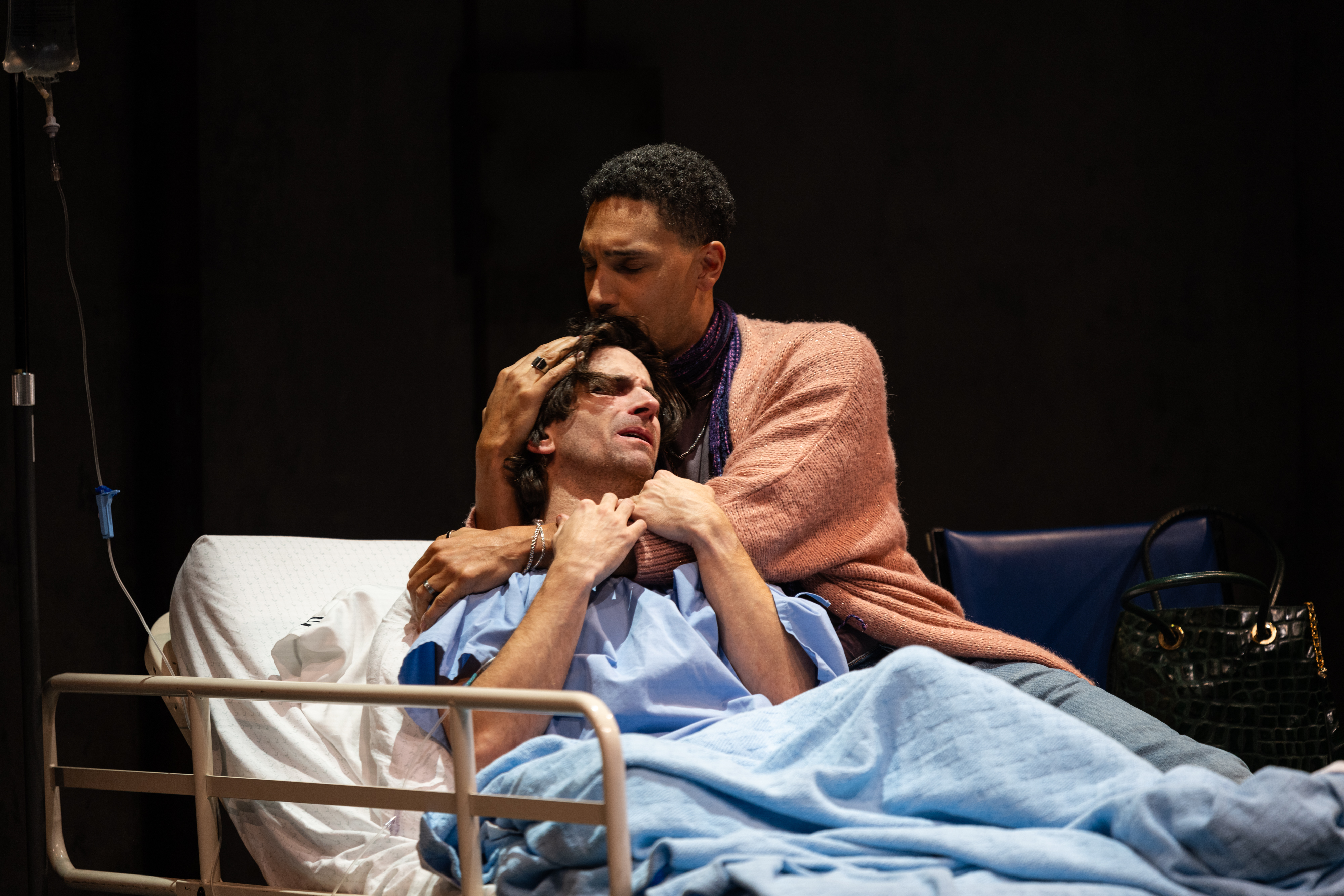
That Theatre Company/Buddies in Bad Times Theatre’s Angels in America

Buddies in Bad Times Theatre’s Roberto Zucco

Goblins:Macbeth – A Spontaneous Theatre Creation at Tarragon Theatre Toronto

Shaw Festival’s The House That Will Not Stand
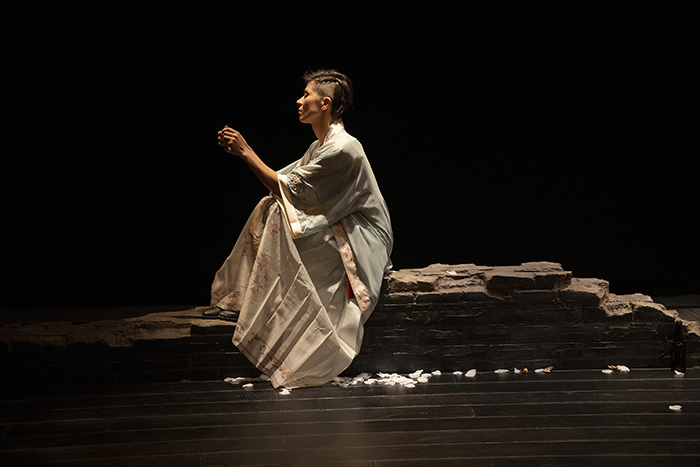
Shaw Festival’s Snow in Midsummer

Icarus Theatre’s Constellations

Canadian Stage’s production of The Inheritance

Photo credit: Cylla von Tiedemann.
Coal Mine Theatre’s A Case for the Existence of God
Best Musical: New York City
What a joyous field to be witness to this year on Broadway and beyond. The following musicals all completely delighted me, in ways unexpected and miraculous. Maybe Happy Ending may be my favorite, mainly because of its surprising sweetness and generosity, but the others listed all exceeded expectations and delivered expertise in abundance. The only question is, will Cats – The Jellicle Ball find its place on Broadway once again. Maybe the Circle in the Square would fit it just right. And what a great Christmas treat, to hear that Dead Outlaw is riding uptown to Broadway. It’s no surprise, but that dead corpse will get a warm welcome, I’m sure of that.

Broadway’s Maybe Happy Ending

PAC NYC’s Cats – The Jellicle Ball

Audible’s Dead Outlaws

Broadway’s Sunset Blvd

Broadway’s Death Becomes Her

Broadway’s The Outsiders

NYCC Encores’ Ragtime
Best Musical: London, England
A killer musical scene in the West End and beyond this year in London, England. And I was thankful to be able to see as many shows as I did. Some on a whim, and others, were solid definites from the moment I booked my plane tickets. All should, and some have already announced, Broadway transfers, and for that, I am grateful, because I will not mind seeing any of them again when they arrive on Broadway.

West End’s Standing at the Sky’s Edge

West End’s Operation Mincemeat

West End’s The Curious Case of Benjamin Button – the Musical

Menier Chocolate Factory‘s The Producers
Best Musical: Canada
These are the standouts for me musically in Canada, with Stratford finding gold in their production of Something Rotten! Mark Uhre astounds, but it’s really the company as a whole who knows how to come together and create stellar magic. As they, and the Shaw Festival, repeatedly do with their varied programming. And I’ve included Canada’s production of Titanique, even though I haven’t seen the production now playing in Toronto (Montreal is next, in the land of Celine), but I’m betting my bottom dollar that the show is as funny and wonderful as the off-Broadway continues to be.

Stratford Festival’s Something Rotten

Soulpepper Theatre’s De Profundis: Oscar Wilde in Jail

Shaw Festival’s My Fair Lady

Titanique in Toronto
Best Performance in a Play
Here’s my list of a few standouts. Many of the productions listed earlier in this (very long) listing should all be here as well, but I tried to focus my attention on a few that really caught my attention, surprising me or just plain wowing me, embedding their excellence in my brain forever.

Kit Connor in Broadway’s Romeo + Juliet

Cole Escola in Broadway/Off-Broadway’s Oh, Mary!

Mark Strong and Lesley Manville in the West End’s Oedipus

Sarah Pigeon and Juliana Canfield in Broadway/Playwrights Horizons’ Stereophonic

Rachel McAdams in MTC/Broadway’s Mary Jane

Sarah Paulson in 2ST/Broadway’s Appropriate

Photo credit: Cylla von Tiedemann.
Mazin Elsadig and Noah Reid in The Coal Mine’s A Case for the Existence of God

Leanne Best, Ophelia Lovibond, Helena Wilson, and Laura Donnelly in Broadway’s The Hills of California.
Best Performance in a Musical

Adrian Blake Enscoe in Broadway’s Swept Away

Jennifer Simard and Megan Hilty in Broadway’s Death Becomes Her

Nicole Scherzinger and Tom Francis in Broadway’s Sunset Blvd

Joshua Henry and Brandon Uranowitz in NYCC Encores’ Ragtime

Kecia Lewis in Broadway’s Hell’s Kitchen

Aaron Tveit and Sutton Foster in Broadway’s Sweeney Todd

Helen J Shen and Darren Criss in Broadway’s Maybe Happy Ending

Grey Hensen in Broadway’s Elf the Musical
And then there is Audra McDonald in Broadway’s Gypsy, a show that my press dates aren’t until early January, just like they did for Hugh Jackman and Sutton Foster’s Music Man, which also opened late December, just before the holidays. But I’m betting she would have been on the list had I had the chance to see her in that iconic musical before the end of 2024.


“There is something profoundly disturbing about a photograph of people laughing when you know what is happening just beyond the frame.”
In Here There Are Blueberries, Moisés Kaufman and Amanda Gronich confront one of history’s most uncomfortable truths: the people responsible for unimaginable atrocities were not necessarily recognizable monsters. They were ordinary human beings who went to work, enjoyed vacations, celebrated birthdays, fell in love, and posed for photographs while participating in the systematic murder of millions.
Now playing at Broadway’s Ethel Barrymore Theatre, this extraordinary documentary drama from Tectonic Theater Project is not another retelling of the Holocaust through the experiences of its victims. Instead, it examines the private lives of those who perpetrated and facilitated its horrors, asking how human beings could maintain the appearance of normality while surrounded by industrialized death. The question is not confined to Nazi Germany. Its implications reach uncomfortably into our own time.
Co-written by Kaufman and Gronich, conceived and directed by Kaufman, and co-created by Scott Barrow and Grant Vargas, the production begins with a deceptively simple observation: “That’s the thing about history. Not all of it is knowable.”

Michelle Beck, Delia Cunningham, Kathleen Chalfant Photo by Matthew Murphy
The story begins at the United States Holocaust Memorial Museum in Washington, D.C., where researcher Rebecca Erbelding (Delia Cunningham) receives an unexpected communication from a man who has possessed a mysterious photograph album for approximately 60 years. Discovered in an abandoned apartment, the album is believed to contain photographs taken at Auschwitz. Initially, Erbelding is reluctant to accept it. These are not the familiar images of emaciated prisoners, they are photographs of their perpetrators enjoying themselves.
Through David Bengali’s remarkable projections and David Lander’s evocative lighting, the audience becomes part of the investigation as the photographs are examined, enlarged, and gradually identified. The discovery of SS commandant Richard Baer, followed by the identification of Josef Mengele, transforms what initially appears to be an ordinary collection of personal photographs into an extraordinary historical document.
The album belonged to Karl Höcker, an SS officer who served as adjutant to the Auschwitz commandant. Its images offer a rare glimpse into the social lives of the men and women who helped operate the camp. We see them relaxing, laughing, singing, and enjoying the pleasures of ordinary existence. They appear comfortable, even happy. There is no visible suggestion of the unimaginable suffering occurring nearby.
And that is precisely what makes these photographs so horrifying.

Delia Cunningham, Montego Glover Photo by Matthew Murphy
One of the production’s most compelling observations concerns the camera itself. The German Leica helped make photography increasingly portable and accessible, allowing people to document their daily lives with an immediacy that feels remarkably contemporary. In many respects, these photographs function as the social media of their era. They preserve the moments their subjects wanted remembered: friendships, celebrations, leisure, and camaraderie.
What they omit is infinitely more revealing.
Today’s Instagram feeds and TikTok videos offer similarly curated versions of existence. We photograph what pleases us, what flatters us, and what supports the identities we wish to project. The difference, in this instance, is almost unbearable. These people were not simply excluding the unpleasant details of their lives. They were documenting their happiness while participating in, administering, or supporting one of humanity’s greatest crimes.
Kaufman’s direction is meticulous, allowing the evidence to accumulate without resorting to theatrical sensationalism. The photographs themselves become witnesses, and the audience is invited to examine them with the same growing unease experienced by the researchers.

Brandon Flynn, Kathleen Chalfant Photo by Matthew Murphy
Kathleen Chalfant is terrific as Judy Cohen, the museum’s director of photographic research. Her measured intelligence and quiet authority give the investigation its necessary gravity. Cunningham’s Erbelding provides the curiosity and determination that propel the discoveries forward. Scott Barrow, Michelle Beck, Michael Cerveris, Montego Glover, and Conrad Ricamora move between museum personnel and historical figures, creating a theatrical landscape in which past and present continually intersect.

Delia Cunningham, Kathleen Chalfant, Michael CerverisPhoto by Matthew Murphy
Brandon Flynn is especially convincing as Rainer Höss, the grandson of Auschwitz commandant Rudolf Höss, whose confrontation with his family’s history introduces another troubling dimension. What does it mean to inherit the name of someone responsible for mass murder? How does a descendant reconcile familial identity with historical truth? The production refuses to pretend that such questions have easy answers.

Scott Barrow Photo by Matthew Murphy
Yet its most chilling revelation concerns six photographs of young German women, members of the Helferinnen, the female auxiliaries who worked within the Auschwitz administrative system. These women were rewarded for their service with recreational outings to Solahütte, an SS retreat near Auschwitz. There, surrounded by the beauty of the countryside, they enjoyed leisure time with the men who administered the camp. In one particularly unsettling series of photographs, the women are seen eating blueberries, laughing and enjoying themselves with the carefree exuberance of young people on holiday. Hence the title, Here There Are Blueberries.
The innocence of the activity stands in grotesque contrast to the reality of their employment. These were not women living in some distant village, unaware of what was happening. They worked within the camp’s administrative structure. Their photographs document a culture in which participation in atrocity had become sufficiently normalized that leisure and mass murder could coexist without apparent contradiction.
Claims of ignorance become increasingly difficult to reconcile with the circumstances in which they lived and worked. The play does not establish that every individual knew every detail of the extermination process, but it makes the broader moral evasion impossible to ignore.
One statement by a woman is particularly devastating: “I believed one must harden oneself against the sight of human suffering. People who want to build empires cannot afford to be squeamish.”
Consider the implications of that philosophy. Human suffering is not denied. It is acknowledged and then deliberately dismissed as an inconvenience to ambition. Compassion becomes an obstacle, and cruelty becomes an administrative necessity.
Therein lies the real horror of Here There Are Blueberries. The machinery of genocide did not require every participant to behave like a raging fanatic. It required people willing to perform their assigned duties, accept the rewards of their positions, and disregard the consequences of their actions.
We are accustomed to imagining evil as something visibly different from ourselves. We expect cruelty to announce itself through appearance, behavior, or some unmistakable indication of moral corruption. Yet the photographs reveal attractive young women, smiling men, ordinary friendships, and familiar expressions of happiness. There is no particular face of evil. It can look like anyone.
That realization gives the play its contemporary urgency. We live in a world where human suffering can become background noise, where images of devastation compete with entertainment, and where people learn to compartmentalize what they know in order to continue living comfortably. The circumstances of contemporary society are not interchangeable with the Holocaust, whose systematic, state-sponsored extermination was historically specific. But the human capacity to normalize cruelty, surrender moral responsibility, and look away from suffering remains an urgent subject for examination.
The production also raises questions about the limits of historical understanding. Photographs reveal what happened within a frame, but they cannot fully disclose what their subjects believed, understood, or chose not to acknowledge. History demands evidence, yet even evidence cannot always provide the complete truth of an individual’s conscience.
My guest, who is Jewish, had one reservation about the production. She felt that the actors appeared more Aryan than Jewish, creating a visual imbalance that made it difficult for her to connect with the story. It is an interesting response, particularly because the production deliberately centers the perpetrators rather than the victims. Her reaction also underscores how personal and complicated the experience of watching Holocaust-related theatre can be.
For me, however, the production’s decision to focus on the perpetrators is precisely what makes it so unsettling. We know the atrocities. We have seen the photographs of the camps and heard the testimony of survivors. What we have seldom been invited to examine so closely is the astonishing ordinariness of the people who helped make those atrocities possible. The photographs do not show individuals tormented by guilt. They show people enjoying their lives. That distinction is devastating.
Here There Are Blueberries began as a work-in-progress at Miami’s Colony Theatre in 2018, premiered at La Jolla Playhouse in 2022, continued to Washington’s Shakespeare Theatre Company, and made its Off-Broadway debut at New York Theatre Workshop in 2024. Following a national tour and a United Kingdom premiere, it has arrived on Broadway with its questions more urgent than ever.
What Kaufman and his collaborators have created is not simply a historical investigation but a theatrical confrontation with the stories human beings tell themselves to justify their behavior. The production is intelligent, restrained, impeccably assembled, and profoundly disturbing. Its power lies in its refusal to offer the audience the comfort of believing that evil always announces itself.
I left the theatre thinking about those young women eating blueberries, laughing in the sunshine while unimaginable suffering continued nearby. Their pleasure was real. So was the horror. Both existed at the same time, in the same place, within the same human experience.
Can we live as a society knowing what we are capable of? More importantly, can we recognize the moment when our own comfort depends upon refusing to see someone else’s suffering?
Here There Are Blueberries does not allow us to look away. Nor should it.
Here There Are Blueberries opened November 9, 2026, at Broadway’s Ethel Barrymore Theatre, 243 West 47th Street, where its limited engagement continues through January 10, 2027.
Broadway
Theatre News: Broadway’s Next Big Stars, a New Home for Creativity, and Some Very Familiar Faces


Broadway is preparing for a star-studded 2027, with Steve Carell and John C. Reilly stepping into one of American comedy’s most beloved partnerships, Jessica Chastain returning in an imaginative new play, and Jordan Fisher preparing to channel Prince. Meanwhile, Schmigadoon! welcomes a new leading lady, and Lin-Manuel Miranda and Thomas Kail celebrate a meaningful addition to the Theatre District.
Steve Carell and John C. Reilly Are Broadway’s New Odd Couple
Neil Simon’s The Odd Couple is returning to Broadway with a pairing that already sounds like comic perfection. Steve Carell will play the obsessively tidy Felix Ungar opposite John C. Reilly’s gloriously disorganized Oscar Madison when the revival begins performances at the Stephen Sondheim Theatre on March 3, 2027. Opening night is set for March 23, with a limited 15-week engagement.
The supporting company is equally impressive. Tony winner Laura Benanti plays Gwendolyn Pigeon, with Heléne Yorke as her sister Cecily. James Monroe Iglehart takes on Murray, Kevin Del Aguila plays Roy, Rob McClure is Vinnie, and David Zayas rounds out the poker table as Speed.
Simon understood that the funniest relationships often emerge from two people who are utterly incapable of living together yet somehow cannot live without each other. Carell’s gift for controlled comic desperation and Reilly’s wonderfully unpredictable humanity could make this a particularly delicious revival. With a company this accomplished, the prospect of those legendary poker games is almost irresistible.
 Michelle Visage Brings Her Own Brand of Mischief to Schmigadoon!
The wonderfully eccentric world of Schmigadoon! is about to welcome another formidable personality. Michelle Visage, best known as a judge on RuPaul’s Drag Race, will make her Broadway debut December 4 at the Nederlander Theatre, taking over the role of the formidable Mildred Layton from Tony nominee Jennifer Simard. Her limited engagement continues through January 31, 2027.
Visage is hardly a stranger to musical theatre. Her West End credits include Everybody’s Talking About Jamie, The Addams Family, and Sea Witch. Before becoming a television personality and recording artist with the group Seduction, she studied musical theatre at AMDA.
Mildred is a character who requires a delicious combination of righteousness, authority, and comic absurdity. Simard has made the role a particular pleasure, and Visage’s larger-than-life personality should bring an entirely different flavor to the proceedings. The question is not whether Visage can command attention. It is what she will do with a character who believes she should command everyone else’s.
 Jordan Fisher Steps Into Prince’s World With Purple Rain
Jordan Fisher has spent much of his career being compared to Prince. Now the resemblance is becoming a theatrical assignment.
The 32-year-old performer will star as The Kid in the Broadway adaptation of Purple Rain, the landmark 1984 film that helped transform Prince into a cultural phenomenon. The production is expected this spring.
Fisher arrives with substantial Broadway credentials, having appeared in Hamilton, Dear Evan Hansen, Sweeney Todd, Hadestown, and Moulin Rouge! The Musical. His combination of vocal ability, physicality, and stage presence makes him an intriguing choice for a role inseparable from one of popular music’s most singular artists.
The challenge, of course, is considerable. Prince was not simply a performer with a distinctive sound and appearance. He was an extraordinary musician whose magnetism came from an artistic identity that could never be duplicated. The success of Purple Rain will depend less on imitation than on Fisher’s ability to capture the emotional intensity, vulnerability, and defiance beneath the legend.

Lin-Manuel Miranda and Thomas Kail Photo by Tricia Baron
Lin-Manuel Miranda and Thomas Kail Open The Gilbert Parker Studio at The Drama Book Shop
One of the Theatre District’s most treasured institutions has reclaimed an important part of its history. On November 12, Lin-Manuel Miranda and Thomas Kail celebrated the opening of The Gilbert Parker Studio at The Drama Book Shop, 266 West 39th Street, restoring a dedicated performance and development space to the beloved theatrical bookstore.
For Miranda and Kail, the occasion was particularly personal. At the shop’s former West 40th Street location, the 60-seat Arthur Seelen Theatre provided a creative home for emerging artists. Among the works nurtured there were In the Heightsand Freestyle Love Supreme, both of which helped shape their extraordinary careers.
The new studio honors Gilbert Parker, the influential theatrical literary agent whose clients included Terrence McNally, Beth Henley, A.R. Gurney, Ken Ludwig, and George Furth. Parker was a mentor to Kail and a close friend of Miranda, and his connection to both artists extended to Wesleyan University, where all three studied. In 2012, Miranda and Kail established a scholarship in his name.
The flexible 50-seat studio includes sound and lighting capabilities and a dressing room, offering established and emerging artists a place to develop new theatrical work.
At a time when New York’s creative spaces are increasingly threatened by rising costs and commercial pressures, the opening carries significance beyond its square footage. Theatre needs places where artists can experiment without the immediate burden of commercial expectations. In the Heights did not begin as a Broadway phenomenon. It began as an idea that needed a room, collaborators, and the freedom to grow.
The Gilbert Parker Studio offers the next generation precisely that possibility.
 Jessica Chastain Returns to Broadway in Lost Lear
Jessica Chastain will return to Broadway next spring in Lost Lear, a new play written and directed by Dan Colley, making his Broadway debut. Joining her are Corey Stoll and Michael Urie, creating an unusually compelling trio for a work that explores memory, family, and the strange intersections between theatre and reality.
Performances begin March 29, 2027, at the Booth Theatre, with opening night scheduled for April 23. The production will play a limited 16-week engagement.
Chastain portrays Joy, a former actress living in a care home whose fading connection to the present has convinced her that she is once again rehearsing Shakespeare’s King Lear. Her nurse, played by Urie, accommodates her shifting reality by assuming whatever theatrical role she requires. When her estranged son Conor, played by Stoll, arrives hoping to confront the unresolved history between them, he discovers that reaching his mother may require entering the imaginary production she now inhabits.
The premise is fascinating, particularly because Shakespeare’s tragedy already concerns the devastating consequences of misunderstanding love, loyalty, and family. By placing King Lear inside the fractured memory of a former actress, Colley creates the possibility of examining those themes through a deeply personal lens.
Chastain’s last Broadway appearance, in the 2023 revival of A Doll’s House, demonstrated her ability to sustain extraordinary dramatic tension through restraint. Stoll brings an equally formidable intelligence to his stage work, while Urie’s versatility should prove invaluable in a role that requires navigating between caregiving and performance.
Of all the new productions announced, Lost Lear may offer one of the season’s most intriguing theatrical questions: when memory begins to disappear, can imagination become another way of telling the truth?
Broadway
Wanted on Broadway: Extraordinary Voices, What Could Have Been a Powerful Story, and a Few Unfortunate Detours

Some musicals arrive on Broadway transformed for the better. Others leave you wondering why certain changes were made in the first place. Wanted, now playing at the James Earl Jones Theatre, is a fascinating example of both. When I first saw the show at Papermill Playhouse, it seemed ready for Broadway, armed with a compelling story, a glorious score, and the kind of emotional authenticity that cannot be manufactured. Its Broadway incarnation remains an exhilarating showcase of exceptional talent, but revisions to the narrative, musical numbers, and choreography have not always served the material. What once unfolded with greater clarity and emotional force has become more elaborate, yet strangely less affecting.

Solea Pfeiffer, Ledisi, Liisi LaFontaine photo by Julieta Cervantes
Inspired by the remarkable family history of book writer and lyricist Angelica Chéri, Wanted tells the story of her great-great-aunts, Mary and Martha Clarke, African American twin sisters who pass as white in the unforgiving landscape of 1893 Texas. Born to Tallulah Clarke (Ledisi), a formerly enslaved woman who had children with a white man, the sisters possess the light skin that allows them to cross a racial boundary upon which their very survival may depend. When the family is penalized for failing to meet its cotton quota, they face the loss of everything unless they can produce $400, an impossible sum for women trapped in the brutal economics of sharecropping.

Luke James, Liisi LaFontaine photo by Julieta Cervantes
Mary and Martha, played magnificently by Solea Pfeiffer and Liisi LaFontaine, decide to leave home and reinvent themselves as white women. Before their departure, Tallulah gives Martha a gun, an act of protection that becomes something considerably more dangerous. Martha discovers that a weapon affords her a power she has never possessed, and the sisters begin robbing their way toward financial independence. Their journey eventually leads them to a saloon, where Mary attracts the attention of Jesse (the handsome, smoldering Bradley Jaden), a fabulously wealthy man who falls in love with her. Their romance leads to marriage, but Mary’s new life is built upon a secret that could destroy everything. The consequences of that deception, and the increasingly divergent choices of the sisters, propel the story into its most intriguing territory.

Solea Pfeiffer photo by Julieta Cervantes
Pfeiffer and LaFontaine are extraordinary. Both possess the vocal prowess to command a Broadway stage, but what makes their performances so compelling is the emotional intelligence beneath the singing. Pfeiffer gives Mary a vulnerability and yearning that make her pursuit of love and security understandable, while LaFontaine’s Martha is fiercer, more restless, and increasingly seduced by the power she has discovered. Their contrasting temperaments give the musical its dramatic heartbeat, and when they sing together, the results are breathtaking.
Ledisi brings formidable vocal authority to Tallulah, grounding the story in the sacrifices and indignities endured by the generation that came before. Bradley Jaden supplies Jesse with considerable charm and romantic appeal, making Mary’s attraction entirely believable. Luke James, as Elijah, a Black servant who falls in love with Martha, brings warmth and an impressive voice to the proceedings. His duet with LaFontaine, “Under a Different Sun,” is, in a word, gorgeous.

Aurelia Williams and Awa Sal Secka photo by Julieta Cervantes
Two performers who come dangerously close to stealing the evening are Awa Sal Secka and Aurelia Williams as Flo and Sissy, the saloon’s housemaids. Their attitude, comic instincts, and killer vocals are irresistible. At Papermill, they had a phenomenal number, “Dirty Shame,” which has been replaced by “Dangerous.” The change is unfortunate. The earlier song had a theatrical bite and personality that made it memorable, while its replacement does not achieve the same effect. Similarly, Elijah’s “Invisible” now leans more toward pop, a stylistic shift that does little to improve upon the original material. The fabulous Katie Thompson has also seen her role reduced, another baffling decision considering what she brings to the stage. When a performer of Thompson’s caliber is available, underusing her is a missed opportunity.
The show’s greatest asset remains the music of Ross Baum and the lyrics of Angelica Chéri. Moving effortlessly through jazz, gospel, spirituals, blues, and Broadway, the score possesses a richness and emotional sweep that makes Wanted feel, at its best, like attending musical theatre church. There is something thrilling about a musical whose sound emerges so organically from the world and history of its characters. From the “Prologue” and “Wide Open Plains” to “All of Me,” the music reaches for something larger than entertainment. It carries the weight of history, the longing for freedom, and the contradictions of a country in which identity could determine whether one lived with dignity or in fear.
Unfortunately, the score has been tinkered with, and not always to its advantage. At Papermill, the music felt more heartfelt, its emotional peaks arriving with greater inevitability. The Broadway version still soars, frequently magnificently, but some of the revisions seem to favor contemporary musical polish over the raw theatrical power that made the earlier production so affecting. Melody A. Betts is electrifying, and the Kinfolk Choir brings an almost overwhelming vocal force to the evening. John Clancy’s orchestrations are superb, and the orchestra under the direction of Paul Byssainthe, Jr. delivers the score with tremendous energy and musical sophistication.

The cast photo by Julieta Cervantes
With voices this exceptional, every lyric should land with clarity. Instead, Gareth Owen’s sound design too frequently swallows the diction, while an overabundance of vocal riffs and embellishments leaves one longing for the purity and emotional impact of a beautifully sustained straight tone. There are moments when sheer volume threatens to obscure the intelligence of Chéri’s writing. Vocal virtuosity is thrilling, but restraint can be equally powerful. A score this sophisticated deserves the space to let its melodies, lyrics, and emotional subtleties breathe.
Director Stevie Walker-Webb has assembled and guided a superb company, and there is no shortage of theatrical excitement. Yet the storytelling has lost some of the precision it possessed at Paper Mill. The earlier production made the sisters’ choices and their consequences easier to follow, allowing the moral complexity of their circumstances to emerge naturally. On Broadway, the narrative is foggier, and certain developments feel less fully earned. This is a story about race, reinvention, survival, love, and the intoxicating nature of power. Its greatest strength lies in the tension between who these women are, who society allows them to be, and who they ultimately choose to become. That tension needs room to develop rather than being obscured by theatrical embellishment.
The choreography has also undergone a significant transformation. At Papermill, Tiffany Rea-Fisher’s work was extraordinary, contributing to the show’s sense of momentum and emotional evolution. Broadway choreographer Chelsea Arce has taken the production in a different direction, one that occasionally feels like the Muses from Disney’s Hercules have wandered into the Wild West. There is energy and visual flair, certainly, but the movement does not always seem rooted in the world of the musical. The earlier choreography felt more organically connected to the storytelling, whereas the Broadway staging sometimes calls attention to itself at the expense of the characters.
Visually, however, the production has much to admire. Beowulf Boritt’s scenic design is deceptively simple and highly effective, providing a flexible canvas for the action. Adam Honor’s lighting and Stefania Bulbarella’s video and projection design bring the landscape vividly to life, creating atmosphere and scale without overwhelming the performers. Emilio Sosa’s costumes beautifully establish the period while reflecting the sisters’ evolving identities and circumstances. The physical production understands the seductive possibilities of the American West, even when the storytelling occasionally loses its way.
What makes Wanted so frustrating is also what makes it so worth seeing. There is a genuinely remarkable musical here, one with a story seldom explored on the Broadway stage, a score of uncommon beauty, and performers capable of turning individual numbers into unforgettable experiences. Chéri and Baum have created something with historical resonance and contemporary relevance, asking what freedom means when survival requires denying one’s identity, and what happens when the pursuit of security becomes a hunger for power.
I left Papermill believing Wanted was ready to move. I left Broadway admiring its extraordinary cast and glorious musical talent while wishing the creative team had trusted more of what already worked. Not every revision is an improvement, and greater spectacle does not necessarily produce greater emotional impact. Still, when Pfeiffer and LaFontaine lift their voices, when Betts and the Kinfolk Choir unleash the full force of the score, and when Baum’s melodies meet Chéri’s most inspired lyrics, Wanted reminds us exactly why musical theatre can be so transporting.
The show may have lost some of its original clarity, but it has not lost its soul. That soul is in the music, the history, and, above all, the remarkable women at the center of the story.
Wanted: James Earl Jones Theatre, 138 West 48th St.

Returning to a musical you have already reviewed can be a revealing experience. Productions are living things, and the show you see several weeks into a run is not necessarily the one you encountered on your first visit. Cast changes alter relationships, performances deepen, and what initially seemed excessive can settle into something far more assured. Such was the case when I returned to Schmigadoon! at the Nederlander Theatre. What I discovered was a production that has grown tighter, more confident, and, most importantly, considerably funnier.

Kayla Pecchioni
My return was prompted by the arrival of Juan Pablo Di Pace and Jennifer Simard, but I happened to attend Kayla Pecchioni’s first performance as Emma Tate, a role normally played by Isabella McCalla. There is something particularly wonderful about witnessing an actor step into an established company for the first time, especially when that company so visibly embraces her. The support surrounding Pecchioni was palpable, and she responded with a performance that was charming, assured, and beautifully integrated into the evening. Her Emma possessed the requisite sweetness without becoming cloying, and her tap dancing provided one of those delicious moments when character and choreography meet effortlessly.
Based on the cult-favorite Apple TV+ series, Schmigadoon! remains a confection of Golden Age nostalgia, its satirical bite wrapped in an affectionate, knowingly absurd tribute to musical theater. The premise is gloriously ridiculous. Josh (Alex Brightman), a musical-averse New Yorker with the emotional range of a shrug, and Melissa (the superb Sara Chase), a romantic who seems to have absorbed every Rodgers and Hammerstein score ever written, find themselves trapped in a pastel-hued musical fantasy somewhere between Brigadoon and the Catskills. Their relationship, already fraying after three years, becomes the central experiment. Cross a bridge, enter an enchanted town, and discover that the only way out is to find true love. Unfortunately, neither is entirely certain that the person standing beside them is the answer.
From there, the show gleefully fractures into a carousel of recognizable musical theater archetypes. Melissa finds herself drawn to Danny (the undeniably hot and charismatic Max Clayton), a balletic carnival performer whose swagger owes more than a little to Carousel’s Billy Bigelow. Clayton has the physical command and sensual confidence to make the role irresistible, and his dancing remains one of the evening’s pleasures.
Then there is the town doctor, now played by the wonderful Juan Pablo Di Pace, who brings an entirely different flavor to the character. His handsome looks, distinctive accent, and natural charm give the doctor a romantic sophistication that works beautifully against the production’s deliberately artificial world. Di Pace understands the joke without needing to announce it. Rather than simply playing another Golden Age stereotype, he gives the character an appealing individuality, making the role distinctly his own.

Sara Chase, McKenzie Kurtz, Alex Brightman Photo by Matthew Murphy and Evan Zimmerman.
Josh, meanwhile, ricochets between the aggressively cheerful attentions of Betsy (a hilarious McKenzie Kurtz, whose comic instincts recall Lucille Ball), the farmer’s daughter with a shotgun-toting father, and the prim but rhythmically gifted schoolteacher Emma, now in Pecchioni’s capable hands.
Yet one of the greatest pleasures of this return visit was Jennifer Simard. Taking over as the preacher’s iron-willed wife, Simard demonstrates why she remains one of musical theater’s most accomplished comic performers. She possesses that rare ability to make the ridiculous seem utterly reasonable to the person delivering it. Her timing is impeccable, her authority unquestionable, and her understanding of how to land a joke without crushing it is a master class in musical comedy. Simard doesn’t simply inhabit the heightened world of Schmigadoon!; she gives it definition. Having followed her career since I Love You, You’re Perfect, Now Change, I found it particularly satisfying to watch her bring her considerable gifts to this material.
The surrounding company remains a colorful collection of theatrical personalities, including Maulik Pancholy as the cheerfully severe preacher, Brad Oscar as a blustering mayor harboring secrets, and Ann Harada as his long-suffering wife, whose resignation is often funnier than anything her husband says.
Cinco Paul’s score, created from the same deep affection for musical theater that informed the television series he developed with Ken Daurio, remains the production’s principal delight. These songs are not merely imitations of familiar Broadway classics. They are remarkably precise musical impressions, drawing on Oklahoma!, The Music Man, Guys and Dolls, and The Sound of Music while understanding the compositional language that makes each recognizable. The jokes are richer when you know the references, but the musical craftsmanship stands independently of the satire.
Director-choreographer Christopher Gattelli has created a world of perpetual motion, and his choreography remains one of the production’s strongest assets. His affection for Michael Kidd and Agnes de Mille is evident in the expansive movement, athletic exuberance, and storytelling woven into the dances. Gattelli understands the physical vocabulary of the Golden Age without treating it as a museum piece. The numbers have lift, velocity, and theatrical imagination, and on this return visit, the entire production seemed more disciplined in how it deployed them.
That discipline makes a significant difference. On my first visit, I found the show’s relentless camp somewhat exhausting, as though its enthusiasm for musical theater occasionally overwhelmed the material itself. This time, the comedy felt more controlled, the performances better balanced, and the company’s collective rhythm considerably sharper. The production still embraces its own extravagance, but it no longer seems quite so determined to remind the audience how clever it is. The jokes have room to breathe, and the emotional story emerges more clearly beneath the confection.
Scott Pask’s pastel-drenched scenery, Linda Cho’s deliberately theatrical costumes, and Donald Holder’s warm, saturated lighting create an idealized Broadway landscape that exists somewhere between affectionate memory and elaborate fantasy. The visual language is intentionally heightened, occasionally approaching the aesthetic of an especially ambitious college musical, but the effect now feels more cohesive. Walter Trarbach’s sound design provides clarity, while the orchestrations by Doug Besterman and Mike Morris shimmer with the musical textures of the period.
At the center, Brightman and Chase continue to provide the necessary emotional anchor. Brightman’s dry resistance to musical theater is an inspired counterweight to the town’s relentless optimism, while Chase allows Melissa’s romanticism to remain sincere even when everything surrounding her is absurd. Their relationship gives the evening something essential: a reason to care about what happens after the next production number.
What ultimately makes Schmigadoon! work is its willingness to celebrate the very theatrical conventions it so gleefully dismantles. Beneath the exaggerated characters, impossible coincidences, and spontaneous tap breaks is a simple argument about love, identity, and the courage to recognize what we actually want.
I still prefer the darker, more cynical theatrical territory explored in the television series’ second season, Schmicago, where the influences of Chicago, Cabaret, and Sweeney Todd gave the satire a sharper edge. But returning to this Golden Age fantasy reminded me that a production can evolve without abandoning its essential character.
The addition of Di Pace and Simard, the delightful discovery of Pecchioni, and a company now operating with greater confidence have made Schmigadoon! a stronger show than the one I originally encountered. Sometimes a second visit doesn’t merely confirm an opinion. It changes the conversation.
In a theater where everything is supposed to happen by magic, is a rather satisfying transformation.
Schmigadoon! is playing at the Nederlander Theatre, 208 West 41st Street, New York City.
Broadway
Broadway’s Got Guts! Part Two: A Million Reasons to Care, and 25 Years of Giving Children Their Childhood Back

I’ve covered the Crohn’s & Colitis Foundation’s annual gala for the past four years, and I can honestly say there is something about this evening that sets it apart from every other benefit I attend. The room is filled with people who genuinely want to help, and the enthusiasm is infectious. Even the fundraising has a wonderfully playful quality that makes giving feel like a celebration rather than an obligation. Having dealt with my own digestive difficulties, I also feel a personal connection to the cause. I have been diagnosed with inflammatory bowel disease. What keeps me coming back, is the extraordinary spirit of the people in that room. There is a warmth, generosity, and sense of community that simply cannot be manufactured.

 After four years of covering this gala, I am still discovering the extraordinary personal stories behind the people who fill that ballroom. The more I learn, the more I understand why this cause inspires such fierce loyalty, and why I keep coming back.


 There is also a delicious irony at the Crohn’s & Colitis Foundation’s 59th Annual Gala, Broadway’s Got Guts!, held November 9 at the Edison Ballroom. Some of New York’s finest restaurants were serving extraordinary food to a room filled with people dedicated to fighting diseases that can make the simple pleasure of eating an ordeal. Yet the contrast was entirely appropriate. This was an evening about reclaiming life’s pleasures, celebrating what medicine has accomplished, and remembering how much remains to be done.


 The food was fabulous. Lure Fishbar, Soledad, Andrew Bellucci’s Pizzeria, and the Edison Ballroom presented an impressive array of culinary offerings before guests settled in for dinner. The abundance was a reminder of something most people take for granted. For those living with Crohn’s disease or ulcerative colitis, food can be complicated. What should be an uncomplicated pleasure can become a source of pain, anxiety, or uncertainty. There is no single diet that works for everyone with inflammatory bowel disease, and the relationship between food and symptoms can vary enormously from one patient to another.


 Yet the evening’s most meaningful celebration had little to do with what was on the menu. It belonged to Camp Oasis NY, marking its 25th anniversary of giving children living with inflammatory bowel disease something that cannot be prescribed in a doctor’s office: the opportunity to feel like everyone else.
 For a child, Crohn’s disease or ulcerative colitis can mean far more than medical appointments and medications. It can mean missing school, abandoning activities, worrying about bathrooms, feeling embarrassed in front of classmates, and wondering why their body behaves differently from everyone else’s. Childhood is difficult enough without having to explain an illness that many adults barely understand.

At my table
Rachel Peifer
Director, Corporate Communications and Social Media, a Crohn’s survivor and her cousin
Camp Oasis changes that equation.
 Created by the Crohn’s & Colitis Foundation, the program offers children and teenagers living with inflammatory bowel disease a traditional summer camp experience surrounded by people who understand exactly what they are facing. There are swimming, games, arts and crafts, campfires, friendships, and all the glorious chaos that makes summer camp memorable. The difference is that nobody has to explain why they need medication, a particular meal, or immediate access to a bathroom.
 The medical support is equally important. Camp Oasis provides around-the-clock care from healthcare professionals experienced in inflammatory bowel disease, allowing children to enjoy their independence while parents know their medical needs are being addressed. It is an extraordinary combination of freedom and reassurance.
 The results are more than anecdotal. Research and evaluations conducted through the Foundation have shown that 98 percent of campers report feeling supported and experiencing a sense of belonging, while 96 percent of campers and parents report a positive impact on well-being. In one evaluation, the proportion of campers who felt alone in their disease dropped from 33 percent before camp to 17 percent afterward.
Those numbers tell an important story. A child who arrives feeling isolated can leave knowing that there are other children who understand. Friendships replace embarrassment. Confidence begins to take the place of fear. For some, it is the first time they have ever met another young person living with the same condition.
The gala recognized Camp Oasis NY founder Marcy Nanus and longtime Medical Director Dr. Keith Benkov, whose dedication has helped make this remarkable program possible. Twenty-five years represents an extraordinary legacy, not simply measured in summers, but in the thousands of moments when children have discovered they are not alone.
Among the young advocates helping carry that legacy forward is Hadley Spencer, whose involvement with Camp Oasis represents the next generation of voices determined to make life better for children facing inflammatory bowel disease. Her advocacy underscores something essential about the program: its impact does not necessarily end when summer does. It can inspire young people to become advocates for others navigating the same challenges.
This year, the goal was $1 million, and in honor of Camp Oasis NY’s 25th anniversary, the fundraising appeal began at $25,000. One generous donor had already committed that amount before the appeal even began. When the auctioneer asked for another, a paddle went up from the back of the ballroom, not from one of the coveted front tables.
The giving continued at $10,000, then $2,500, where the goal was to secure 25 donors in celebration of the anniversary. When the count reached 24, three more paddles shot into the air, carrying the total beyond the target. At $1,000, the appeal became even more extraordinary. Guests were invited to surrender their numbered Playbill-style paddles to make their pledges, and what seemed like nearly the entire room responded. Then a young man, who couldn’t have been much older than 35, stepped forward with an offer to match the pledges collected at that level. There was no hesitation, no theatrical reluctance, just an infectious willingness to give. At a time
That spirit of resilience extended to the stage, where Broadway performers brought their talents to an evening that was as entertaining as it was emotionally meaningful.
 Alexander Silber, a Broadway performer who also lives with a J-pouch, performed “I’m in Love with a Wonderful Guy,” bringing a particularly personal dimension to the entertainment. A J-pouch is an internal reservoir surgically created from the small intestine, often following removal of the colon in patients with ulcerative colitis. Silber’s presence was a reminder that a serious medical history need not define the limits of an artistic life.
Mary Kate Morrissey, familiar to Broadway audiences for her portrayal of Elphaba in Wicked, was another of the evening’s featured performers. Her participation added Broadway star power to a celebration that drew its strength from the intersection of theater and personal commitment.
Pearl Sun delivered “Don’t Rain on My Parade,” a song whose defiant optimism could hardly have been more appropriate. The number’s determination to push forward against the odds captured the spirit of an organization that refuses to accept the limitations imposed by chronic disease.
Bishal Vaidya also lent his voice to the evening, contributing to a musical program that showcased the breadth of talent supporting the Foundation’s work.
 One of the more unusual attractions was Wrecked’em, a band made up entirely of doctors. There is something wonderfully appealing about physicians trading their medical instruments for musical ones, particularly at an event devoted to the patients and families whose lives they work to improve. Their performance added humor, energy, and a welcome sense of personality to a profession too often associated exclusively with clinical seriousness.
 Throughout the evening, the entertainment served a larger purpose. The Crohn’s & Colitis Foundation has spent nearly six decades supporting research, education, advocacy, and patient services. Its work has helped advance understanding of diseases that affect approximately one in every 100 Americans, yet remain widely misunderstood.
The fundraising reflected both the generosity of the room and the ambition of the organization. More than $850,000 was raised, an impressive achievement that brought the evening within reach of its $1 million goal. The remaining distance is a reminder that the need for research, patient support, and programs like Camp Oasis continues long after the applause has ended.
What made Broadway’s Got Guts! particularly effective was its refusal to allow illness to dominate the atmosphere. There was laughter, music, extraordinary food, and the unmistakable pleasure of people coming together for a cause they believed in. The evening acknowledged the seriousness of Crohn’s disease and ulcerative colitis without allowing those diagnoses to become the entirety of anyone’s identity.
That is precisely what makes Camp Oasis so important.
For one week, children who have spent much of their lives being patients can simply be children. They can make friends, take chances, discover new abilities, and experience the kind of carefree summer memories that every young person deserves. The illness is still there, but it no longer has to occupy center stage.
Broadway knows a great deal about transformation. It can take an ordinary moment and make it unforgettable, turning vulnerability into strength and individual experience into something universally understood.
Camp Oasis accomplishes its own kind of transformation, one child at a time.
The Crohn’s & Colitis Foundation may have raised more than $850,000 at the Edison Ballroom, but the true measure of the evening’s success lies in what that generosity makes possible. Somewhere next summer, a child who has felt different, frightened, or alone will arrive at camp and discover an entire community that understands.
For that child, the experience could be priceless.


Sunday Brunch With Prince Max: When Everything Goes Wrong, Make It Fabulous

I Play Rocky Gets Inside the Making of a Hollywood Underdog

The Glorious Corner

Prince Mario-Max Schaumburg-Lippe: Jean Shafiroff’s Beautiful Reception For The Mission Society Of New York

OpenAI Opens ChatGPT to Business Profiles and Customer-Facing AI Agents

Here There Are Blueberries: The Banality of Evil, Captured in a Photograph

It’s beginning to look a lot like…

Kevin & Sam Talk Shop: Bite-Sized Wisdom for Actors
Sunday Brunch With Prince Max: When Everything Goes Wrong, Make It Fabulous
I Play Rocky Gets Inside the Making of a Hollywood Underdog
The Glorious Corner
Prince Mario-Max Schaumburg-Lippe: Jean Shafiroff’s Beautiful Reception For The Mission Society Of New York
OpenAI Opens ChatGPT to Business Profiles and Customer-Facing AI Agents
Here There Are Blueberries: The Banality of Evil, Captured in a Photograph
It’s beginning to look a lot like…
Kevin & Sam Talk Shop: Bite-Sized Wisdom for Actors
-

 Entertainment4 days ago
Prince Mario-Max Schaumburg-Lippe New York City – Best Museums For Free – And They Are Americas Best!
-

 Cabaret4 days ago
My View: A Family United By Love, Laughter, and MUSIC at Cafe Carlyle…John, Jessica, & Maddie
-

 Cabaret4 days ago
My Vew: It Was All About Being A New Yorker at The Dutch Treat Club
-

 Entertainment3 days ago
Prince Mario-Max Schaumburg Lippe Celebrates Legendary Photographer Patrick McMullan at One Art Space Tribeca Manhattan!
-

 Celebrity4 days ago
The Glorious Corner
-

 Broadway4 days ago
Wanted on Broadway: Extraordinary Voices, What Could Have Been a Powerful Story, and a Few Unfortunate Detours
-

 Out of Town3 days ago
All Playgrounds Are Fun – Gruesome Playground Injuries
-

 Business4 days ago
Black Friday Is Becoming a Season. Retailers Still Need a Reason to Discount.