
Off Broadway
He Says: Happy Talk Deflates But Ireland Floats Up High


The hopes are high when entering the New Group‘s production of Happy Talk, a new play by actor and writer Jesse Eisenberg (The Revisionist, The Spoils), and I’m super excited to see Susan Sarandon back on stage, but almost more thrilled to once again get a chance to witness the magnificent work of Marin Ireland, who destroyed us all with her breathtaking work in both ATC’s Blue Ridge and CSC’s Summer and Smoke this past year. She is truly a gift to the NYC stage, and one I will try to never miss in the future. Sarandon, a gifted film actor, destroying us all in “Dead Man Walking” (1995) and “Thelma and Louise” (1991) hasn’t performed on stage in NYC since Exit the King in 2009 when she rocked the Eugène Ionesco’s absurdist drama at the Ethel Barrymore Theatre, alongside Geoffrey Rush (who won a Tony Award for his performance), Andrea Martin, and Lauren Ambrose, so I was holding my breath to see what brought her back to us.
This time around on the Griffin stage at the Pershing Square Signature Center, Sarandon’s star power grabs hold and presents the petty narcissism and self-centeredness of the off-putting central character, Lorraine. The delusional woman sees herself as a gifted artist and musical theatre actress, discussing the rehearsal process as if she’s a star-player working on a celebrated production of the classic South Pacific. But alas, we soon learn that this is community theatre, and we can venture a guess what kind of woman this actress truly is. “Darling, I’m an artist. We live in the shadows, we bend the rules.” she states, talking endlessly about her delusional accomplishments to her motionless husband, Ronny, deviously well played by Nico Santos (WB’s ‘Crazy Rich Asians‘) who seems to have decided that it is best to not listen, remain still, have a drink, and play (almost) dead. It might be the best action of them all; to avoid and dismiss the endless prattle that leans sometimes towards passively vicious and demeaning, that is, if anyone is actually listening. It’s a startling piece of writing, her first monologue, deftly creating a character we would most likely want to avoid at all costs, smiling simply as we too try to vanish from her eyesight, which might, in fact, be a small part of the problem with the play. We inch away from her, in the same hesitant manner that she inches, reluctantly, towards the door of her ailing mother, an unseen sickly character that if it was up to Lorraine, should hurry up and die. We want to avoid her, move away from her smiles and inane chatter, and sadly, Happy Talk never gives us a good enough reason to want to lean back in.
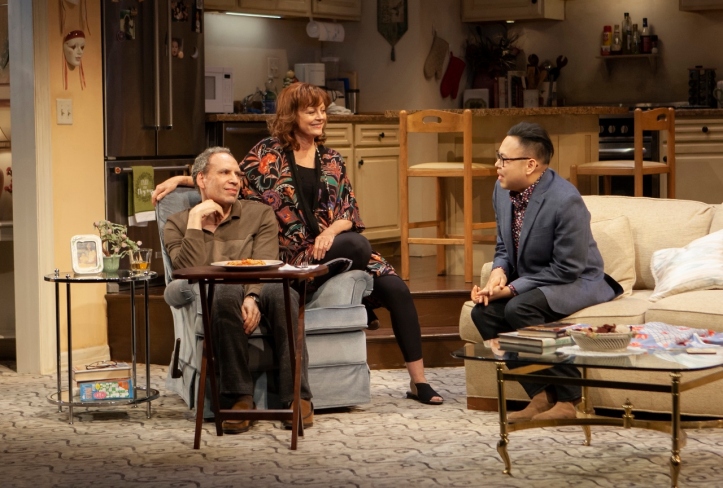
Wisely for her character, Lorraine has hired a captive audience, the fiery yet sweet-natured Ljuba, a live-in care giver for her sickly mother. This well crafted character, the illegal immigrant worker from Eastern Europe, is played to heightened perfection by the magnificent Ireland, finding the kind happiness amongst the uncomfortable pain and helplessness of her existence. She’s a woman desperate to fit in, and devastated to find out she doesn’t and may never, but tries valiantly to find the joy and companionship in those around her. It’s a compelling and fascinating conceptualization, making these two women who live in the Happy Talk world of positivity and looking on the bright side of things, but have really nothing in common in the way they interact in the world. “This scene isn’t about you” Lorraine states emphatically. Ireland’s Ljuba strives to survive the heavy weight around her neck, while Saradon’s Lorraine does it to make her existence feel more important, even if it is at the cost of those around her.

As directed by Scott Elliott (TNG’s The True, Good for Otto) with an off balance energy and focus, Lorraine’s delusional narcissistic vantage point sours all yet never feels fully formatted and believable. Sarandon can’t seem to find the heart or the pain that should at least make us interested or curious about her self interest and haughtiness. Her daughter, the snide and dismissive Jenny, played with a strong sense of purpose by Tedra Millan (PR’s The Wolves) sees her pretty clearly though, although as Jenny is quite the horrific spoiled brat herself, her observations are difficult to emotionally get behind. It is somewhat satisfying to watch Jenny get a lashing from Ljuba, but seemingly pointless in the long run.

One has to wonder why fellow community theatre actor, Bill, played to the gay heavens by Daniel Oreskies (Broadway/LC’s Oslo) allows himself to be pulled into the tidy mess that lives inside this conventional suburban home, courtesy of the fine work of scenic designer Derek McLane (TNG’s Sweet Charity), with perfectly appropriate costuming by Clint Ramos, (TNG’s Downtown Race Riot), lighting by Jeff Croiter (TNG’s Jerry Springer…) and sound design by Rob Milburn & Michael Bodeen (Broadway’s Sweat). But his intentions, even though coming from a financial need, seem pure and kind, while Lorraine’s act of charity seem predictably selfish and enmeshed in privilege and insensitivity. Their clash is telling, but oddly dismissive and passive on all accounts, just like the quick wrap up at the end of this confusing play.
The plotting of Happy Talk is convoluted and abstract, making one wonder why some scenes, especially the sneaky arrival of the daughter, are even inserted. Maybe some are included to send us off scent, in other directions so when the conflict finally comes we are surprised (we aren’t), but that is a weak impetus for inclusion. It’s clear from the first scene who Lorraine is and what she is capable of, with Eisenberg giving the actress very little to strive towards or dig deep into. Ireland’s caregiver is given a bit more of a journey with some lovely story-telling to delivery, but as the whole messy story unfolds, reasonings beyond the obvious and straightforward are lacking in the details of the writing. Ireland is the star here, giving a deceptively great performance wrapped up in a positive, caring character in great need of help. We care for Ljuba and her unclear future, but the trap she finds herself in, as passively disturbing as it is and as well played, isn’t dramatically engaging enough to hold our heart, our attention, and this play together. “You make everything happy, even when it’s sad” is a smart duo-purposed line, shining a dirty light on that type of positivity, but Ljuba’s plight is left to be microwaved and eaten by the monstrous Lorraine as an interesting flavor for lunch but nothing more. As a full theatrical experience, it doesn’t satisfy, leaving us cringing at the shallowness of the comedy, unfulfilled, disheartened, and embarrassed at the lightness of Lorraine’s non-insightful delusion.


Twenty-five years after Our Sinatra became one of Off-Broadway’s unexpected musical pleasures, Eric Comstock, Christopher Gines and Hilary Kole have returned to the material that started it all. What is remarkable is how little dust has gathered on either the songs or the performers.
Our Sinatra: A Musical Celebration, now at the Marjorie S. Deane Little Theater, isn’t an impersonation show. Nobody is trying to become Frank Sinatra, and that is precisely why the evening works. Instead, three exceptionally accomplished interpreters take on the extraordinary catalogue Sinatra made famous and allow the songs to breathe in their own voices. “Fly Me to the Moon,” “The Way You Look Tonight,” “Come Fly with Me,” “The Best Is Yet to Come,” “I’ve Got You Under My Skin,” “Where or When,” “One for My Baby” and “The Lady Is a Tramp” arrive carrying all the memories we associate with Sinatra, without becoming museum pieces. Ironically missing is “My Way.”

Eric Comstock, Hilary Kole, Christopher Gines Photo Genevieve Rafter Keddy
The chemistry among Comstock, Gines and Kole is the evening’s greatest asset. After all these years, they fit together musically with an ease that cannot be manufactured. In harmony, their voices match beautifully, yet individually they couldn’t be more distinct. That contrast keeps the evening alive.

Eric Comstock Photo Genevieve Rafter Keddy
At the piano, Comstock is brilliant, with the kind of musical intelligence that makes everything look considerably easier than it is. As musical director, his choices feel intuitive and instinctive rather than arranged within an inch of their lives. As a singer, he is suave, personable and completely at home in this material. His patter is equally important. Comstock understands that Sinatra’s catalogue came from a world in which the space between the songs mattered almost as much as the songs themselves.
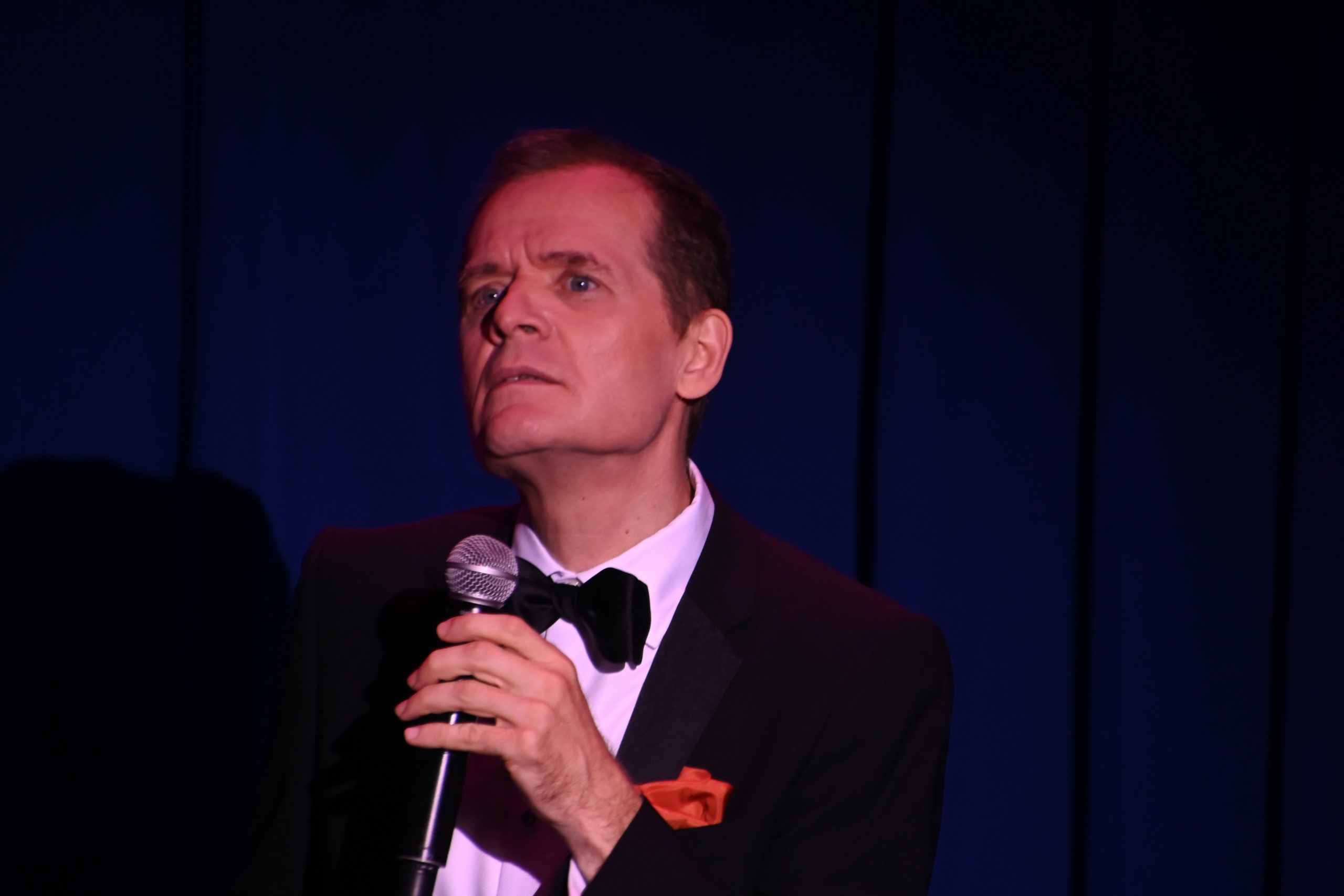
Christopher Gines Photo Genevieve Rafter Keddy
Gines brings a wonderfully smooth, creamy vocal quality that simply melts you. There is warmth in his singing without sentimentality, and he understands the conversational nature of this music. Sinatra’s greatest performances never sounded as though he were demonstrating how beautifully he could sing; they sounded as though he had something to tell you. Gines understands that distinction.

Hilary Kole Photo Genevieve Rafter Keddy
Then there is Hilary Kole, whose sophisticated jazz sensibility makes her particularly thrilling in this material. She honors the Sinatra sound without ever becoming imprisoned by it. Her scatting on “I’ve Got the World on a String” is worth the evening by itself. It is playful, technically dazzling and completely alive—a performer taking a familiar song and reminding us that a standard becomes a standard precisely because there is always another way into it.
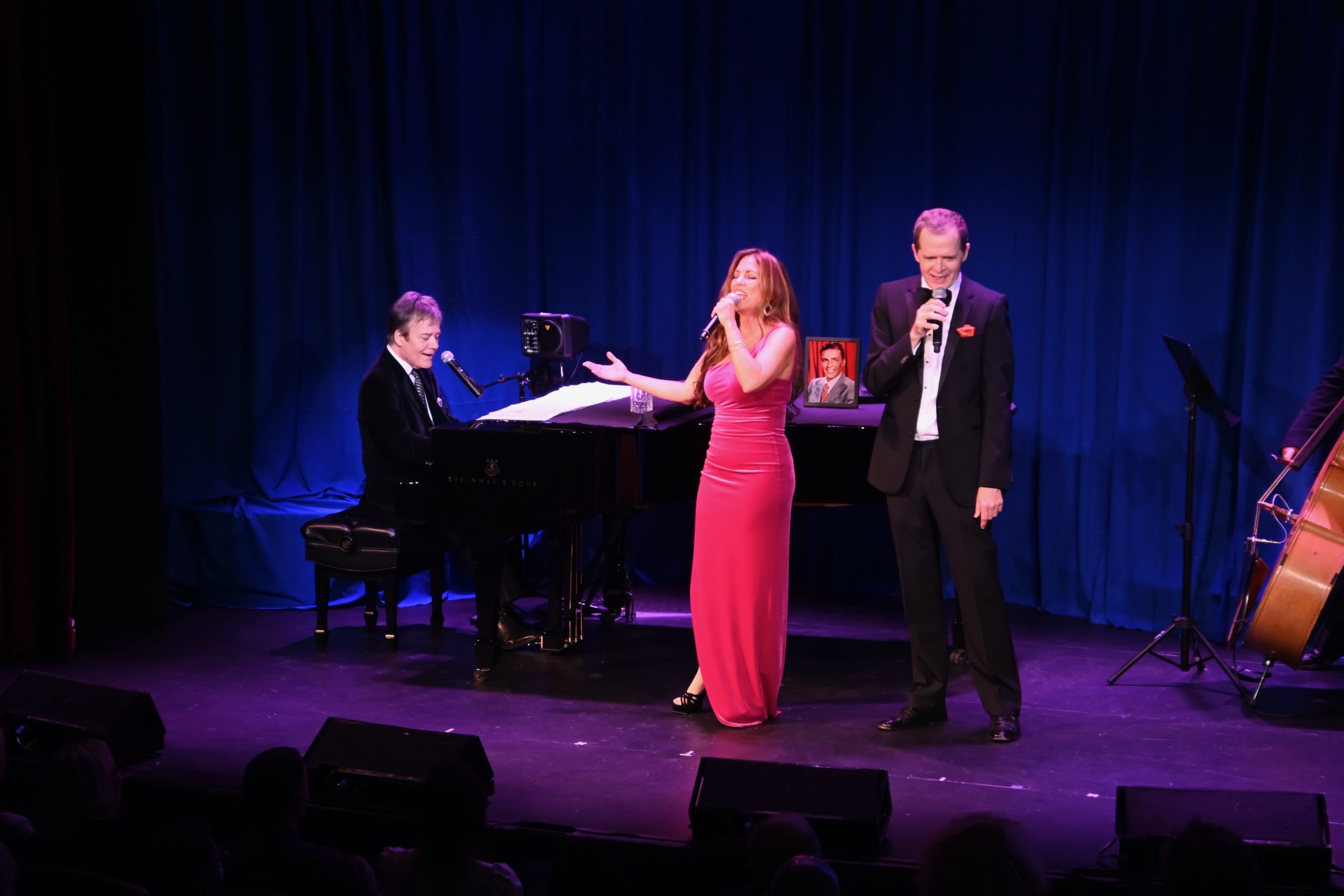
Eric Comstock,m Hilary Kole, Christopher Gines Photo Genevieve Rafter Keddy
That is what makes Our Sinatra so fabulous. These performers aren’t trying to preserve the songs under glass. They make them their own.
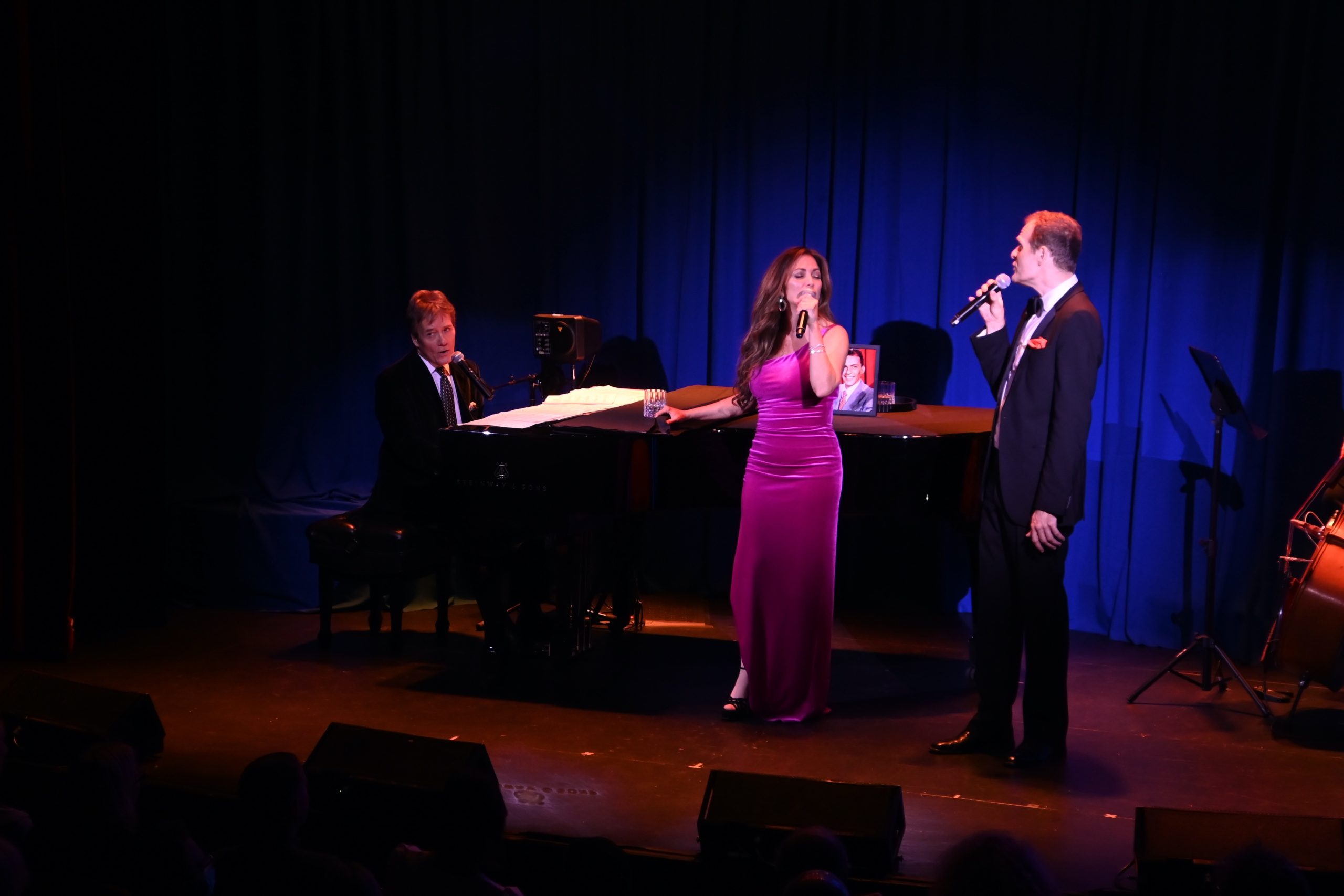
Eric Comstock, Hilary Kole, Christopher Gines Photo Genevieve Rafter Keddy
Kole’s stories about her father and Sinatra give the evening an unexpectedly personal dimension, while Comstock’s patter provides both history and humor. Those stories matter because Sinatra wasn’t simply a singer with an enviable songbook. He represented an era when popular music was built around lyricists and composers who assumed an audience was listening to the words. Cole Porter, Rodgers and Hart, Sammy Cahn, Jimmy Van Heusen and the other writers whose work became inseparable from Sinatra understood sophistication without mistaking it for pretension.
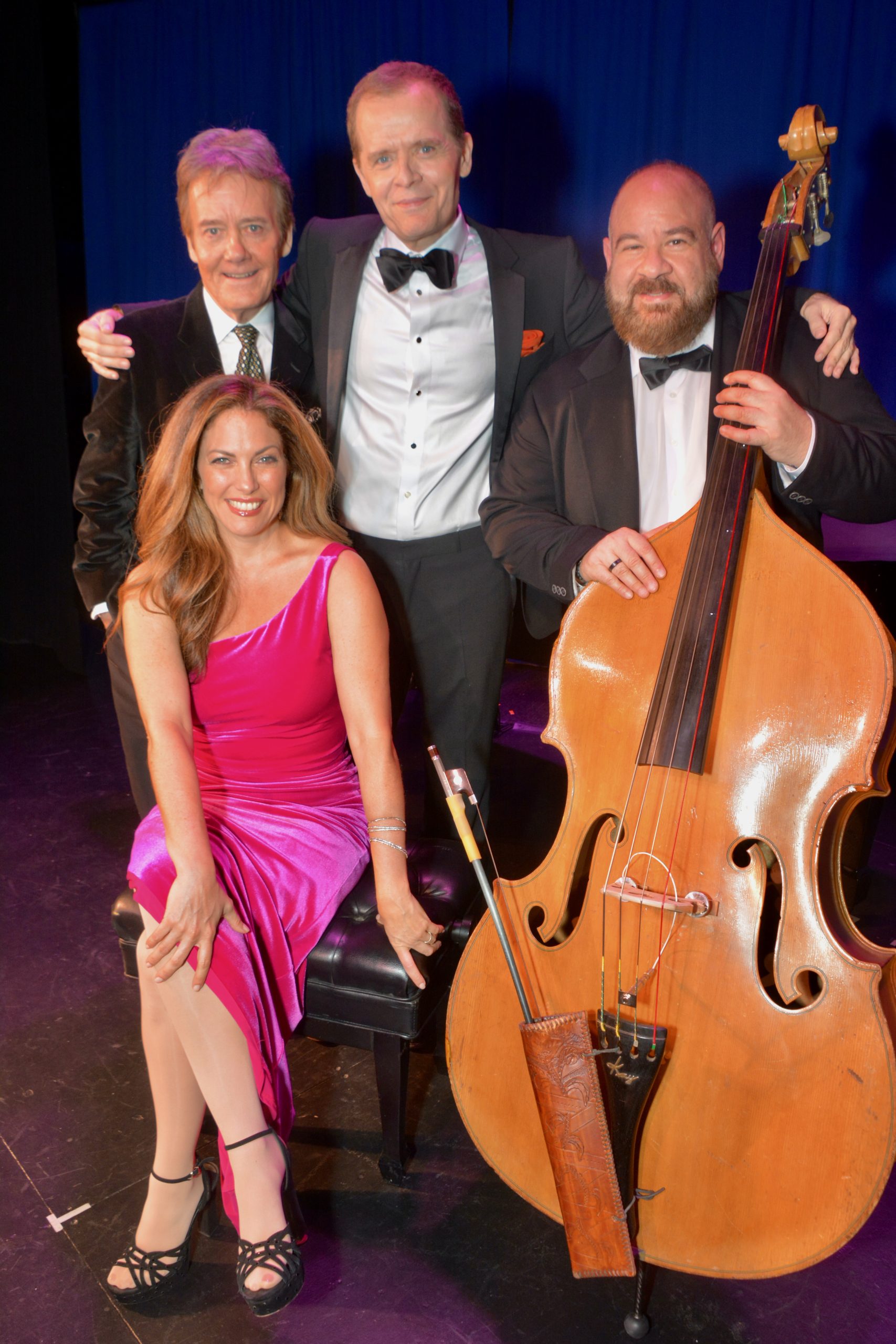 The musical economy of the production is another pleasure.
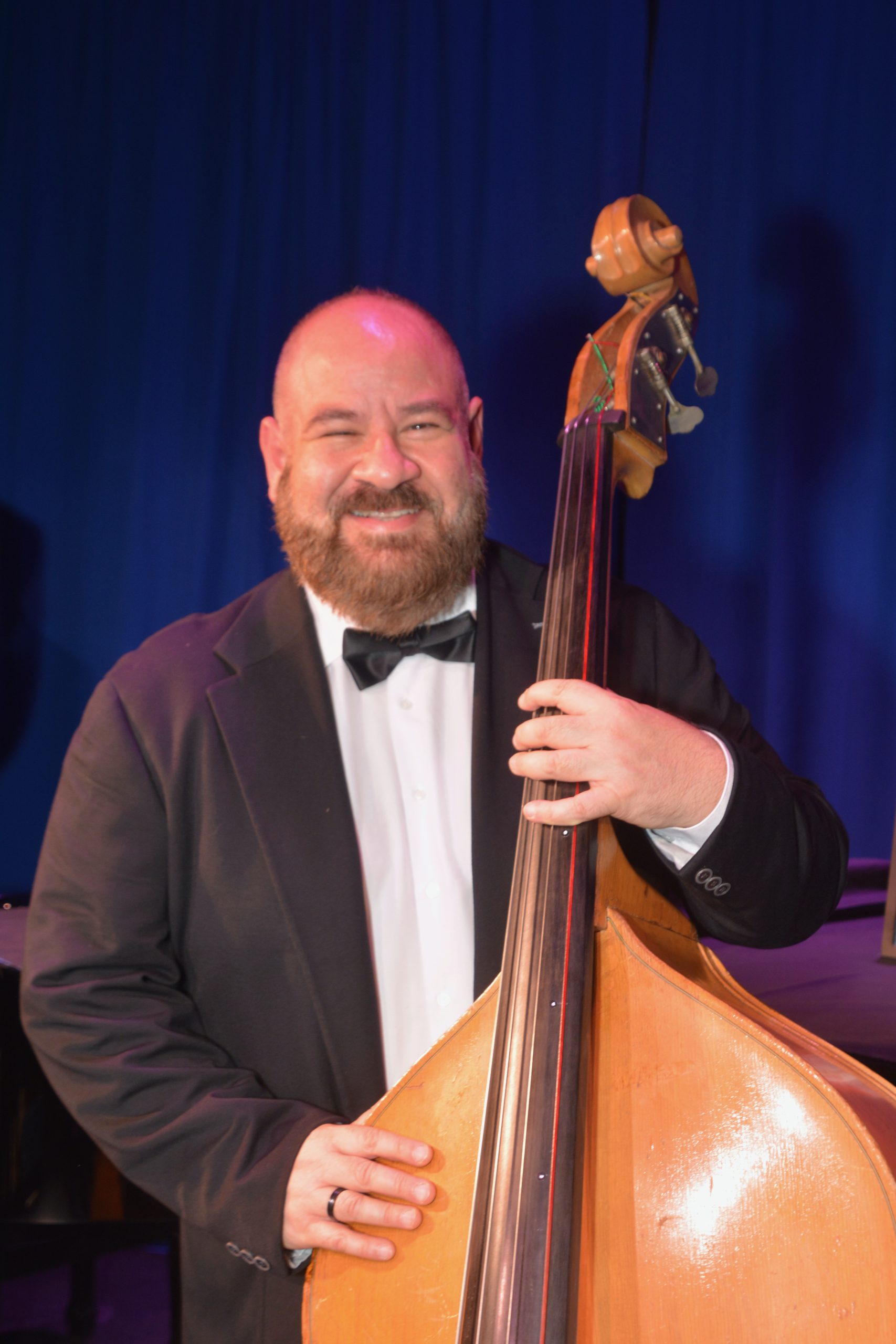
Marco Panascia Photo Genevieve Rafter Keddy
Backed only by the superb bassist Marco Panascia, Comstock’s piano provides everything these singers require. There is nowhere to hide in an arrangement this exposed, but there is also nothing unnecessary competing with the lyric. The result has the intimacy of a great New York supper club—the kind of room where the performer wasn’t some distant figure across an arena, but someone telling a story a few feet away.

Richard Maltby Jr. Photo Genevieve Rafter Keddy
That intimacy is particularly appropriate because Our Sinatra began in precisely that world. Created by Comstock, Gines and Kole, the revue premiered in 1999 at the legendary Algonquin Oak Room before moving into a commercial run in 2000, first at the Blue Angel Theatre and later the Reprise Room. It ultimately played more than 1,000 performances during its two-year run, followed by national tours and regional productions. Now the original trio has come home to celebrate its 25th anniversary, with Richard Maltby Jr. supervising the production and Kurt Stamm directing.
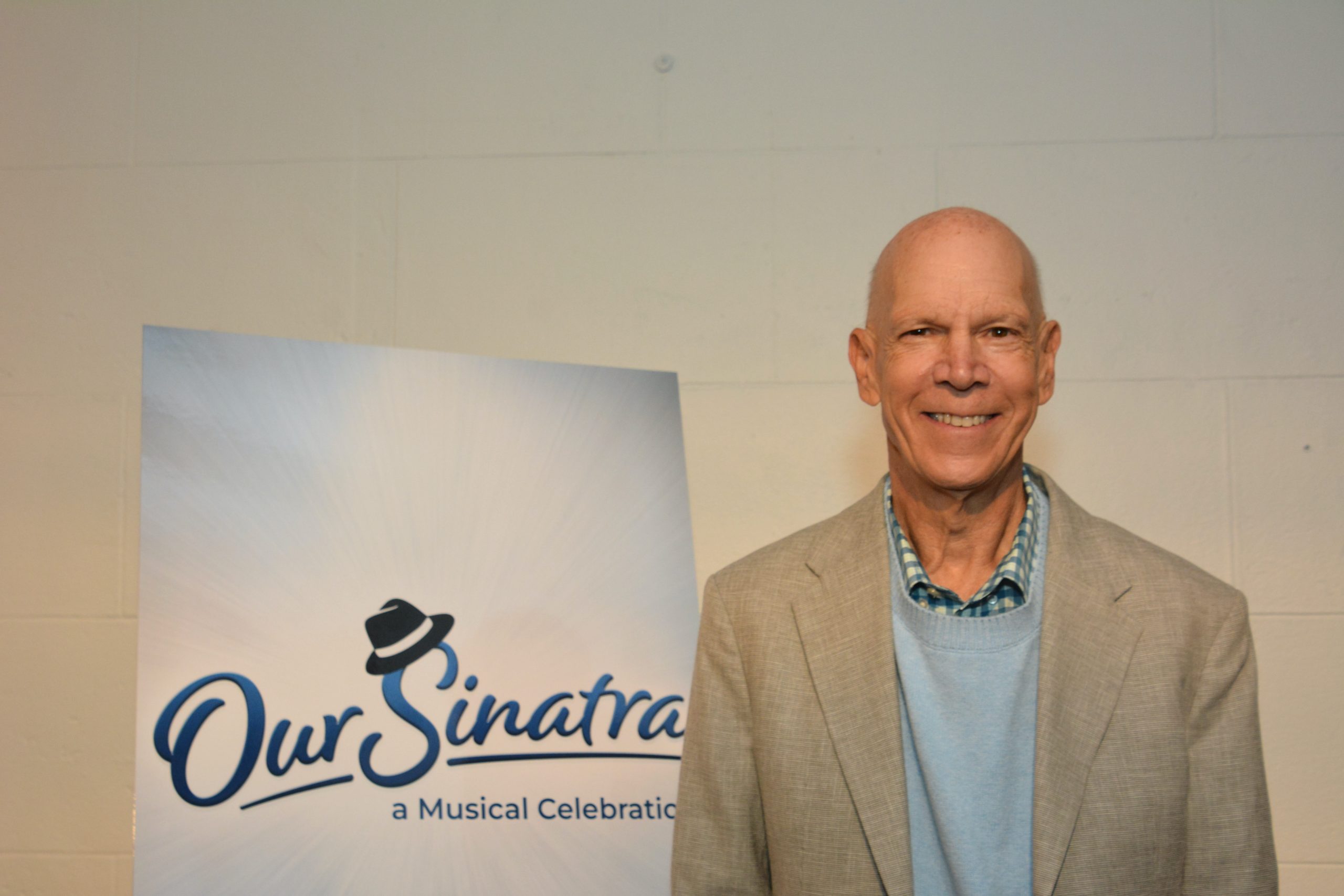
David Zippel Photo Genevieve Rafter Keddy
There is inevitably nostalgia in Our Sinatra, but nostalgia isn’t what makes the show work. The songs do. In an age when so much music is produced, processed and digitally perfected, there is something wonderfully luxurious about sitting in a small theatre listening to three singers, a pianist and a bassist trust melody, lyric and musicianship to do the work. And they do.
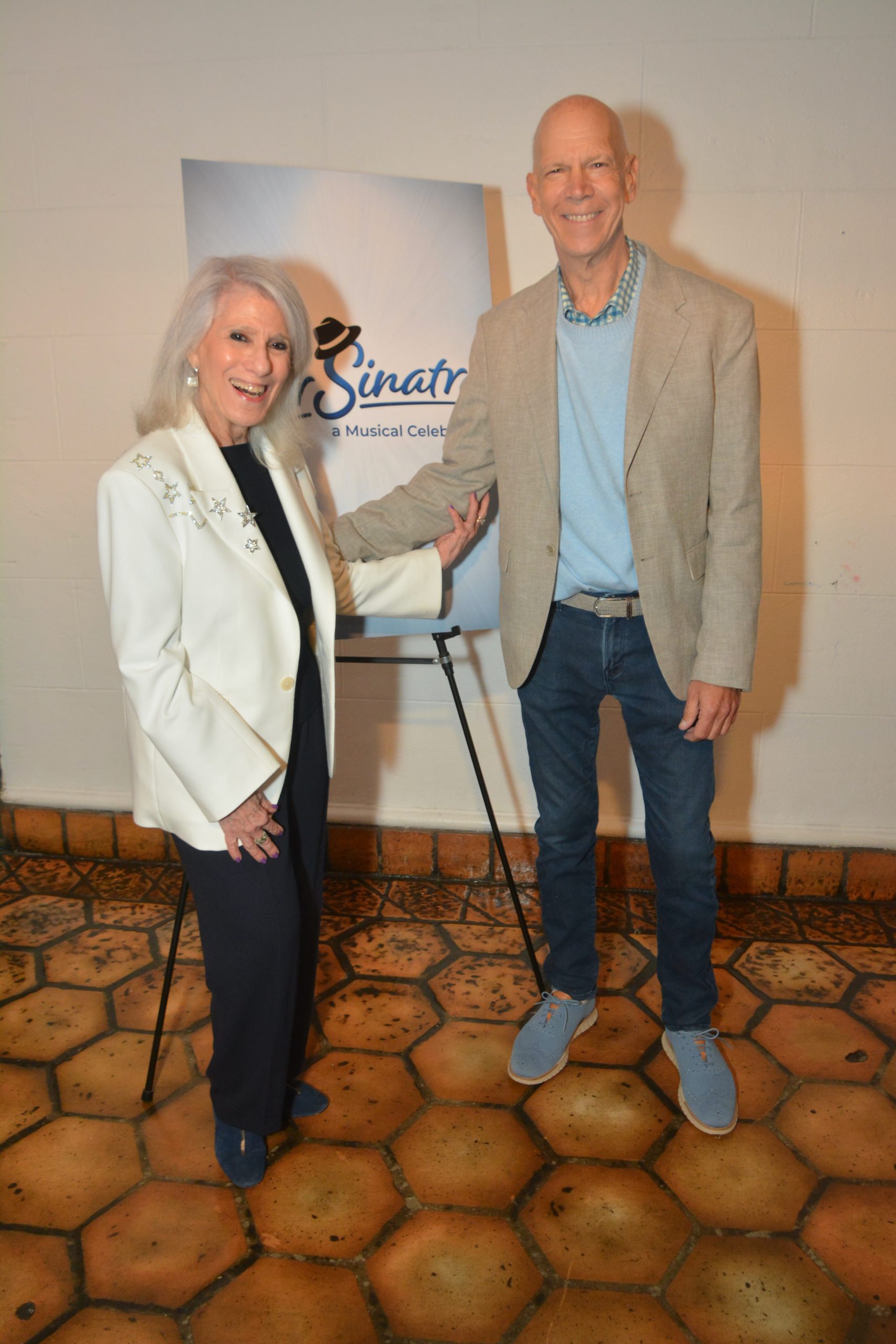
Jamie de Roy and David Zippel Photo Genevieve Rafter Keddy
Our Sinatra takes us back to another time, but it doesn’t feel embalmed by that time. Comstock, Gines and Kole remind us why these songs survived in the first place: extraordinary writing becomes new again when extraordinary musicians know what to do with it.
Twenty-five years later, Our Sinatra is very welcome back.
Our Sinatra: at the Marjorie S. Deane Little Theater, 10 West 64th Street, through November 29th. The regular performance schedule is Tuesday at 7:30PM, Saturday at 5PM and Sunday at 1:30PM.
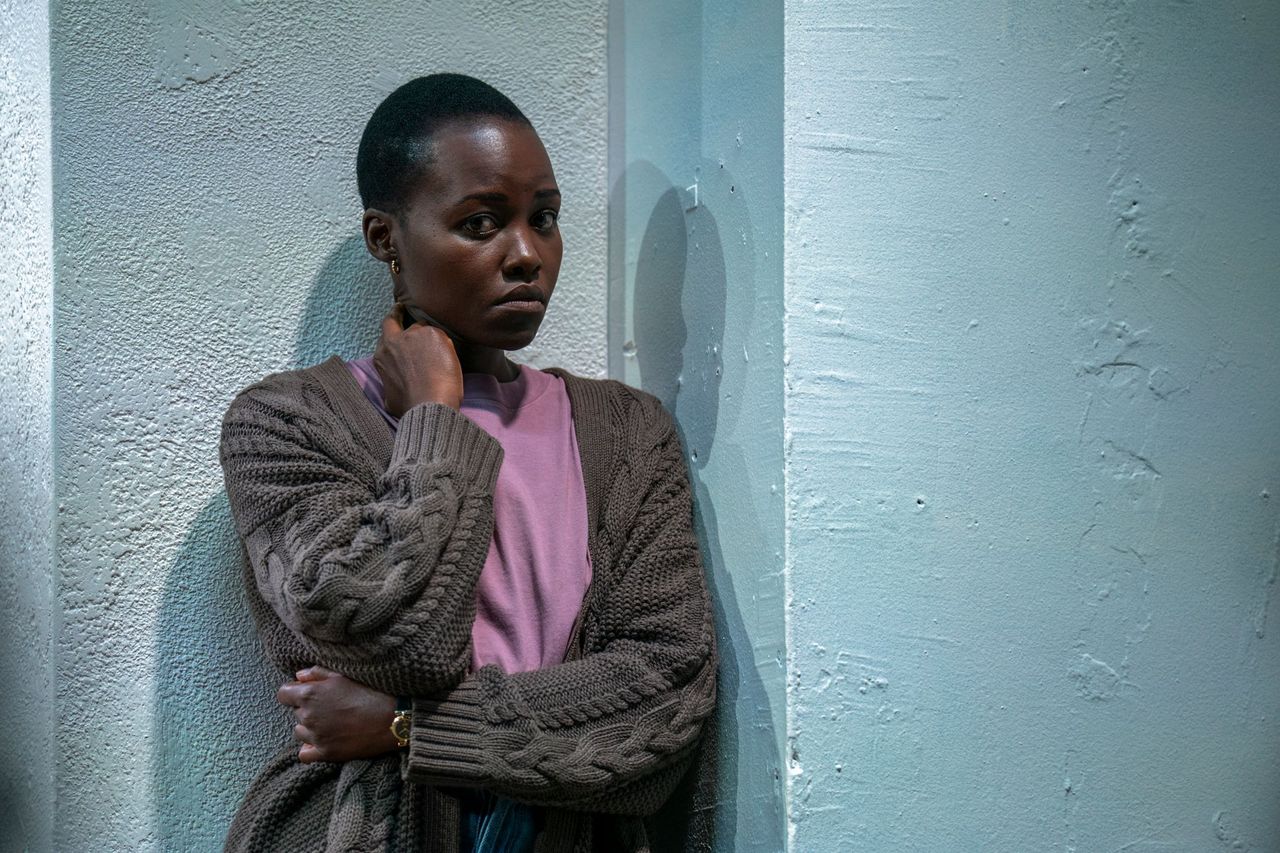
Marin Ireland’s Pre-Existing Condition returns Off-Broadway to the Greenwich House Theatre
27 Barrow Street, carrying both considerable acclaim and an extraordinarily impressive roster of actresses. The play, directed by Maria Dizzia had Lupita Nyong’o playing the central character, known simply as A. She will be followed by Phillipa Soo, Susannah Flood, Hari Nef, Edie Falco and, finally, Whitney White. Greg Keller, Dael Orlandersmith and Sarah Steele reprise their roles from the production’s sold-out 2024 premiere at the Connelly Theater.
The list of rotating actresses as A is fascinating because Pre-Existing Condition is ultimately less interested in the particulars of one woman than in the aftermath of intimate-partner violence itself. Ireland examines what happens after the incident everyone else would like to turn into a completed sentence. A has survived the violence, but survival has not restored her confidence, her relationships, her understanding of herself or even her ability to decide precisely how she feels about what happened. The production contains no reenactment of violence; its territory is everything that remains afterward.
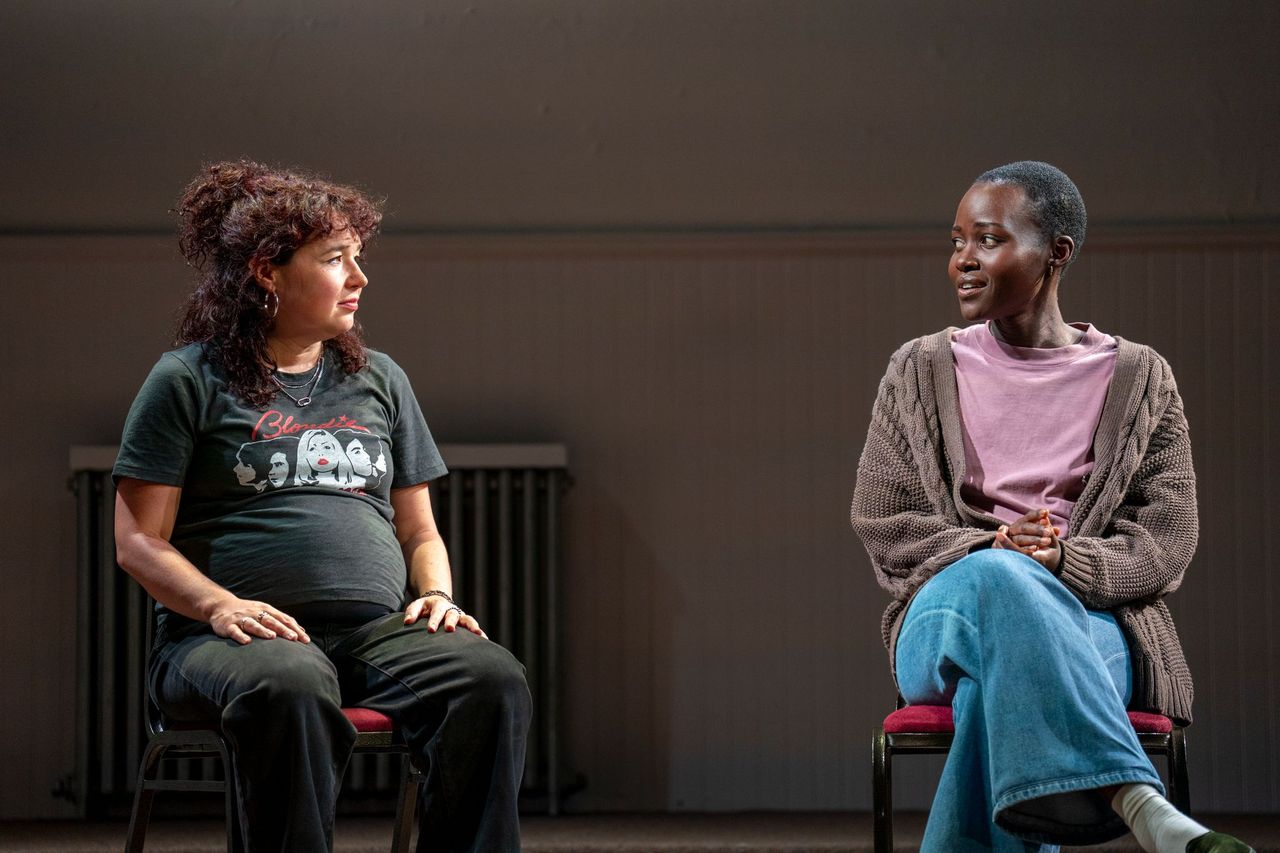
Sarah Steele, Lupita Nyong’o Photo by Jessica Kourkounis
We first encounter A speaking with a lawyer, played by Steele, and almost immediately understand that the systems supposedly available to help her are not necessarily going to do so. Another attorney, played by Keller, had initially offered his services pro bono, only to conclude that pursuing the case would simply cost too much. A moves through lawyers, group therapy, friendships, dates and family encounters, searching less for an answer than for some stable ground on which to stand.
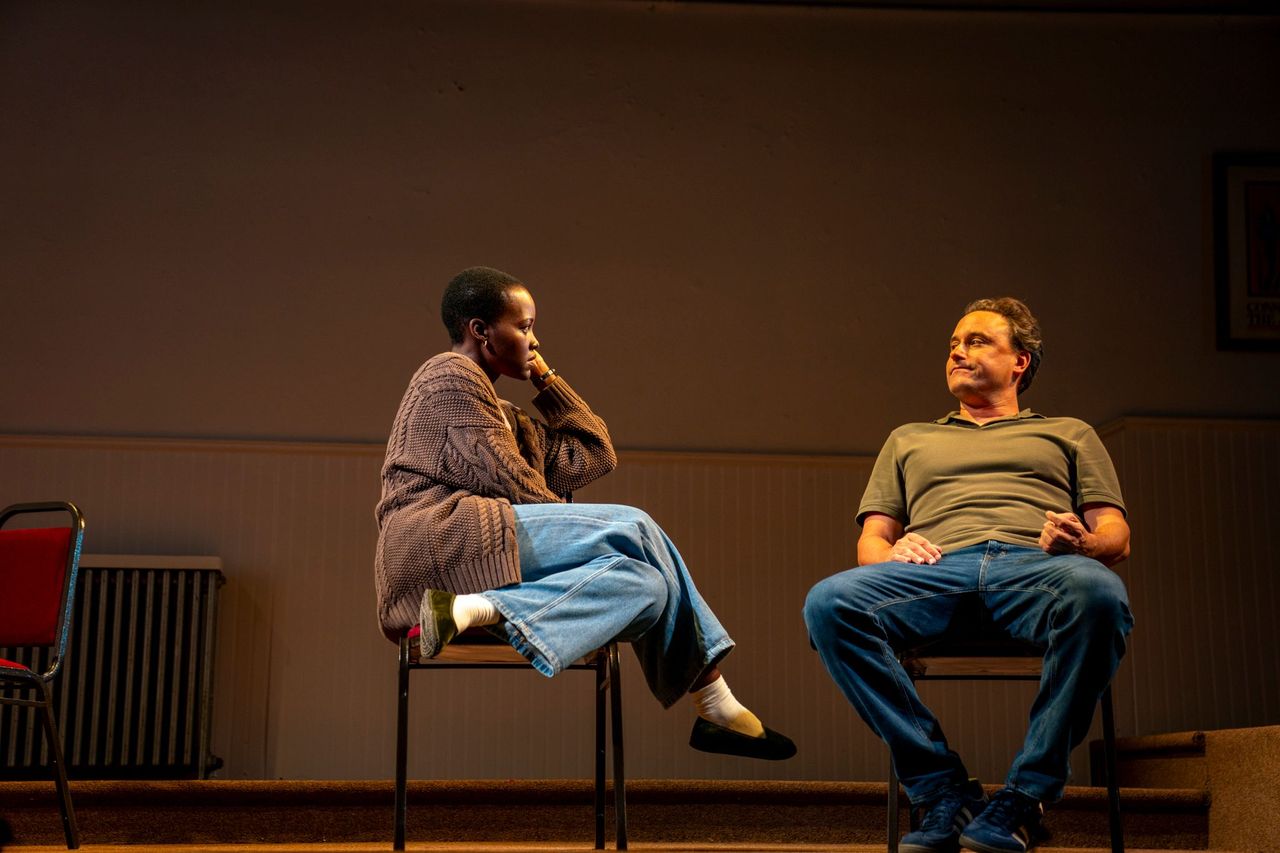
Lupita Nyong’o, Greg Keller Photo by Jessica Kourkounis
That ground proves difficult to find. Her mother, one of several characters played by Keller, chips away at her confidence rather than rebuilding it. A woman who claims to be her friend, played by Steele, delivers the devastating dismissal that it is not as though A is the only woman who has ever been hit—and appears increasingly interested in A’s former boyfriend herself. The cruelty of the remark lies precisely in its casualness. Violence has rearranged A’s world, while to someone outside it, what happened can be reduced to something almost commonplace.
Ireland is at her strongest when she exposes the shame that attaches itself to the victim rather than the perpetrator. A admits to her therapist that she once looked at “women who got hit by their boyfriends” with contempt. Now she feels like the very thing she once judged: “trash.” Worse, she wonders whether the abuse merely revealed something about herself that had always been true. It is a brutal idea because abuse does not simply injure the body; it can recruit the victim into continuing the abuser’s work long after the relationship has ended.
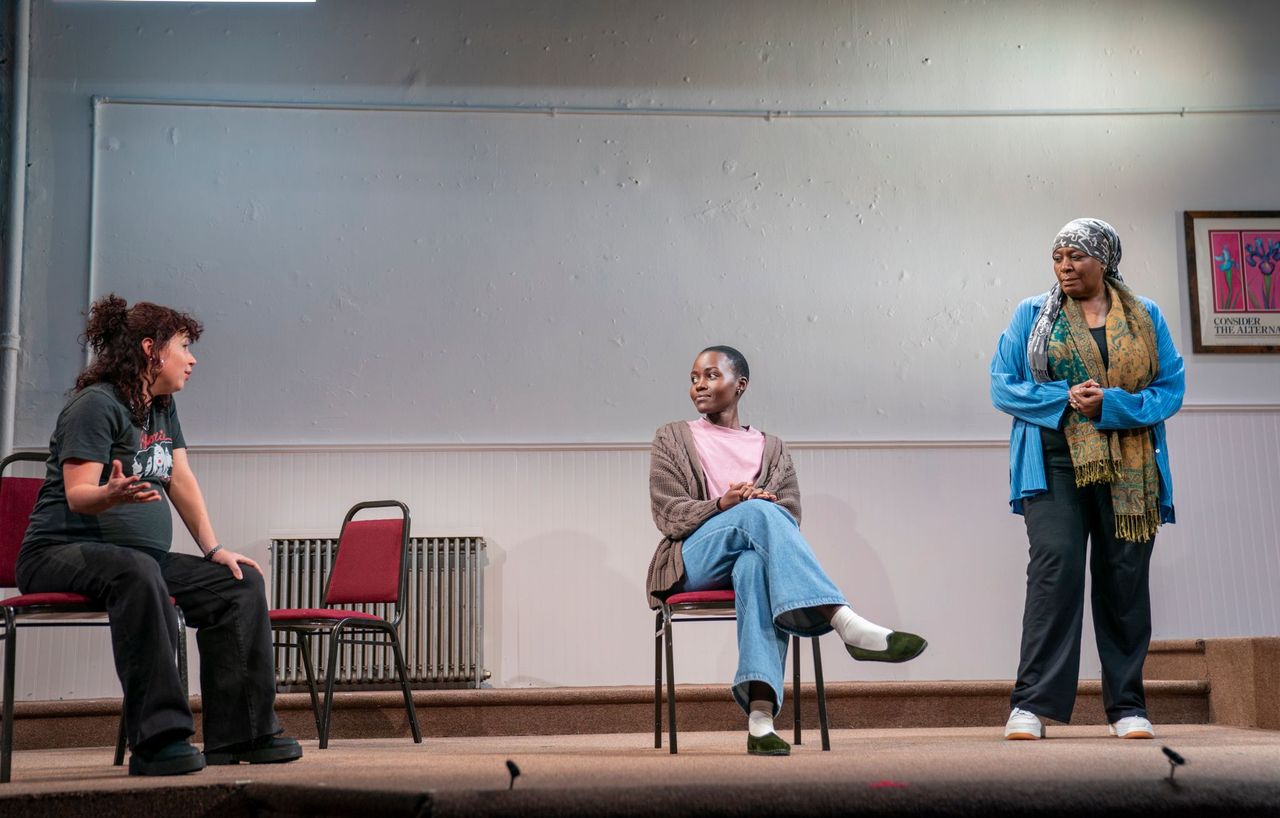
Sarah Steele, Lupita Nyong’o, Dael Orlandersmith Photo by Jessica Kourkounis
A also carries guilt. On a date, she finally finds the courage to explain why her previous relationship ended, but complicates her own story by admitting that the day before the assault she had tried to hit her boyfriend herself. She missed, and they had both been drinking, but the attempt matters enormously to her. Ireland understands something important here: victims do not always present themselves as uncomplicated saints, and the desperate need to determine whether one somehow caused what happened can become another form of imprisonment.
Ireland dispenses information as though every detail were so valuable it must be kept under lock and key. We know A’s boyfriend hit her, but what exactly happened? There are no visible bruises, no physical aftermath and very little information about the assault itself. I don’t need—or want—to watch violence reenacted onstage, but if the entire play is about the imprint that violence has left on this woman’s body and soul, I need enough of the puzzle to understand the picture. Instead, Ireland keeps handing us isolated pieces. A friend appears to be falling for the man who assaulted her and wonders why A cannot simply get over what happened. An estranged father suddenly enters, played by Keller, and for several moments I thought we were finally meeting the ex-boyfriend. Then we discover he is her father, without ever really understanding why father and daughter became estranged. Fragmentation may accurately reflect trauma, but fragmentation alone does not create dramatic complexity. At some point the pieces of a puzzle have to begin forming a picture. Here, too many simply don’t fit. At 75 minutes, Pre-Existing Condition paradoxically feels longer because A never reaches enough clarity—or is given enough language—for us to fully understand where she has arrived. The play circles her experience rather than penetrating it.
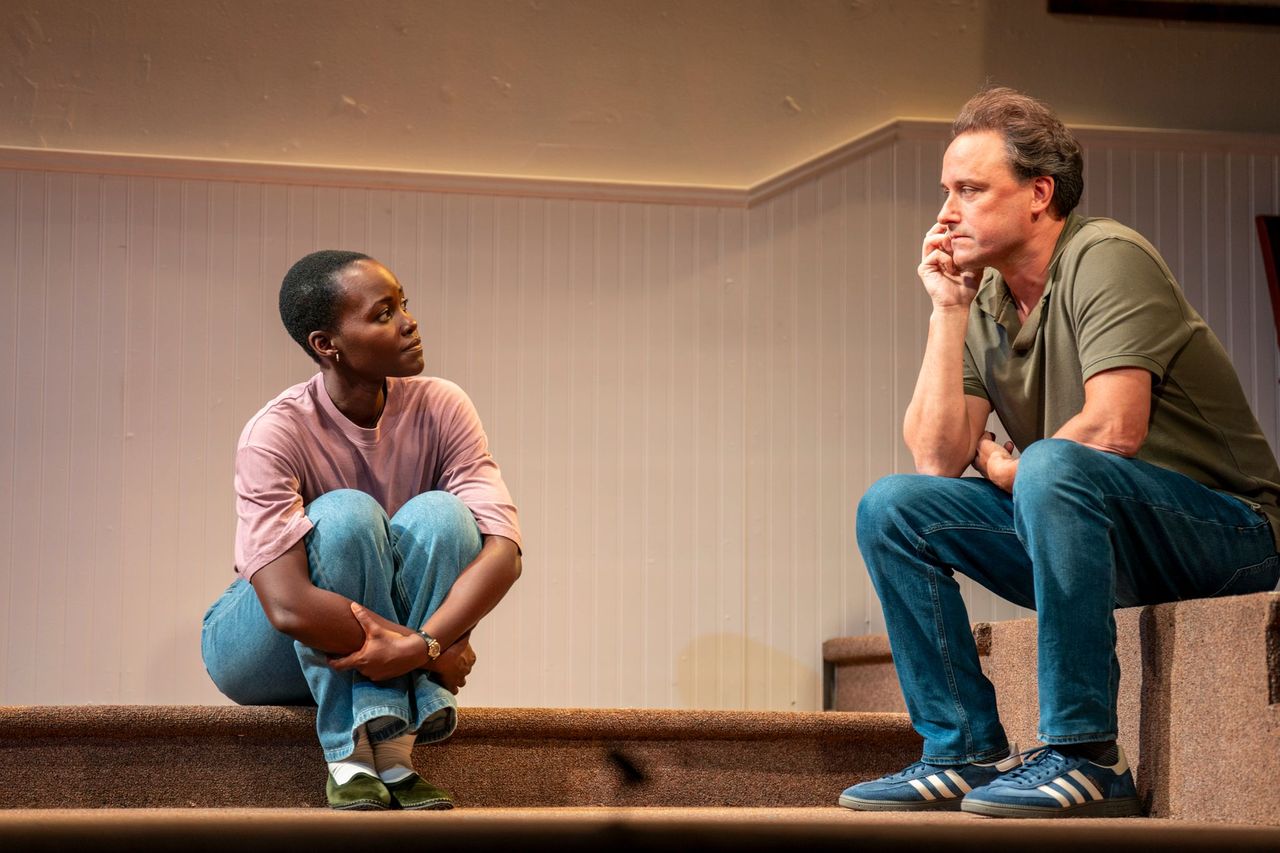
Lupita Nyong’o, Greg Keller Photo by Jessica Kourkounis
Keller plays multiple men and women in A’s orbit—a lawyer, her mother, a genuinely decent man, a first-rate jerk and her father—and while his versatility is undeniable, the characters eventually begin to resemble a revolving door of noise around A.
Sarah Steele fares particularly well with Ireland’s more conversational characters and displays wonderful range. She is especially funny as A’s old friend launching into a rant about contemporary dating and the endless supply of men determined to “keep it casual.” Those flashes of humor are necessary because one of the play’s strengths is its recognition that a person who has experienced violence does not cease having absurd conversations, bad dates, irritating friends or moments of laughter. Life does not reorganize itself into a tasteful drama simply because something terrible has happened.

Sarah Steele, Dael Orlandersmith Photo by Jessica Kourkounis
Dael Orlandersmith brings something different. As both a group leader and A’s therapist, she provides the production with its most palpable sense of safety. When A finally sits across from her one-on-one, something in Nyong’o begins to crack because Orlandersmith does something surprisingly rare in A’s world: she appears genuinely concerned with what A is feeling rather than what she should do, what the case might cost or how inconvenient her experience has become. Orlandersmith’s stillness becomes its own form of generosity.
Then there is Lupita Nyong’o.
It is thrilling to watch her. Nyong’o is extraordinarily vulnerable without ever advertising vulnerability. Ireland may not give A enough to say, but Nyong’o fills the silence with what the dialogue withholds. Watch her eyes fill without surrendering the tears. Watch the jaw clench. Watch the body attempt to remain composed while something underneath it is struggling not to collapse. She allows us to see A thinking, editing herself, swallowing reactions and trying to determine which version of her own experience she is permitted to believe.
That performance also exposes the limitation of the play. I wanted Ireland to give Nyong’o more. Not another explanation of domestic violence and certainly not a tidy resolution—survival rarely supplies one—but language capable of meeting the emotional complexity Nyong’o is already creating physically. The actress takes us somewhere the script repeatedly approaches and then retreats from.
Dizzia directs with admirable restraint, refusing to sensationalize the violence or turn A into an object of pity. Cate McCrea’s set, Enver Chakartash’s costumes, Isabella Byrd’s lighting and Palmer Hefferan’s sound all serve a production deliberately more interested in the ordinary landscape following violence than in theatricalizing the violent act itself. The approach is ethically intelligent. Whether it is always dramatically satisfying is another question.
Pre-Existing Condition asks an important question: What happens to a woman after everyone else believes the worst thing has already happened? Ireland understands that the bruise may disappear long before the imprint does, and she is particularly perceptive about the humiliations, judgments and institutional indifference that can follow someone attempting to rebuild a life. What she has written is compassionate, intelligent and deliberately unresolved.
For me, however, unresolved eventually becomes underwritten. A spends 75 minutes trying to understand what happened to her, but the play withholds so much of her interior life that we are often left trying to understand her from the outside. With Lupita Nyong’o in the role, that gap is partially overcome because she can make a clenched jaw speak paragraphs. She is an absolute marvel to watch.
Pre-Existing Condition: Greenwich House Theatre, 27 Barrow Street, Lupita Nyong’o until 9/26, Phillipa Soo until 10/17, Susannah Flood until 11/7, Hari Nef until 11/28, Edie Falco until 12/19 and, finally, Whitney White until 1/8
Broadway
Broadway and Theatre News: Julia Roberts, Paul Rudd, Sarah Paulson, Billy Porter, Gina Torres and More


Broadway and Off-Broadway are heading into fall with major stars, surprising crossovers, record-breaking runs and a few farewells. Julia Roberts is returning to Broadway after two decades, & Juliet has set its closing date, Billy Porter is about to sing about paying bills, Hamilton is heading to MetLife Stadium and Oh, Mary! is making the leap to HBO.
Julia Roberts, Paul Rudd and Sarah Paulson to Star in Small Mouth Sounds. Bess Wohl’s acclaimed Small Mouth Sounds will finally make its Broadway debut with the kind of cast that could sell tickets without saying a word—which is particularly appropriate for a play largely built around silence. Julia Roberts, Paul Rudd, Sarah Paulson, Martin Freeman, Greta Lee and Isaac Powell will star as six strangers attending a silent spiritual retreat, where their attempts at enlightenment inevitably collide with everything they brought with them. Joe Mantello directs, with previews beginning February 18, 2027, at the Ethel Barrymore Theatre ahead of a March 18 opening. The production marks Roberts’ first Broadway appearance in more than 20 years and reunites her with Rudd and Mantello, with whom she worked on Three Days of Rain in 2006. It will also mark Freeman’s Broadway debut. Wohl, meanwhile, arrives with considerably more heat following Liberation, which won both the 2026 Pulitzer Prize for Drama and Tony Award for Best Play.
After More Than Four Years, & Juliet Will Say Goodbye to Broadway. The Max Martin-powered musical will play its final performance at the Stephen Sondheim Theatre on January 3, 2027, ending a Broadway run that began previews in October 2022 and officially opened November 17 of that year. By closing night, & Juliet will have played 1,723 regular performances and 20 previews, placing it among the 50 longest-running Broadway musicals of all time. The David West Read musical, which imagines Juliet deciding that perhaps dying over Romeo isn’t the best life choice after all, has grossed more than $175 million on Broadway, welcomed more than 1.5 million audience members and recouped its investment in 2024. The production earned nine Tony nominations and has become an international franchise, proving that Shakespeare, Max Martin and an astonishing quantity of confetti made a surprisingly durable Broadway marriage.
Billy Porter, Billy Zane and Jessica Vosk Are Going to Broadway to Pay the Bills—Literally. In one of the stranger Broadway announcements of the season, Tony winner Billy Porter, Billy Zane and Jessica Vosk will headline Bill Pay The Musical, a one-night-only musical comedy at the Broadhurst Theatre on September 25. The fully staged production is being produced by financial technology company Ramp to promote its bill-payment platform, reviving the wonderfully peculiar mid-century tradition of the “industrial musical,” when corporations commissioned elaborate shows about everything from automobiles to appliances. Kevin Zak wrote the book, Jason Michael Snow provides music and lyrics, Keaton Wooden directs and Antoinette DiPietropolo choreographs, with Rema Webb among the additional cast. What sounds like an elaborate Broadway joke is apparently quite real—and with Porter, Vosk and Zane involved, paying invoices may never again seem quite so theatrical.
 Taylor Mac and Matt Ray Bring Songs From Bark of Millions to the Delacorte. Taylor Mac and composer Matt Ray are bringing a special concert version of their epic rock-opera Bark of Millions to the revitalized Delacorte Theater September 18–20 as part of Joe’s Pub in the Park. The work, originally conceived as an enormous musical meditation on queer history and culture, becomes a two-hour Central Park concert featuring songs inspired by queer figures across generations. Mac provides lyrics and direction, Ray supplies music and musical direction, and performers include André De Shields, Heather Christian, Machine Dazzle, Mama Alto and members of the original company. The Public is offering both reserved donation seating and free day-of-performance tickets, making this three-night engagement an unusually expansive way to welcome audiences back to the Delacorte.
Broadway Meets the NFL as Hamilton Takes Over Halftime. Former Hamilton cast members will perform at halftime during the New York Giants’ season opener against the Dallas Cowboys today, September 13, at MetLife Stadium. Tony nominee Nicholas Christopher returns as Aaron Burr, joined by Mandy Gonzalez, Morgan Anita Wood and Candace Quarrels as the Schuyler sisters for a medley arranged by Hamilton musical mastermind Alex Lacamoire and Don P. Roberts. The Broadway performers will be joined by marching bands from Morgan State University and Penn State as well as percussionist Jaheim Lee. The game will also commemorate the 25th anniversary of September 11, honoring first responders, service members and 9/11 families, with members of the NYPD and FDNY performing the national anthem. It is an unusually New York collision of Broadway, football and remembrance—and certainly a halftime show unlike anything the Giants have staged before.
Cole Escola’s Oh, Mary! Is Heading to HBO. Those who never managed to get into Oh, Mary! will finally have another way to see the theatrical phenomenon. A live capture of Cole Escola’s Tony-winning comedy will premiere on HBO and stream on HBO Max in 2027. Rather than filming the Broadway production, the performance was captured in July during the show’s West End engagement at London’s Trafalgar Theatre, with Escola once again playing their gloriously unhinged version of Mary Todd Lincoln. The filmed cast also includes Giles Terera, Bianca Leigh, Tony Macht and Michael Urie. What began as an Off-Broadway oddity became one of the most unlikely Broadway sensations in years; an HBO release now gives Escola’s wildly revisionist First Lady an audience far beyond Broadway and the West End.

Gina Torres
Gina Torres Is Joining Buena Vista Social Club. Suits star Gina Torres will return to Broadway this fall, stepping into the role of Omara Portuondo in the Tony-winning Buena Vista Social Club. Torres will appear at the Gerald Schoenfeld Theatre from October 13 through November 29 while Natalie Venetia Belcon takes a planned leave of absence to play Claudia in New York City Center’s gala presentation of In the Heights. Although Torres is best known to television audiences for Suits, Pearson and 9-1-1: Lone Star, Broadway isn’t foreign territory: her earlier credits include Face Valueand The Best Little Whorehouse Goes Public. Her casting gives the already musically formidable Buena Vista Social Clubanother distinctive presence for its fall run.
Off-Broadway’s Little Shop of Horrors Makes History. Feed it long enough and apparently Little Shop of Horrors will just keep growing. The hit revival at the Westside Theatre has surpassed the 2,210-performance run of the musical’s original 1982 Off-Broadway production, making the current staging the longest-running production of Little Shop in the show’s history. The revival began previews in September 2019 and opened the following month, survived the pandemic shutdown and resumed performances in September 2021. Its longevity has been helped by an ever-changing roster of performers stepping into Seymour and Audrey, turning the intimate revival into something of an Off-Broadway institution. More than four decades after Alan Menken and Howard Ashman unleashed Audrey II on New York, audiences apparently still haven’t learned the fundamental lesson: never feed the plant.

There are family secrets we inherit, family stories we repeat and family wounds we spend a lifetime trying to understand. In Crazy Mama: A True Story of Love and Madness, playwright Sharon Scott Williams turns her own family history into a theatrical examination of what happens when a child grows up loving someone she cannot save.
Rubicon Theatre Company will bring the Off-Broadway premiere of Williams’ autobiographical play to 59E59 Theaters this fall, with Linda Purl taking on an extraordinary 16 characters under the direction of Anson Williams. Will Huse joins her as The Blues Man.
For television audiences, the director Anson Williams remains instantly associated with Warren “Potsie” Weber on the iconic series Happy Days, but his career behind the camera has been extensive, directing hundreds of hours of television. There is also a delightful bit of Happy Days symmetry in his collaboration with Purl: she played Ashley Pfister, Fonzie’s girlfriend, during the series’ tenth season. Decades later, the two are reunited on considerably darker territory, with Williams directing Purl through a story in which comedy and heartbreak live uncomfortably close together.
The story begins just days after Sharon’s eighth birthday. Racing home from school to beat her teenage brother, Spikey, to the final piece of birthday cake, she walks into the kitchen and finds her mother holding a knife. The sheriff takes her mother away, and a deputy gives the little girl an explanation both brutally simple and wholly inadequate: her mama is “not right in the head.”
What follows is not simply a story about mental illness. It is the story of a daughter who spends decades believing that if she loves fiercely enough, tries hard enough or somehow finds the right answer, she can rescue her mother.
That distinction gives Crazy Mama its emotional center. Mental illness affects the person living with it, but its reach rarely stops there. It changes marriages, childhoods, siblings and entire families. Williams writes from the perspective of someone who knew both the love and the fear inside that experience.
“Mental illness affects one in four people, but all-too-often individuals and families don’t speak of their experience and hide their pain,” Williams says. “I was lucky. I had my family to help me through it, but there were times we were afraid to talk about it. Crazy Mama is a story that helps lift that stigma.”
Rather than treating its subject with unrelenting solemnity, the play is laced with humor as well as pathos. That matters. Families living through extraordinary circumstances still laugh, fight over birthday cake, irritate one another and get through Tuesday. Resilience isn’t always heroic. Sometimes it is simply continuing to love someone when love cannot fix what is wrong.
For Purl, whose career has moved easily between stage, film and television, Crazy Mama presents a formidable theatrical challenge. Sixteen characters pass through a single performer, requiring not merely vocal or physical transformation but the creation of an entire family and world around one woman’s memory.
The production arrives in New York following its world premiere at Rubicon Theatre Company in Ventura, California, in March 2025. Rubicon Producing Artistic Directors Karyl Lynn Burns and Jonathan Drahos now bring the work east for its Off-Broadway debut.
The creative team includes Brian Gale, who provides lighting and projection design, and Lindsay Jones on sound design. Alexandrea Hess Rodriguez serves as production stage manager, with Stephanie Coltrin as associate producer.
At its heart, Crazy Mama asks a difficult question: What happens when the person you desperately want to save is someone you do not have the power to save?
Williams lived that question. Now Linda Purl will become the 16 people who helped her tell the story.
Performances begin September 16, with opening night set for September 22. The limited engagement runs through October 18 in Theater C.
Crazy Mama runs two hours and five minutes, including intermission, with performances Tuesday through Friday at 7:30 p.m., Saturdays at 2:30 and 7:30 p.m., and Sundays at 2:30 p.m. Tickets are $42, including the $2 fee, through 59E59 Theaters, by phone at 646-892-7999, or at the box office at 59 East 59th Street.

DamonHorowitz with-Truman Gaudoin, Desiree Baxter, Jim Pratzon and Tyler Moss Photo by Valerie Terranova
There is a provocative idea buried inside Becoming Hamlet, Damon Horowitz’s new adaptation of Shakespeare’s tragedy at the Five Angels Theater: We are Hamlet. I am Hamlet. You are Hamlet. Horowitz is Hamlet. Director Sybille Bruun invites the audience not simply to observe Shakespeare’s tortured prince but to inhabit him, speaking his words and, for those who choose, stepping directly into the action. The production describes the audience as a “central dramatic presence,” with participation optional and designated non-participatory seating available, which I took.
It is an intriguing concept. I also found it pretentious. Horowitz, who serves as the production’s “Hamlet Guide,” has an unusual résumé for an Off-Broadway adaptor and performer. He previously served as Google’s in-house philosopher, has appeared on the TED mainstage and has taught at Columbia, Stanford and San Quentin State Prison. That philosophical impulse is all over Becoming Hamlet. The production is less interested in presenting Hamlet than in deconstructing him, turning Shakespeare’s tragedy into an exploration of whether Hamlet’s grief, indecision, anger, fear and eventual acceptance are somehow universal. Is this who we all are? Becoming Hamlet thinks so. I am not convinced.
The bones of the story remain familiar. Hamlet’s uncle Claudius (David H. Littleton) has murdered Hamlet’s father, seized the throne and married his widowed sister-in-law Gertrude, played here by an emotionally cold Désirée Baxter. Claudius wants Hamlet to remain at court, accept the new family structure, continue his relationship with Ophelia (a lackluster Judith Feingold) and settle into his place as the king’s new son. In other words: I have the power now, and someday, if you behave yourself, perhaps you will too.

Damon Horowitz, an audience member, and Equiano Mosieri Photo by Valerie Terranova
Then Hamlet’s dead father returns. Equiano Mosieri makes a genuinely ghoulish Ghost, bringing the production one of its strongest jolts of theatricality as the murdered king demands revenge. From there, Hamlet’s emotional trajectory remains Shakespeare’s: profound grief gives way to despair, obsessive questioning and paralysis before arriving at something resembling calm acceptance in the face of death.
The production’s central conceit is that Horowitz does not carry that journey alone. We do. Audience members who consent to participate are handed cards containing Shakespeare’s lines and invited to speak them from their seats. Those choosing active participation can become even more directly involved, while four facilitators guide the audience through the evening. The company explicitly describes the audience as Hamlet and the professional actors as scene partners responding to whatever the participants bring to the performance.
Here is where Becoming Hamlet lost me. I do not particularly like participating in my theatre. I want the actors to make me think, feel, question and reconsider; I don’t need to be handed a line to accomplish that. More importantly, the device repeatedly interferes with the dramatic momentum. Shakespeare’s language requires thought, breath, intention and emotional connection. Passing Hamlet among audience members inevitably means passing him among people with wildly different abilities to deliver that language. One moment has theatrical weight; the next sounds like somebody reading from a card.
The result is a production constantly operating at different levels of performance. Just as one of the professional actors begins digging into a scene, Hamlet can suddenly become an audience member concentrating primarily on getting the words out correctly. The emotional temperature drops, the rhythm changes and the actors have to begin rebuilding what has just been interrupted.
That is not the audience’s fault. It is the structural problem created by the concept.
The irony is that a production designed to get us deeper inside Hamlet sometimes kept me farther away from him. Rather than becoming immersed in one man’s increasingly desperate psychological state, I became conscious of the theatrical mechanism required to make all of us that man. I saw the facilitators facilitating. I saw the participation being organized. I saw the concept. I wanted to see Hamlet.
There are moments when the conceit suggests something genuinely interesting. Hearing the same character voiced by different people can underline the universality of grief and indecision, and I can see Becoming Hamlet being particularly effective for a high school or college audience encountering the play seriously for the first time. Shakespeare can become intimidating when his language is placed behind glass and treated as sacred literature. Asking young people to put the words into their own mouths could break that barrier beautifully.
As theatre for me, however, it became somewhat sing-song and overly intellectualized. Hamlet already contains one of the greatest examinations of consciousness ever written. Shakespeare does not need much help making us recognize ourselves in the prince. That is precisely why the play has survived for more than four centuries.

Claudius (David H. Littleton), (Addy Jenkins) and an audience member Photo by Valerie Terranova
The supporting actors are therefore placed in an unusual and not always enviable position. Littleton’s Claudius understands the seductiveness of authority, while Baxter keeps Gertrude emotionally protected, a woman whose choices remain deliberately difficult to penetrate. Feingold’s Ophelia has the challenge of establishing intimacy with a Hamlet who is, by design, never entirely one person. Steven Lamont brings welcome force to Laertes, while Truman Gaudoin as Guildencrantz and the rest of the ensemble move in and out of a theatrical world whose center is constantly changing.
Visually, the production fares better. Amit Gajwani’s costumes manage to feel contemporary while keeping the characters connected to Shakespeare’s world, which also helps enormously in keeping everyone straight. Maryam Sweirki’s lighting knows exactly where our eyes should go, while Yijun Yang’s minimalist scenic design uses reflective Mylar to return our own images to us. It is a clever extension of the evening’s thesis: wherever we look for Hamlet, eventually we encounter ourselves. Marlon Feld’s original music is rather brilliant, giving the production a cinematic scope that the small physical space cannot provide.
That brings me back to the question underneath the entire evening. Are we all Hamlet? We certainly know grief. We know betrayal, indecision, anger, desire, paralysis and the terror of making a choice whose consequences cannot be undone. In that sense, Shakespeare settled the argument centuries ago. We recognize Hamlet because some part of him already belongs to us. Recognizing Hamlet is not the same thing as being Hamlet.
That distinction matters. Theatre allows us to enter another human being’s consciousness without requiring us literally to become that person. That mysterious transaction between actor and audience is one of the things theatre does better than almost any other art form. I don’t need to speak Hamlet’s words to feel his grief. I need an actor capable of speaking them so truthfully that, for an instant, I recognize his grief as my own.
Becoming Hamlet attempts to collapse the distance between spectator and character. For some audiences, particularly those who love participatory theatre, that may be exactly what makes the evening exciting. For me, eliminating that distance also eliminated some of the dramatic depth.
At least Horowitz and Bruun have done something merciful that generations of Hamlet directors have struggled to accomplish: the evening runs approximately 100 minutes, without an intermission, rather than the three-plus hours a relatively complete Hamlet can demand. Strangely though, it still felt longer than it should.
There is intelligence behind Becoming Hamlet, and there is certainly ambition. I simply found its central device more gimmick than revelation. When the audience becomes Hamlet, the production gains participation but loses the sustained psychological journey that makes Hamlet such an extraordinary role in the first place.
To participate or not to participate? For me, the answer was easy. I would rather watch a great Hamlet become Hamlet than be told that Hamlet is me.
Becoming Hamlet: Five Angels Theater, 789 Tenth Avenue at 52nd Street. Presented by The Directors Company. Performances through October 3.


Our Sinatra Returns With the People Who Made It Sing

Broadway’s Biggest Treasure Hunt Returns as Flea Market Auction Bidding Opens

Who Let The Dogs Out? CatWalk FurBaby Kicks off NYFW

Prince Mario-Max Schaumburg-Lippe: Royal Attends Privé Dinner At Ultra Exclusive Moss Club 5th Avenue NYC

Meta Is About to Find Out Whether People Will Pay for Better Social Media

How Piano Moving in Christchurch Has Changed This Year

The Appeal of Halo Collectibles for Gamers

Bob Mackie, Who Made the World More Glamorous, Dies at 87
Our Sinatra Returns With the People Who Made It Sing
Broadway’s Biggest Treasure Hunt Returns as Flea Market Auction Bidding Opens
Who Let The Dogs Out? CatWalk FurBaby Kicks off NYFW
Prince Mario-Max Schaumburg-Lippe: Royal Attends Privé Dinner At Ultra Exclusive Moss Club 5th Avenue NYC
Meta Is About to Find Out Whether People Will Pay for Better Social Media
How Piano Moving in Christchurch Has Changed This Year
The Appeal of Halo Collectibles for Gamers
Bob Mackie, Who Made the World More Glamorous, Dies at 87
-

 Art4 days ago
Hare Apparent: Hunt Slonem Multiplies at One Art Space
-

 Cabaret4 days ago
My View: Charles Busch Sings Johnny Mercer at 54 Below….A Master at Theatrical and Musical Melodrama
-

 Events5 days ago
Victor de Souza Brings a Decadent Court to New York Fashion Week
-

 Business5 days ago
AI Surveillance Has a Marketing Problem: The Technology Works, but Younger Customers Don’t Want It
-

 Entertainment4 days ago
I Love Jewish Girls Makes History at New York Fashion Week
-

 Family5 days ago
Linda Purl Takes on 16 Characters in Crazy Mama Off-Broadway
-

 Business4 days ago
AI’s Race Is Starting to Meet Its Safety Limits
-

 Celebrity5 days ago
The Glorious Corner